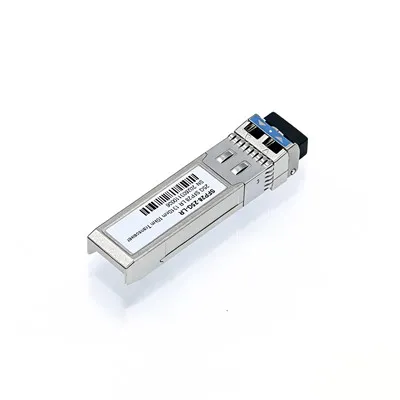

Fiber Transceiver Types: From 1G to 800G
Jun 24, 2026
Leave a message
TL;DR: Fiber transceiver types have evolved from bulky 1G GBIC modules to compact 800G QSFP-DD800 and OSFP800 form factors. Each generation brought smaller packages, lower power draw, and faster speeds through advances in NRZ and PAM4 signaling. This guide covers every major fiber transceiver type, includes a full specifications table, and walks you through a four-factor selection framework (speed, application, connector, device compatibility) so you can pick the right fiber transceiver types for your network.
Fiber transceiver types are the pluggable optical modules that convert electrical signals into light (and back) inside your switch or router - and they span from 1G GBIC and SFP modules all the way to 800G QSFP-DD800 and OSFP800. The major fiber transceiver types, organized by speed tier, are: GBIC and SFP (1G, 1 channel); XENPAK, X2, XFP, and SFP+ (10G, 1 channel); QSFP+ (40G, 4 × 10G channels); SFP28 (25G) and QSFP28 (100G, 4 × 25G) using NRZ signaling; and the PAM4-based generation: SFP56 (50G), QSFP56 (200G), QSFP-DD / OSFP (400G, 8 channels), SFP112 (100G), QSFP112 (400G), QSFP-DD800 / OSFP800 (800G, 8 × 112 Gb/s). Each type differs in form-factor size, channel count, signaling standard (NRZ vs. PAM4), supported distances (100m multimode to 120km single-mode), and backward compatibility. This guide covers every major fiber transceiver type from 1G to 800G, includes a full specifications table, and walks you through a four-factor selection framework (speed, application, connector, device compatibility) so you can pick the right module for your network.
What Is a Hot-Pluggable Fiber Transceiver?
A hot-pluggable fiber transceiver is a compact module containing both a transmitter and a receiver for converting data between electrical and optical signals. You can remove and replace it without powering down your switch, router, or other active equipment. This lets you upgrade or swap any port quickly, with zero downtime.
Hot-pluggable transceivers support structured cabling applications across data centers, LANs, and WANs. They work with twisted-pair copper cables for speeds up to 10G and with multimode or single-mode fiber for speeds up to 800G and beyond.
While transceivers can also be embedded in DAC and AOC cables, the hot-pluggable format offers clear advantages. You can mix and match speeds across ports on the same switch. You can upgrade individual links one at a time. And you avoid expensive full-switch replacements when technology moves forward.
Over the past few decades, signal encoding has advanced dramatically. The move from NRZ (Non-Return-to-Zero) signaling to PAM4 (Pulse Amplitude Modulation, 4-level) has pushed per-channel data rates from 1 Gb/s to 112 Gb/s. According to the IEEE 802.3 Ethernet standard, PAM4 transmits two bits per symbol instead of one, doubling lane efficiency without doubling the baud rate. This is what made 400G and 800G practical in small, pluggable packages.
The result is higher port density, faster throughput, and support for the data-intensive services that modern networks demand.
Understanding these fundamentals - what a transceiver does, how it connects to your cabling, and why PAM4 replaced NRZ - is the foundation for choosing among the fiber transceiver types covered in the sections below.
1G Fiber Transceiver Types: GBIC and SFP
The Gigabit Interface Converter (GBIC) arrived in the late 1990s as the first hot-pluggable, single-channel interface for 1G speeds. It supported 1 Gigabit transmission over twisted-pair copper cables (Cat5e, Cat6, and Cat6A) up to 100 meters. On fiber, it reached up to 550 meters on multimode and up to 120 kilometers on single-mode.

GBIC was a breakthrough for its time. Before it, changing a network interface meant swapping an entire line card. But by today's standards, GBIC modules are large and slow. They're mainly found in legacy infrastructure and have been almost entirely replaced.
The replacement? The SFP (Small Form-factor Pluggable) transceiver. When SFP modules first launched around 2001, people called them "mini-GBICs" because they supported the same applications in a much smaller package.
SFP transceivers are the modern standard for 1G network applications. They support the same copper and fiber distances as GBIC (100m copper, 550m multimode, 120km single-mode) but deliver significantly higher port density.If you're running a 1G network today, SFP is the current standard fiber transceiver type: it matches GBIC's copper and fiber distances (100m copper, 550m multimode, 120km single-mode) in a smaller, denser package.

What Are the Main Multi-Gigabit Fiber Transceiver Types?
The main multi-gigabit transceivers are XENPAK, X2, XFP, SFP+, QSFP, and QSFP+. For single-channel 10G, SFP+ is today's standard because of its small size, low 1 to 1.5 watt power draw, and backward compatibility with 1G SFP ports. For multi-channel 40G, QSFP+ leads with four 10Gb/s lanes using parallel fiber or WDM technology.
The 10G Generation: XENPAK, X2, XFP, and SFP+
XENPAK was the first 10 Gigabit transceiver, introduced in the early 2000s. It supported single-channel 10G applications over copper (up to 100m), multimode fiber (up to 400m), and single-mode fiber (up to 80km).
X2 followed in 2002. It offered the same functionality as XENPAK but cut the physical size by roughly 50%, improving switch port density. Both XENPAK and X2 are now considered legacy modules. Their large size and high power consumption made them impractical as networks grew.

XFP transceivers came next as a smaller, lower-power alternative. XFP transceivers are considered "self-contained" modules because they include onboard features like digital diagnostic monitoring. While XFP modules still appear in some WANs, they've been largely replaced in LANs and data centers.
SFP+ transceivers launched in 2006 and quickly became the standard for single-channel 10G applications. According to the SFF Committee specifications, SFP+ draws about 1 to 1.5 watts compared to 3.5 to 4.5 watts for XFP. That's a significant reduction when you multiply it across hundreds of ports.
SFP+ is also backward compatible with 1G SFP transceivers. This means you can plug an older SFP module into an SFP+ port and it will work at 1G. That backward compatibility, combined with its smaller size (vs. XFP) and lower power draw (1–1.5 W vs. 3.5–4.5 W), established SFP+ as the dominant 10G fiber transceiver type for LANs and data centers.

The 40G Generation: QSFP and QSFP+
In 2006, the Quad Small Form-factor Pluggable (QSFP) transceiver also entered the market. QSFP modules support four channels, each running at 1 Gb/s, for a total throughput of 4G. Think of them as a high-density alternative to four separate SFP modules.
The real game-changer was QSFP+. These modules support four channels running at 10 Gb/s each, for a total of 40G. QSFP+ modules use two key optical technologies:
Parallel optics. Data transmits simultaneously across multiple fibers through MPO/MTP connectors. This supports 40G over multimode fiber for up to 150 meters.
Wavelength Division Multiplexing (WDM). Multiple data signals travel on different wavelengths over a single fiber through duplex connectors. This supports 40G over single-mode fiber for up to 80 kilometers.
QSFP+ transceivers are also popular in 4x10G breakout mode. One QSFP+ port can split into four separate 10G connections for switch-to-server links. This improves port density and cost efficiency, which is why QSFP+ remains common in enterprise networks.

High-Speed Fiber Transceiver Types: 25G to 800G
The shift from NRZ to PAM4 signaling produced three distinct speed waves and a new class of fiber transceiver types - here is how each wave maps to its form factors.
NRZ at 28 Gb/s: The 25G and 100G Generation
NRZ signaling reached a maximum channel rate of 28 Gb/s. This gave us:
SFP28 for single-channel 25G. While SFP28 was designed for both copper and fiber, the 25GBASE-T copper application never gained market traction. The reason? A 30-meter distance limit, high power draw, and the expensive cost of fully shielded cabling made it impractical. SFP28 thrives in 25G fiber applications, reaching 100 meters on multimode and 80 kilometers on single-mode.
QSFP28 for four-channel 100G (4 x 25G). QSFP28 became the backbone of enterprise and cloud data center 100G networks. According to Dell'Oro Group research, the optical transceiver market reached record highs driven by 100G and 400G adoption. If you're running a 100G network today, QSFP28 is almost certainly what's in your switches.
PAM4 at 56 Gb/s: The 50G to 400G Wave
When PAM4 signaling appeared and doubled the NRZ rate to 56 Gb/s per channel, a new generation of transceivers launched, including the introduction of Double Density (DD) form factors:
SFP56: single-channel, 50G
QSFP56: four-channel, 200G (4 x 50G)
SFP-DD: dual-channel, 50G (2 x 25G) or 100G (2 x 50G)
QSFP-DD: eight-channel, 400G (8 x 50G)
QSFP-DD dominated early 400G deployments because it's backward compatible with existing QSFP ports. You can plug a QSFP28 module into a QSFP-DD port and run it at 100G, then upgrade to 400G by swapping modules when you're ready. The QSFP-DD MSA designed this compatibility from the start.
A competing eight-channel form factor called OSFP also launched for 400G. OSFP is slightly larger than QSFP-DD, which gives it better thermal management. For a detailed comparison of these two form factors, see our QSFP-DD vs OSFP selection guide.
Specifically: QSFP-DD measures 18.35 mm wide (same as QSFP28) with a 15 W power budget, while OSFP measures 22.58 mm wide with a 25 W power budget - making OSFP the preferred fiber transceiver type for high-power coherent optics and AI/HPC workloads.
PAM4 at 112 Gb/s: The 100G to 800G Leap
As PAM4 technology advanced to 112 Gb/s per channel, it opened the door to even faster modules:
SFP112: single-channel, 100G
SFP112-DD: dual-channel, 200G (2 x 100G)
QSFP112: four-channel, 400G (4 x 100G)
QSFP-DD800: eight-channel, 800G (8 x 100G)
OSFP800: eight-channel, 800G (8 x 100G)
OSFP800 has become especially popular for AI and high-performance computing (HPC) applications. Because it's slightly larger than QSFP-DD800, OSFP800 dissipates heat more effectively. High-power AI workloads push modules hard, so that thermal headroom matters. For a deep dive into 800G technology, check out our 800G optical transceiver overview.
What Comes After 800G? The Road to 1.6T
PAM4 signaling is now advancing to 224 Gb/s per channel, enabling 1.6 Terabit transceivers. The QSFP-DD MSA has announced the QSFP-DD1600, which uses eight 200 Gb/s channels and maintains backward compatibility with QSFP-DD800 and QSFP-DD switch ports. The OSFP MSA has also announced the eight-channel OSFP1600 for 1.6T applications.
This matters because backward compatibility protects your investment. According to the Ethernet Alliance technology roadmap, the industry is moving toward 1.6T as the next major speed tier for data center switching. If you deploy QSFP-DD switches today, you can upgrade to 800G and eventually 1.6T by simply swapping modules, not replacing entire switches.
OSFP1600 takes a different approach. It prioritizes maximum thermal headroom for the highest-power applications. For AI training clusters and long-haul coherent optics, that extra cooling capacity can be the deciding factor.
The bottom line: hot-pluggable transceivers remain the preferred interface type because they let network operators adapt to changing technology without expensive full-switch upgrades. That flexibility is why hot-pluggable fiber transceiver types will remain the industry standard through the 1.6T era and beyond.
How Do You Choose the Right Fiber Transceiver types?
Choosing the right fiber transceiver comes down to four key factors: transmission speed (which determines the form factor), application type (which determines internal circuitry), connector interface (which must match your cabling), and device compatibility (which must match your switch vendor). Get any one of these wrong and the module won't work in your network.
Factor 1: Transmission Speed
Speed is the primary parameter that determines which form factor you need. The form factor depends on two things: the number of channels and the channel rate. A single-channel module at 28 Gb/s gives you 25G (SFP28). A four-channel module at 28 Gb/s gives you 100G (QSFP28). An eight-channel module at 112 Gb/s gives you 800G (QSFP-DD800 or OSFP800).
Factor 2: Application Type
This is where things get tricky. A transceiver's internal circuitry varies based on the specific application, so you must match the module to your use case.
For example, a four-channel QSFP+ supporting 40GBASE-SR4 (a multimode application reaching 150m using 4 fibers to send and 4 fibers to receive at 10G each) has a completely different internal design than a QSFP+ supporting 40GBASE-LR4 (a WDM single-mode application reaching 10km using 4 wavelengths at 10G on one fiber to send and 4 wavelengths at 10G on another to receive). For details on 400G application types, see our 400G QSFP-DD SR8, DR4, FR4, LR4 guide.
Also consider breakout configurations. While QSFP112 uses four 112 Gb/s channels for 400G, if you want to split one 400G port into eight 50G connections, you'll need a QSFP-DD running at 56 Gb/s per channel instead. The application dictates the transceiver, not just the speed.
Factor 3: Connector Interface
Once you know the application, match the transceiver to your cabling infrastructure's connector type:
RJ-45: Used for copper applications like 1000BASE-T and 10GBASE-T.
MPO connectors: Used for parallel fiber applications where data transmits and receives across multiple fibers simultaneously.
LC or SC duplex connectors: Used for duplex, bidirectional, and WDM applications that need only one or two fibers.
SFP, QSFP, and OSFP form factors also support newer Very Small Form Factor (VSFF) connectors like the duplex CS, SN, and MDC connectors, as well as multi-fiber SN-MT and MMC connectors. Because VSFF connectors are much smaller, a single transceiver can house multiple VSFF connectors. This enables split-link support directly on the transceiver.
For example, an SFP-DD, QSFP-DD, or OSFP transceiver can hold 2 or 4 VSFF connectors to support breakout modes like 2x25G, 2x50G, 2x100G, 2x200G, 2x400G, 2x800G, 4x25G, 4x50G, 4x100G, 4x200G, and 4x400G.

Factor 4: Device Compatibility
Your transceiver must be compatible with the switch you're plugging it into. While transceivers don't have to come from the original equipment manufacturer (OEM), you need to confirm compatibility with whichever vendor's switch you're deploying. Whether it's Brocade, Cisco, Dell, Extreme, HP, or Juniper, check the vendor's transceiver compatibility matrix before ordering.
Third-party transceivers that meet industry standards and carry proper EEPROM coding work reliably in most platforms. Compatible third-party modules can deliver the same performance at a lower cost. At COBTEL, we test every transceiver for compatibility across major switch brands before it leaves our factory.
Fiber Transceiver Quick-Reference Table
The table below summarizes every major transceiver form factor from 1G to 800G. It shows the maximum speed, number of channels, maximum channel rate, and maximum transmission distance by media type.
The table below covers all major fiber transceiver types from 1G to 800G. Use Channel Count × Max Channel Rate to verify the total throughput for each form factor.
Use this table as your starting point. Identify the speed you need, check how many channels and what channel rate the form factor uses, and then verify the maximum distance against your actual cable runs.
Conclusion
Hot-pluggable fiber transceivers have come a long way. In the 1G era, GBIC pioneered the hot-swap concept before SFP took over as the modern standard. At 10G, SFP+ won out over XENPAK, X2, and XFP with its smaller size, lower power, and backward compatibility. The QSFP family introduced multi-channel designs for 40G (QSFP+) and 100G (QSFP28). And today, PAM4 signaling at 112 Gb/s powers 400G QSFP-DD and 800G QSFP-DD800 modules, with 1.6T already on the horizon.
Three key takeaways:
1. Each generation brought smaller size, lower power, and faster speeds.
2. Backward compatibility (especially in the QSFP-DD family) protects your investment across upgrade cycles.
3. Choosing the right transceiver requires matching four factors: speed, application, connector, and device compatibility.
At COBTEL, we're a core manufacturer of high-speed optical chips (DFB/EML), optical transceivers, and MPO patch cords. We've developed end-to-end 400G/800G/1.6T transmission solutions for AI data centers and work with Fortune 500 companies every year
If you need help selecting the right fiber transceiver type for your network - whether for a 100G enterprise upgrade, a 400G data center buildout, or an 800G AI fabric - fill out the inquiry form below and our engineering team will provide a customized recommendation.
Frequently Asked Questions
Q: What is the difference between SFP and SFP+ transceivers?
SFP supports 1G speeds using a single channel at 1000 Mb/s. SFP+ supports 10G speeds using a single channel at 10 Gb/s. SFP+ modules are slightly smaller and draw significantly less power than earlier 10G alternatives like XFP. SFP+ ports are also backward compatible with 1G SFP modules, so you can use older modules in newer switches.
Q: Can I use a third-party transceiver instead of the switch manufacturer's module?
Yes. Transceivers don't have to come from the original equipment manufacturer. Third-party modules that meet industry standards and carry proper EEPROM coding work reliably in switches from Brocade, Cisco, Dell, Extreme, HP, and Juniper. Always confirm compatibility with your specific switch model before ordering, and check the vendor's compatibility documentation if you're unsure.
Q: What is PAM4 signaling and why does it matter for high-speed transceivers?
PAM4 (Pulse Amplitude Modulation, 4-level) transmits two bits per symbol instead of one. This doubles the data rate per channel without doubling the baud rate. PAM4 at 56 Gb/s per channel enabled 400G QSFP-DD modules. PAM4 at 112 Gb/s per channel made 800G transceivers possible. Without PAM4, today's high-speed form factors wouldn't fit in standard pluggable packages.
Q: Why did QSFP-DD dominate early 400G deployments over OSFP?
QSFP-DD maintains the same 18.35mm width as QSFP28, which means it's backward compatible with existing QSFP ports. You can deploy QSFP-DD switches and keep using your QSFP28 100G modules while gradually upgrading links to 400G. OSFP is 22.58mm wide and doesn't fit QSFP ports, so it requires a full infrastructure change. That backward compatibility gave QSFP-DD a significant adoption advantage.
Q: Which fiber transceiver type is best for AI data center deployments?
For AI data centers, OSFP800 and QSFP-DD800 at 800G are the current leading choices. OSFP800 is slightly larger, which lets it handle higher power loads and dissipate heat more effectively. This makes it popular for GPU interconnects and high-performance computing clusters. For the 1.6T future, both QSFP-DD1600 and OSFP1600 have been announced with backward compatibility to their respective 800G and 400G ports.
Q: What are the main fiber transceiver types and how are they classified?
Fiber transceiver types are most commonly classified by form factor and speed tier. The primary form factors are SFP family (SFP, SFP+, SFP28, SFP56, SFP112) and QSFP family (QSFP, QSFP+, QSFP28, QSFP56, QSFP112, QSFP-DD, QSFP-DD800). OSFP and OSFP800 are a separate form factor targeting high-power applications. Within each form factor, transceivers are further classified by fiber mode (multimode or single-mode), transmission distance (SR/LR/ER/ZR), wavelength (850nm, 1310nm, 1550nm), and connector type (LC, SC, MPO, RJ-45). For a full breakdown by speed from 1G to 800G, see the Quick-Reference Table above.