


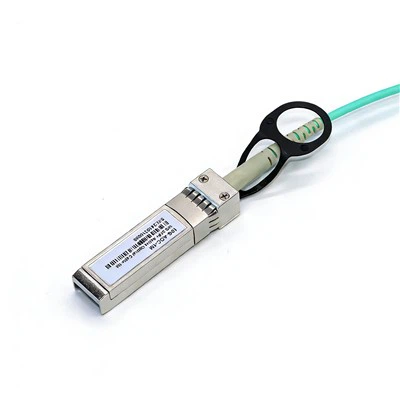


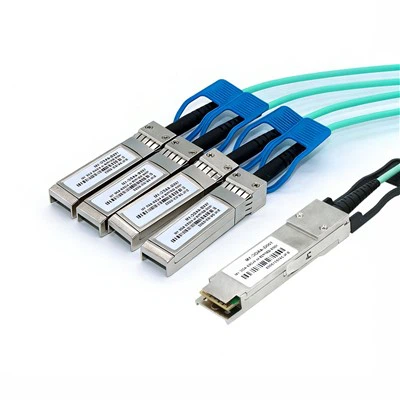
High-Speed Copper Cables: A Brief Intro to DAC, AEC, AOC, and ACC
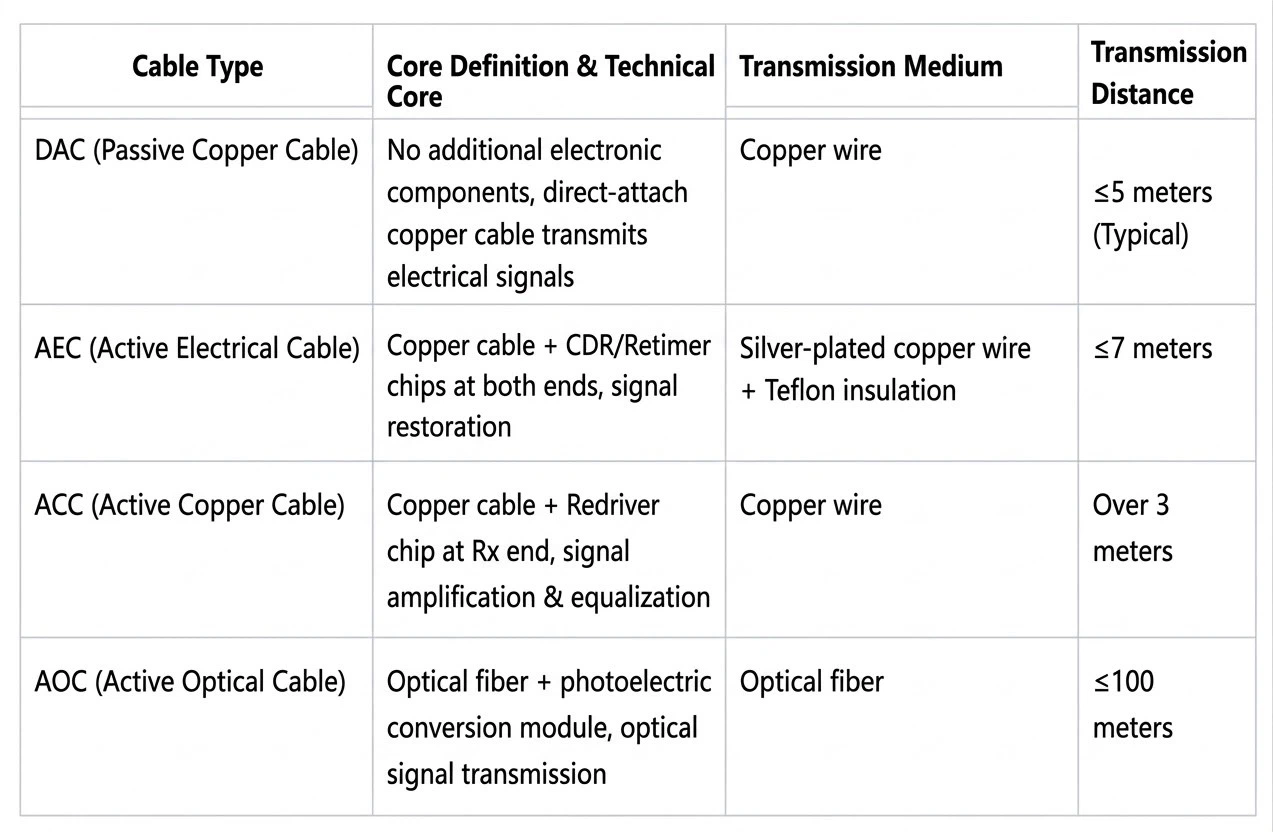
The market currently features four main types of data transmission cables: DAC (Direct Attach Cable), AOC (Active Optical Cable), AEC (Active Electrical Cable), and ACC (Active Copper Cable). They differ in their transmission medium, performance characteristics, and application scenarios. Today, we'll take a look at DAC, AEC, AOC, and ACC. Who will be the ultimate winner in the field of data communication?

Ⅰ, DAC (Direct Attach Cable)
1. Core Definition and Technical Composition
The DAC high-speed cable (Direct Attach Cable) is a passive high-speed data transmission cable assembly. Its core technical feature is that it operates without additional electronic components, such as signal converters or amplifiers, relying entirely on the inherent signal conduction properties of high-specification copper wire to achieve direct electrical signal transmission. Structurally, the core components of a DAC high-speed cable include:
Core Wire Section: Uses silver-plated conductors as the core, combined with one of three insulation materials—foam insulation, Teflon (PTFE), or PP (polypropylene)—to form a high-performance core wire, providing the foundation for high-frequency broadband transmission.
Shielding Structure: Employs a dual-shielding design of "pair shielding plus overall shielding," which effectively enhances anti-interference capability and ensures signal transmission stability.
Specifications and Structural Options: Offers wire gauge specifications from 32 to 24 AWG, as well as various core structures such as 2P, 4P, 8P, or 16P, to adapt to the transmission needs of different scenarios.
Integrated Architecture: Features a "fixed length with integrated fixed connectors on both ends" design. The optical module head and cable are permanently attached; ports cannot be replaced individually. Users must select finished cables of preset lengths according to actual deployment needs. This design is a direct manifestation of its technical principle and is key to ensuring transmission stability.
2. Core Transmission Principle
Signal Transmission Mechanism: The DAC high-speed cable uses silver-plated conductor core wires as its core transmission medium. It uses the signal isolation properties of the insulation materials and the dual-shielding design to transmit electrical signals directly from one end to the other via the conductive properties of copper, bypassing intermediate processes like signal conversion or amplification. This simplifies the technical complexity of the transmission link. Simultaneously, the excellent core wire and shielding structure provide outstanding attenuation performance and low latency, enabling high-frequency broadband transmission.
Rate and Distance Adaptation: Technically, DAC high-speed cables support data transmission rates up to 400 Gbps. This rate advantage stems from the superior conduction performance of silver-plated conductors, the low-loss characteristics of specialized insulation materials, and the stable signal control afforded by the integrated structure. However, limited by the signal attenuation of copper wire and the passive design, its transmission distance is typically restricted to within 3 meters, which makes it ideal for short-distance, point-to-point transmission scenarios.
3. Advantages and Limitations Derived from Technical Characteristics
Core Advantages (Based on Technical Design):
Low Cost: The passive design eliminates the cost of additional electronic components. Copper material is far less expensive than optical fiber, and the integrated structure simplifies production. This makes it one of the lowest-cost options among similar transmission cables, significantly reducing overall data center cabling costs.
Low Power Consumption and Energy Efficiency: The passive version requires no power supply, so its power consumption is almost negligible. Even active-type DAC cables consume only about 440mW, which is much lower than other transmission solutions. Additionally, the copper core offers good natural heat dissipation. This aligns with energy-saving and environmental requirements.
Plug-and-Play and High Performance: The integrated fixed connector design eliminates port adaptation debugging; it requires no extra configuration—simply plug it in for stable transmission. It supports high-frequency broadband transmission, is suitable for short-distance data center cabling, offers strong performance in integrated switching solutions, and has a broad range of applications.
Optimized Anti-Interference: The "pair shielding plus overall shielding" structural design, combined with high-quality insulation materials, effectively enhances resistance to electromagnetic interference (EMI), ensuring signal stability in complex environments.
Inherent Limitations (Originating from Technical Principles):
Limited Transmission Distance: The signal attenuation of copper wire and the passive design mean it can only meet connection needs within 3 meters; it is unsuitable for medium- to long-distance transmission scenarios.
Insufficient Cabling Flexibility: The physical properties of copper result in cables that are relatively thick and stiff, with poor flexibility for bending and routing, which places certain limits on cabling space and layout methods.
4. Technologically Adapted Application Scenarios
Based on its technical core of "high speed, low power consumption, low cost, short distance, and high stability," DAC high-speed cables are the preferred solution for short-distance applications. They are widely used in data center interconnection scenarios, such as SATA storage devices, RAID systems, core routers, and 10G/40G Ethernet. Within data centers, they are primarily used to connect servers and Storage Area Networks (SANs) and are also suitable for high-speed data transmission between devices in close proximity, such as high-performance computer clusters. They are the optimal high-speed data communication solution for these scenarios.

II. AEC (Active Electrical Cable)
1. Core Definition and Technical Composition
An AEC (Active Electrical Cable) is an active high-speed data transmission cable conforming to the unified electrical and mechanical specifications established by the HiWire Alliance. Its core technical characteristic is the integration of dedicated chip architectures at both ends of the copper cable, which overcomes the performance limitations of traditional passive copper cables to achieve superior signal transmission performance. Its technical structure primarily includes:
Core Wire and Insulation System: Employs high-specification silver-plated conductors as the core transmission medium, paired with Teflon (FEP) insulation to form a low-loss core wire structure that provides the foundation for high-frequency broadband transmission. The properties of Teflon material give the core wire excellent high-temperature resistance, anti-aging characteristics, and signal isolation capability, effectively reducing signal attenuation during transmission.
Dual Shielding Design: Utilizes a composite "pair shielding + overall shielding" structure. Pair shielding minimizes crosstalk between individual core wires, while overall shielding protects against external electromagnetic interference (EMI). This dual protection ensures signal transmission stability in complex electromagnetic environments.
Port and Chip Integration: Features fixed connectors at both ends, with package types covering mainstream specifications such as QSFP56, OSFP, and QSFP-DD for direct compatibility with various equipment interfaces. These connectors embed CDR (Clock and Data Recovery) chips and Retimer chips, forming the core signal processing unit. Support for Forward Error Correction (FEC) functionality completes the integrated active signal optimization system.
Specification Diversity: Offers wire gauge options from 28 to 24 AWG and various core wire configurations (e.g., 8P, 16P), allowing flexible adaptation to different transmission rates and application scenarios to meet diverse deployment requirements.
2. Core Transmission Principle
Signal Processing Mechanism: The core advantage of AEC cables stems from their combined "passive transmission + active optimization" mode. Electrical signals are first transmitted point-to-point via the silver-plated conductor cable. When signals experience attenuation, distortion, or timing skew during transmission, the chipset at both ends initiates real-time processing: the Retimer chip amplifies and equalizes the signal to compensate for transmission loss and correct distortion; the CDR chip simultaneously recovers synchronization between the clock and data signals, removing timing skew; and the Forward Error Correction (FEC) function automatically detects and corrects bit errors. Working in synergy, these components function as a signal regenerator and retimer, reshaping distorted signals to a standard form and ensuring signal integrity.
Rate and Distance Adaptation: Leveraging the optimized core wire structure and chip processing capability, AEC cables support multiple high-speed transmission rates such as 100G, 200G, and 400G, meeting mid-to-high-end data transmission requirements. Through chip-based signal enhancement technology, they break the distance barrier of passive copper cables, achieving a maximum transmission distance of up to 7 meters. This represents a significant extension compared to traditional passive Direct Attach Copper (DAC) cables (typically ≤3 meters) while maintaining an ultra-low bit error rate across the entire distance.
3. Advantages and Limitations Derived from Technical Characteristics
Core Advantages (Based on Technical Design):
Exceptional Signal Integrity: The chipset's amplification, equalization, reshaping, and FEC error correction ensure minimal signal distortion during transmission and an extremely low bit error rate, delivering data transmission reliability far exceeding that of passive copper cables.
Optimized Transmission Distance: The 7-meter transmission distance fills the short-range gap between passive copper cables (≤3 meters) and active optical cables (AOC, typically >10 meters), adapting to a wider array of scenarios.
Cost-Performance Balance: Priced between passive DAC cables and AOCs, AEC cables cost approximately 50% less than optical components by avoiding the expense of high-cost elements like lasers. Their performance approaches that of mid-to-short-reach optical cables, offering outstanding value.
Compact and Energy-Efficient: With a smaller form factor than traditional DAC cables, they save up to 70% on cable management space and are lighter, suiting space-constrained deployments. Power consumption is 25% lower than optical devices; although they require power, overall energy use is controllable and meets green computing requirements.
High Compatibility and Reliability: Adherence to HiWire Alliance specifications ensures strong interface compatibility for direct connection with mainstream equipment. The copper-base, chip-optimized structure offers greater resistance to environmental interference and higher reliability than pure optical solutions.
Inherent Limitations (Originating from Technical Principles):
Requires Power Supply: The chipset at both ends requires power to operate, introducing a power supply requirement not needed for passive cables. Power consumption is higher than for DACs, though still lower than for AOCs.
Limited Transmission Distance: While extended to 7 meters, the technology remains fundamentally for short-reach applications. It cannot meet medium- to long-distance needs (e.g., exceeding 10 meters), keeping its focus on short-range interconnects.
Higher Structural Complexity: The integration of chips and power supply modules results in slightly higher manufacturing and maintenance costs compared to purely passive copper cables.
4. Technologically Adapted Application Scenarios
Built on the technical core of "high speed, low bit error rate, medium-short reach, and space savings," AEC cables have become a key enabling technology for DDC (Distributed Disaggregated Chassis) architecture. They are primarily suited for:
Connections between Top-of-Rack (ToR) switches and servers within data centers, allowing deployment of up to 500 cables per rack to meet high-density interconnection demands.
Short-distance interconnects between distributed chassis equipment, overcoming the density and weight constraints of traditional DACs.
Short-reach interconnection needs in distributed data centers, telecom networks, and enterprise networks, particularly where space is limited and signal stability is critical.
Cost-sensitive, high-speed data transmission scenarios that require breaking the distance limitations of passive copper cables, effectively filling the application gap between DAC and AOC solutions.
III. AOC (Active Optical Cable) – Active Optical Cable
1. Core Definition and Technical Composition
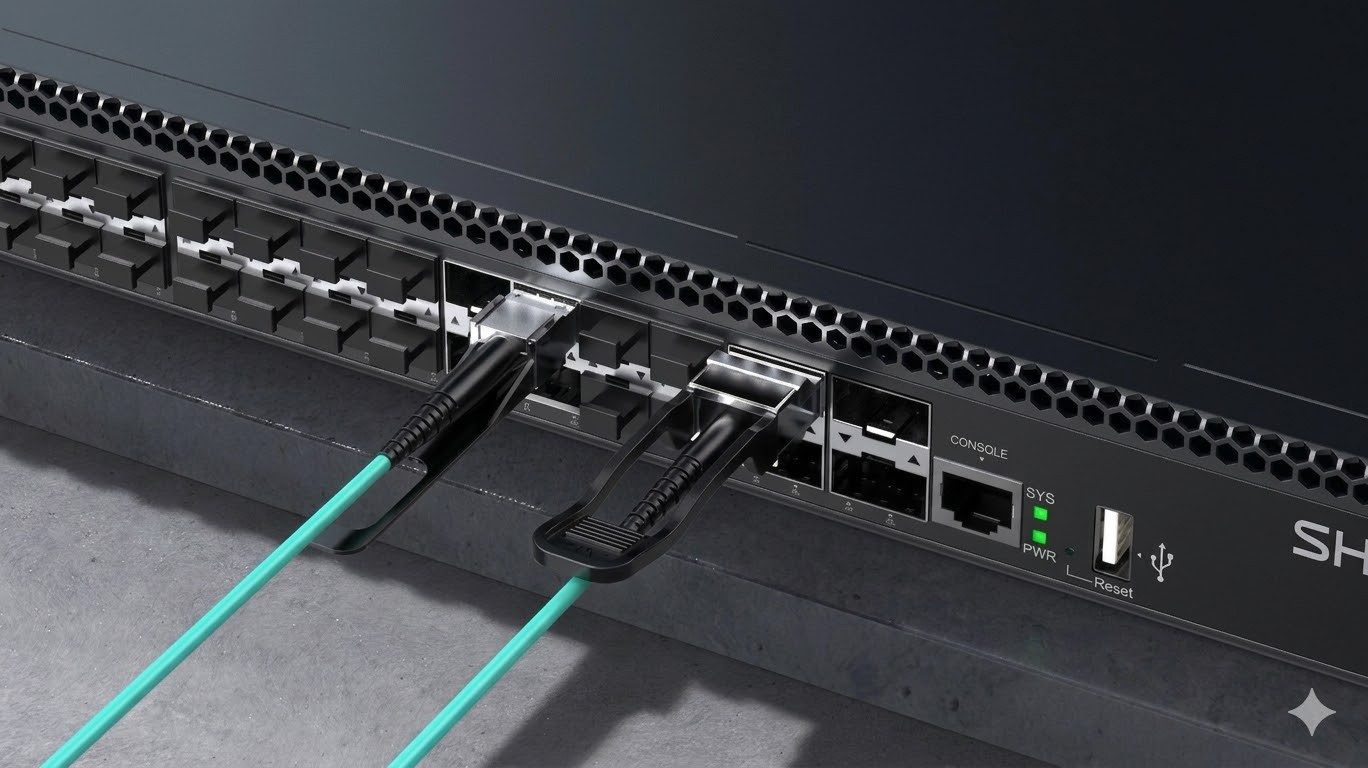
AOC (Active Optical Cable) is a high-speed data transmission cable that relies on external energy to achieve optoelectronic signal conversion. Its core technical characteristic is the integrated optoelectronic conversion modules at both ends, which mutually convert electrical and optical signals, using optical signals as the transmission medium to complete data transfer. This principle is fundamentally different from the direct electrical signal transmission of traditional copper cables (including DAC and AEC). Its technical structure primarily includes: Core Transmission Medium: Optical fiber serves as the core transmission carrier. As a dielectric material, fiber does not rely on current conduction, inherently isolating electromagnetic interference and providing the foundation for long-distance, low-loss transmission. In some scenarios, auxiliary components such as optical amplifiers and attenuators are integrated to optimize signal transmission performance and ensure system stability. Optoelectronic Conversion Module: Optical transceivers (containing lasers and photodetectors) are built into both ends of the cable, forming the core unit for "electrical-optical-electrical" conversion. The receiver converts electrical signals from the device into optical signals, while the transmitter restores the transmitted optical signals back to electrical signals. It also possesses optical transmission functionality, completing the full data transmission link. Connectors and External Structure: High-density connectors are employed, connecting the modules at both ends via a single optical cable. The external appearance is similar to copper cables, but the internal structure differs significantly. The overall design is compact, with a volume approximately half that of DAC copper cables and lighter weight, facilitating cabling operations.
2. Core Transmission Principle
Signal Conversion and Transmission Mechanism: The core of an AOC is the combined mode of "optoelectronic conversion + optical signal transmission." First, the electrical signal output from a device enters the optical transceiver at one end of the cable, where an internal laser converts the electrical signal into an optical signal. The optical signal travels along the fiber medium, leveraging fiber's low-loss characteristic to reduce signal attenuation during transmission. Upon reaching the other end, the optical transceiver restores the optical signal back to an electrical signal, transmitting it to the target device and completing the data transmission loop. Rate and Distance Adaptation: Supports high-speed transmission rates up to 400Gbps. Benefiting from the low-loss transmission properties of optical fiber and the signal optimization capabilities of the optoelectronic conversion modules, the maximum transmission distance can reach 100 meters, far exceeding passive copper cables (≤5 meters) and AEC active cables (≤7 meters). It is the preferred solution for short-to-medium and medium-to-long distance transmission. Anti-Interference Principle: Since the transmission carrier is optical signals rather than electrical signals, and optical fiber is a dielectric material, it does not generate electromagnetic radiation nor is it affected by external electromagnetic interference (EMI). Even in data centers with complex electromagnetic environments, it maintains signal transmission stability.
3. Advantages and Limitations Derived from Technical Characteristics
Core Advantages (Based on Technical Design): Extremely Strong Anti-Interference Capability: The dielectric properties of optical fiber and the optical signal transmission mode make it completely immune to electromagnetic interference and radiation, suiting high-reliability transmission requirements in complex electromagnetic environments. Lightweight and Flexible Cabling: Weight is significantly lighter than copper cables like DAC and AEC, with a volume about half that of DAC. The texture is soft, offering high flexibility during cabling, effectively saving space and suiting high-density deployment scenarios. Long Transmission Distance and Stable Performance: The 100-meter transmission distance fills the long-distance gap of copper cables. The low-loss characteristic of fiber optic transmission ensures stable signals and low bit error rates across the entire distance, suitable for long-distance device interconnection. High Transmission Rate: Supports rates up to 400Gbps, meeting mid-to-high-end, long-distance, high-speed data transmission needs, such as high-capacity data exchange between core devices. Inherent Limitations (Originating from Technical Principles): High Cost: Internally integrates high-precision components like lasers and optoelectronic conversion modules, making its production cost the highest among the four cable types (DAC, AEC, AOC, and passive copper cables). Large-scale deployment faces significant cost pressure. Higher Power Consumption: Energy loss occurs during the optoelectronic conversion process, and components like lasers and optical transceivers require external energy, resulting in overall power consumption higher than DAC and AEC. High Maintenance Cost: The optoelectronic conversion module and the optical cable are integrated into a single design, preventing separate disassembly and replacement. If the module or fiber fails, the entire cable must be replaced. Additionally, laser lifespan is typically 3-5 years, requiring complete cable replacement afterward, leading to high subsequent maintenance costs. Difficulty in Widespread Adoption: Energy loss and thermal energy loss during optoelectronic conversion, coupled with high costs, are the core reasons hindering its large-scale adoption.
4. Technologically Adapted Application Scenarios
Based on the technical core of "long-distance, high anti-interference, high-density," AOC active optical cables are primarily suited for the following scenarios: Long-distance transmission within data centers, such as connections between core switches and cross-zone equipment interconnection in server rooms; Scenarios with extremely high requirements for reliability and anti-interference, such as industrial server rooms with complex electromagnetic environments and backbone links of core communication networks; High-density deployment scenarios, such as long-distance interconnection between server clusters and storage devices in large data centers, where saving cabling space while ensuring transmission stability is needed; Medium-to-long-distance high-speed data transmission scenarios with explicit distance requirements (exceeding 7 meters and ≤100 meters) and stringent demands for signal stability.
VI. ACC (Active Copper Cable) – Active Copper Cable
1. Core Definition and Technical Composition
ACC (Active Copper Cable) is a high-speed data transmission cable based on a copper wire medium, integrating an active signal processing unit. Its core technical characteristic is the use of a built-in active signal driver (linear Redriver chip) to compensate for the high-frequency signal loss of passive copper cables, breaking through the transmission distance limitations of traditional passive copper cables (e.g., DAC), while maintaining the essence of electrical signal transmission in copper cables, balancing cost and performance. Its technical structure primarily includes: Core Transmission Medium: High-specification copper wire serves as the basic transmission carrier, continuing the core mode of electrical signal conduction in copper cables, ensuring foundational performance for high-speed transmission. The cable material is consistent with passive copper cables but is adapted to the power supply and signal interaction requirements of the active chip, resulting in a more targeted physical structure. Active Signal Processing Unit: A linear Redriver chip is integrated at the cable's receiving end (Rx end), serving as the core signal processing module. Its core function is to equalize and amplify high-frequency electrical signals that have attenuated and distorted during transmission, rather than reshaping or repairing signals. It acts as a "signal booster," compensating for high-frequency loss in passive transmission. Interface and Specification Configuration: Supports a wide range of transmission rates and form factors, covering 10G SFP+, 25G SFP28, 40G QSFP+, 50G QSFP+, 100G QSFP28, 200G QSFP-DD, 400G OSFP, 800G OSFP, 400G QSFP-DD, 800G QSFP-DD, etc., allowing flexible adaptation to different device interfaces and bandwidth requirements. External Structural Characteristics: Due to the integration of the active chip and its supporting power supply unit, the overall cable is thicker and heavier than traditional passive DAC copper cables. The physical form is influenced by the layout of active components, resulting in slightly lower cabling flexibility compared to passive copper cables.
2. Core Transmission Principle
Signal Transmission Mechanism: Follows the core mode of "copper cable electrical signal transmission + active chip compensation," essentially an optimized upgrade of passive copper cable transmission. First, the electrical signal output from a device travels along the copper wire medium, inevitably experiencing high-frequency signal attenuation. When the signal reaches the receiving end, the built-in Redriver chip initiates real-time signal processing, compensating for high-frequency loss and enhancing signal strength through linear amplification and equalization techniques, ensuring the receiving end obtains stable signal quality. It is important to note that this chip only possesses signal amplification and equalization functions; it lacks signal repair, clock data recovery (CDR), or retiming capabilities and cannot reshape severely distorted signals. Rate and Distance Adaptation: Supports high-speed transmission rates up to 800Gbps (including mainstream tiers like 400Gbps). Transmission distance is significantly improved compared to DAC passive copper cables, exceeding 3 meters, typically 2-3 meters more than DAC (depending on the rate and cable specification). However, it still falls within the short-distance transmission category overall. Cable length significantly impacts performance; selecting an appropriate length based on the actual scenario is a key variable for ensuring transmission effectiveness. Technical Boundary Characteristics: The core limitation lies in its limited signal processing capability—it can only amplify and equalize signals. It lacks functions like Forward Error Correction (FEC), signal reshaping, or clock synchronization, cannot correct bit errors or severe distortions during transmission, and its signal optimization capability is weaker than AEC active cables that integrate CDR/Retimer chips.
3. Advantages and Limitations Derived from Technical Characteristics
Core Advantages (Based on Technical Design): Superior Signal Integrity Compared to Passive Copper Cables: The high-frequency compensation function of the Redriver chip allows electrical signals to remain stable over longer distances. Compared to DAC passive copper cables, signal attenuation is smaller, and transmission reliability is higher, suitable for short-distance scenarios with certain requirements for signal quality. Balanced Cost and Power Consumption: Compared to AOC active optical cables, it does not require expensive components like optoelectronic conversion modules and lasers, resulting in significantly lower costs. Although it integrates an active chip, its power consumption is far lower than AOC, and it does not require complex optoelectronic conversion energy consumption, offering outstanding cost-effectiveness in short-distance scenarios. Comprehensive Rate Coverage: Supports multiple transmission rate tiers from 10G to 800G, with a rich variety of form factors, adaptable to various device interfaces from low-end to high-end, demonstrating strong compatibility. Precise Scenario Adaptation: Provides a cost-effective solution for niche scenarios characterized by "cost sensitivity, transmission distance slightly exceeding DAC, and no need for signal repair," filling the gap between passive copper cables and high-end active cables. Inherent Limitations (Originating from Technical Principles): Transmission Distance Remains Limited: Although it breaks through the 3-meter limit of DAC, it is essentially still short-distance transmission, unable to meet medium-to-long-distance needs, and lacks the long-distance transmission capabilities of AEC and AOC. Limited Signal Processing Capability: Can only amplify and equalize signals, lacking repair or reshaping functions. It cannot effectively compensate for severe signal distortion or bit errors, resulting in lower reliability compared to AEC active cables. Constrained Physical Form: Due to the integration of the active chip and power supply module, the cable is thicker and heavier than DAC, with reduced cabling flexibility, posing certain challenges for rack cabling space and management. Narrower Market Application Scope: Limited by its functional focus, it is only suitable for specific niche scenarios. Its overall market space is smaller than the three cable types: DAC, AOC, and AEC.
4. Technologically Adapted Application Scenarios
Based on the technical core of "short-distance, low-cost, signal amplification compensation," ACC active copper cables are primarily suited for the following scenarios:
4.1 Close-range interconnection within data centers, such as connections between ToR (Top-of-Rack) switches and servers, where breaking the 3-meter limit of DAC is needed but reaching the 7-meter distance of AEC is not required, and cost sensitivity is a factor;
4.2 Short-link transmission scenarios with a clear need for signal amplification but no requirement for signal repair/reshaping, such as high-speed interconnection between equipment in small server rooms and close-range data exchange at edge computing nodes;
4.3 Cost-sensitive scenarios: Where transmission distance requirements are not high (typically within 5 meters), seeking a balance of "passive copper cable cost + limited distance extension," and unwilling to incur the high cost of AOC or the premium for AEC's complex functions;
4.4 Device interface adaptation scenarios: High-speed interconnection needs requiring matching specific form factors (e.g., 800G QSFP-DD, OSFP) with short transmission distances, utilizing its rich specification configurations for precise adaptation.

Ⅴ. Summary: DAC, AEC, AOC, ACC
1. Cable Selection Criteria
Selecting data transmission cables requires a comprehensive evaluation of specific application needs, transmission distance, cost budgets, and space constraints.
In data communications, we observe a trend toward Ethernet applications, with ACC expected to expand from InfiniBand into Ethernet use cases. We believe that switch speed upgrades will also drive changes in high-speed data center interconnects. New products like AEC and ACC are poised to expand their downstream customer base. The emergence of higher-speed switches is expected to drive port rate upgrades. Traditional Direct Attach Copper (DAC) cables are prone to significant signal loss and attenuation at high speeds. To compensate, the diameter of DAC cables must be continually increased. According to Amazon, a DAC supporting 100G rates over 2.5 meters has an outer diameter of 6.7 mm, while a 400G-rate DAC for the same distance reaches 11 mm, making cable management difficult for cloud service providers. Furthermore, the larger outer diameter necessitates a larger bend radius, increasing the overall rack footprint and space usage. The current innovative solution for high-speed copper connections is the Active Electrical Cable (AEC). Compared to DAC, AEC incorporates signal recovery chips at both ends of the copper cable to reduce loss and attenuation of high-speed signals. Consequently, AEC has a smaller outer diameter than traditional DAC and occupies less space. In constructing large-scale AI clusters, we believe the significantly higher interconnect density compared to standard cloud computing makes AEC—with its smaller outer diameter—better suited for large-scale network cabling. Additionally, for short-reach applications, AEC offers advantages in low cost, low energy consumption, and low maintenance compared to optical communication solutions using modules and fiber. According to Credo, the total cost of ownership for 400G AEC can be 53% lower than for an AOC solution. We believe that as data center network rates continue to increase, DAC will face significant challenges in short-reach applications, and innovative interconnects like AEC are expected to replace it. According to LightCounting's December 2023 estimate, the combined market for AOC, DAC, and AEC is projected to be approximately $1.75–1.82 billion in 2025, reaching $2.8 billion by 2028. The projected Compound Annual Growth Rates (CAGRs) from 2023 to 2028 for the AOC, DAC, and AEC segments are 15%, 25%, and 45%, respectively.
|
Cable Type
|
Core Definition & Technology
|
Core Transmission Medium
|
Transmission Distance
|
Maximum Rate
|
Core Advantages
|
Key Limitations
|
|
DAC (Direct Attach Copper Cable)
|
Passive; no additional electronics; direct electrical signal transmission over copper
|
Copper wire
|
≤5 m (typically ≤3 m)
|
400Gbps
|
Lowest cost, negligible power, plug-and-play, fast deployment
|
High signal loss at speed, thick diameter, high space use, weak EMI immunity
|
|
AEC (Active Electrical Cable)
|
Copper cable + CDR/Retimer chips at both ends for signal repair
|
Silver-plated copper + Teflon insulation
|
≤7 m
|
400Gbps
|
Strong signal integrity, compact size (saves 70% space), 50% lower cost than AOC, low power (25% lower than AOC)
|
Requires power, still short-reach only
|
|
ACC (Active Copper Cable)
|
Copper cable + Redriver chip at Rx end for signal amplification/equalization
|
Copper wire
|
>3 m (2-3 m longer than DAC)
|
800Gbps
|
Full rate coverage (10G-800G), lower cost than AOC, adapts to specific short-reach cases
|
No signal repair, thick/heavy cable, limited market applicability
|
|
AOC (Active Optical Cable)
|
Fiber + integrated optical-electrical modules for optical signal transmission
|
Optical fiber
|
≤100 m
|
400Gbps
|
Excellent EMI immunity, physical size half of DAC, stable over long distances
|
Highest cost, high power, high maintenance (integrated design), laser lifespan 3-5 years
|
2. Core Differences and Application Boundaries
Technology Path Differences:
Copper Cable Series (DAC/AEC/ACC): All copper-based, differing corely in signal processing—DAC has no active components, ACC performs signal amplification/equalization, and AEC provides signal repair/reshaping, offering progressively greater functionality.
Optical Cable Series (AOC): Transmits optical signals, completely avoiding electrical transmission over copper, solving EMI and long-distance challenges at the medium level.
Scenario Adaptation Boundaries:
Ultra-short reach (≤3 m), cost priority: DAC is preferred, suitable for intra-rack equipment interconnection in standard data centers.
Short-reach extension (3-7 m), high-density cabling (e.g., AI clusters): AEC is optimal, balancing space savings and cost.
Short reach (≤5 m), specific rate/packaging needs: ACC suits cost-sensitive niche scenarios not requiring signal repair.
Medium-to-long reach (7-100 m), high EMI immunity required: AOC is the core choice for interconnecting core equipment across rooms or in complex EMI environments.
3. Industry Trends and Market Outlook
Technology Replacement Trends:
High-speed rates drive replacement: As data center rates migrate to 400G+, DAC's high signal loss and surging outer diameter (11mm for 400G vs. 6.7mm for 100G) exacerbate cabling difficulty and space use. AEC, with its "chip-based signal repair and small outer diameter," emerges as the key DAC replacement in short-reach scenarios, particularly for high-density networking like AI clusters.
Cost and power advantages: 400G AEC reduces total cost by 53% versus AOC, with lower power and maintenance, offering far better cost-effectiveness than optical solutions for short reaches.
Market Size Forecast:
Overall market: The AOC/DAC/AEC market is projected to reach $1.75–1.82 billion in 2025, growing to $2.8 billion by 2028, with an ~18% CAGR from 2023-2028.
Segment growth: AEC grows fastest (45% CAGR), becoming the core growth engine; DAC maintains steady growth (25% CAGR), retaining demand in mid-to-low speed scenarios; AOC grows steadily (15% CAGR), focused on long-reach applications.
Innovation and expansion: ACC is expected to expand from InfiniBand to Ethernet, leveraging its rate and packaging versatility for more mid-range short-reach scenarios. AEC penetration in AI clusters and large-scale data centers will keep rising, establishing it as the mainstream short-reach high-speed interconnect.
4. Core Selection Recommendations
Prioritize transmission distance: Choose DAC for ≤3 m, AEC for 3-7 m, AOC for >7 m and ≤100 m, and ACC for ≤5 m with specific rate needs.
Consider deployment constraints: Prioritize AEC for high-density cabling (e.g., AI clusters) and space-constrained scenarios; choose AOC for complex EMI environments; select DAC/ACC for cost-sensitive cases.
Evaluate long-term cost: For short-reach high-speed (400G+) scenarios, AEC's "low total cost + low energy consumption" offers clear advantages over DAC and AOC.
Anticipate technology iteration: AEC replacing DAC over the next five years is a clear trend. For new large-scale data centers and AI clusters, prioritize deploying AEC solutions.
We're well-known as one of the leading dac/aoc cables manufacturers and suppliers in China. If you're going to wholesale bulk high quality dac/aoc cables with competitive price, welcome to get pricelist and quotation from our factory.