


1. What are the best rj45 pass through connectors?
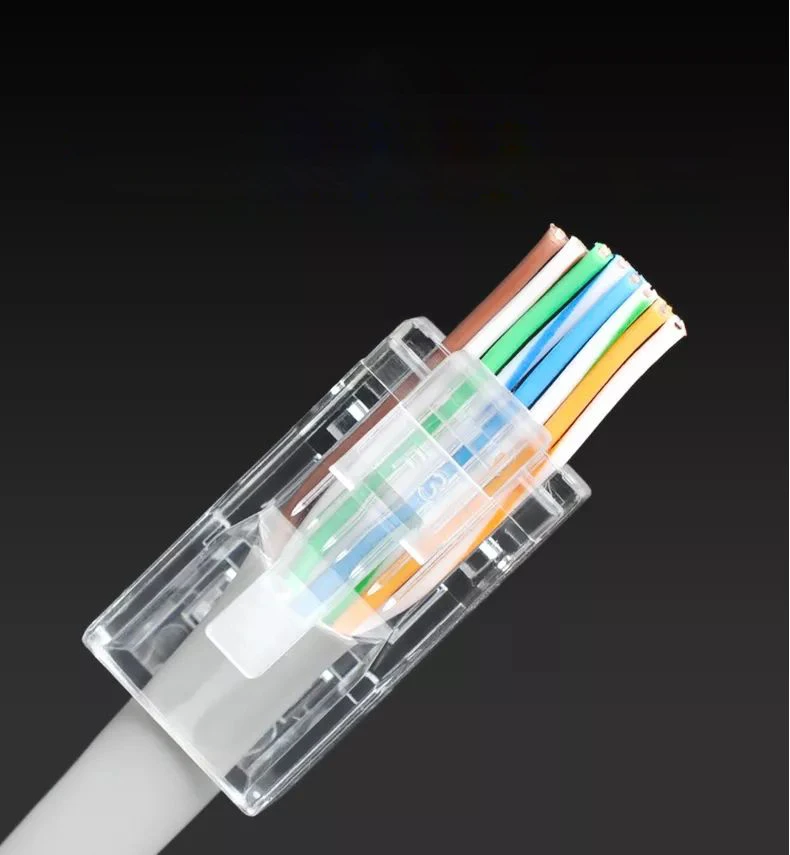
RJ45 pass through connectors are essential interface devices in network connections. These plastic connectors, which can be inserted in a fixed direction and automatically lock in place to prevent disconnection, are used for network communication. They are called "RJ45 pass through connectors" due to their clear and transparent appearance resembling crystal. Primarily, they are used to connect network interface card (NIC) ports, hubs, switches, telephones, and other equipment. Based on their specifications, they are categorized into RJ-11, RJ-45, RJ-48, and others.

The name "RJ45 pass through connector" stems from its crystal-clear exterior. A RJ45 pass through connector is a plastic connector that can be inserted in a fixed direction and secured via a latch mechanism. Commonly referred to as a "RJ45 pass through plug," it is technically known as an RJ-45 connector (RJ-45 being a network interface standard; another example is the RJ-11 interface commonly used for telephone connections). RJ45 pass through connectors are suitable for on-site termination between devices or within horizontal subsystems. Their housings are made of high-density polyethylene. Twisted-pair cables are connected at both ends to a NIC and a hub (or ethernet switch) by attaching RJ45 pass through connectors.
2. Advantages of rj45 pass through connectors
In May 2018, after several months of research and development, COBTEL introduced a newly designed front-end pass-through RJ45 connector to the market. Over the years, this design has gained increasing acceptance among industry professionals. The advantages of this pass-through connector include improved patch cord assembly efficiency with one-step wire trimming and compliance with Cat 6 patch cord performance testing for one-piece Cat 6 connectors.
An engineering contractor who was using pass-through connectors for the first time remarked that this design significantly improves cabling efficiency. It eliminates traditional steps such as measuring wire stripping lengths, marking wires with pens, aligning cuts, and checking insertion accuracy. Instead, users can simply strip a wire length slightly longer than required by the connector, arrange the wires according to the correct sequence, straighten them out, insert them directly into the plug without close observation, and complete the task effortlessly—making it highly accessible for novice users.
3. Why rare manufacturers are manufacturing RJ45 pass-through connectors
This prompts a question: why haven’t manufacturers universally adopted this design? Is there something inherently problematic about these pass-through connectors? Do they have built-in defects or pose risks such as short circuits? According to an experienced cabling contractor with years of installation expertise: “For traditional RJ45 pass through connectors, after threading the wires through properly, it’s best to tap the plug lightly with crimping pliers to ensure all eight wires are fully inserted before crimping. With RJ45 pass-through connectors, as long as you’ve arranged all eight wires correctly and threaded them through properly, there’s no need to worry about incomplete insertion—installation becomes faster and more accurate. For experienced workers who don’t struggle with poor lighting or vision issues during outdoor installations using headlamps, traditional plugs aren’t particularly challenging. However, using pass-through connectors simplifies things further—they’re less stressful and faster once you get accustomed to them.

“It’s crucial to select high-quality pass-through connectors; look for those with three-pronged contact pins or copper plating since iron contacts tend to rust over time. Additionally, traditional crimping tools cannot be used with RJ45 pass-through connectors! Whether you’re working with 80 meters of 045 oxygen-free copper or 80 meters of 045 high-conductivity aluminum/copper-clad aluminum cables—if you’re not using advanced Fluke testing equipment commonly employed for network diagnostics—software-based tests reveal minimal differences between pass-through and traditional plugs. Even when tested using network amplifiers under identical conditions within 200 meters of cable length, performance remains essentially comparable except for speed reductions down to 30 Mbps. In terms of efficiency though, pass-through designs clearly offer significant improvements by eliminating steps like verifying whether each wire has been fully inserted.”