


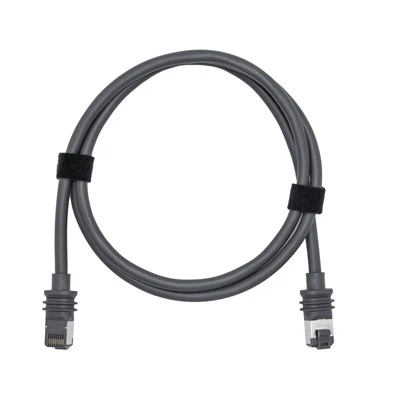

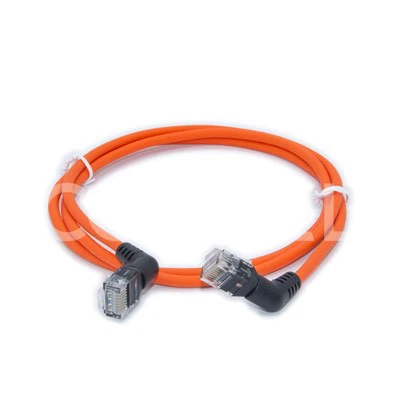


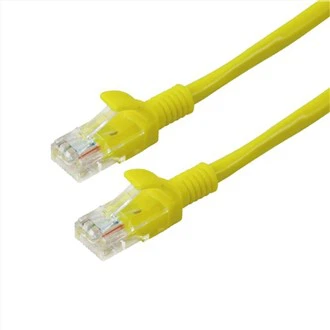


Cat 5 and Cat 5e twisted pair cables come in both unshielded and shielded varieties. The twisted pairs cable have 23 or 24 AWG bare copper conductors with fluorinated ethylene as insulation material, including a 24AWG TPG leakage wire. Shielded twisted pair cables feature aluminum foil shielding. Cat 5 cables are designed to support transmission frequencies up to 100 MHz, while Cat 5e cables support frequencies up to 155 MHz. The conductor color configurations for both Cat 5 and Cat 5e, unshielded and shielded twisted pair cables, are shown in Table 1.
Table 1: Composition of Conductor Colors for 4-Pair Shielded Twisted Pair Cables
|
Pair No.
|
Color Code
|
Shielding
|
|---|---|---|
|
1
|
White/Blue and Blue
|
0.002[0.051] Aluminum/Polyester Tape
|
|
2
|
White/Orange and Orange
|
Contains a 24AWG TPC Drain Wire
|
|
3
|
White/Green and Green
|
|
|
4
|
White/Brown and Brown
|
|
1. Electrical Performance Specifications of Category 5, 4-Pair, 24AWG Unshielded Cable
(1) The electrical characteristics of the Category 5, 4-pair, 24AWG unshielded cable are as shown in Table 2.
Table 2: Electrical Characteristics of Category 5, 4-Pair, 24AWG Unshielded Cable
|
Cable Category
|
Pairs
|
Conductor Diameter (mm)
|
Insulation Thickness (mm)
|
Insulated Diameter (mm)
|
Sheath Thickness (mm)
|
Aluminum Foil Shielding
|
Copper Wire Braid Density
|
Finished Outer Diameter (mm)
|
|---|---|---|---|---|---|---|---|---|
|
5
|
4
|
0.512
|
0.21
|
0.93
|
0.7
|
—
|
—
|
5.2
|
*Note: The symbols "—" indicate that there is no aluminum foil shielding or copper wire braid density applicable for this category of unshielded cable.
(2) Performance Specifications of the Cable
The performance specifications of Category 5, 4-pair, 24AWG unshielded cable are as shown in Table 3.
Table 3: Performance Specifications of Category 5, 4-Pair, 24AWG Unshielded Cable
Table 3: Performance Specifications of Category 5, 4-Pair, 24AWG Unshielded Cable
|
Category 5 4-Pair 24AWG Unshielded Cable Conductor (Solid)
|
Unit
|
Frequency (MHz)
|
UTP5 Values
|
|---|---|---|---|
|
DC Resistance
|
Ω/100m, 20°C
|
|
9.38
|
|
Maximum DC Resistance Unbalance
|
%
|
|
2.5
|
|
Maximum Unbalance with Ground Capacitance
|
pF/100m
|
|
330
|
|
Characteristic Impedance
|
Ω
|
1.0~100
|
100±15%
|
|
Structural Return Loss shall be greater than or equal to the values listed in the table. In the frequency range from greater than 20MHz to 100MHz, Return Loss shall be calculated by the following formula: Structural Return Loss = N23-101g (f/20) (for UTP5), Structural Return Loss=N28-101g(f/20)(for UTP5e)
|
dB/100m
|
1.0~20.0 25.0 31.2 56.2 5 100.0
|
23 24.3 23.6 21.5 20.1
|
|
Attenuation data is for engineering design and not for testing use. When tested at 40℃, the maximum attenuation value should increase by 8%, at 60℃, it should increase by 16%. At room temperature within the frequency range of 0.772~100MHz, the maximum loss test per pair of conductors shall be calculated using the following formula: Attenuation (f)≤1.967+0.023+0.050
|
dB/100m
|
0.772 1.0 4.0 8.0 10.0 16.0 20.0 25.0 31.2 5 62.5 100.0
|
1.8 2.0 4.1 5.8 6.5 8.2 9.2 10.4 11.7 17.0 22.0
|
|
Worst Pair-to-Pair Near-End Crosstalk (KEXTdB), Minimum Value At room temperature within the frequency range of 0.772~100MHz, the minimum crosstalk coupling loss for each pair among at least 100m long samples should be calculated by the following formula:NEXT(f)≥62.31gf (for UTP5), NEXAT(f) ≥65.3-151gf(for UTP5e)
|
dB/100m
|
0.772 1.0 4.0 8.0 10.0 16.0 20.0 25.0 31.2 5 62.5 100
|
64 62 53 48 47 44 42 41 39 35 32
|
|
Power-Sum Near-End Crosstalk Attenuation to Crosstalk Ratio, PSNEXT≥62.3-15XLgf
|
dB/100m
|
20.0 25.0 31.2 56.2 5 100.0
|
42.8 41.3 39.9 35.4 32.2
|
|
Equal Level Far-End Crosstalk
|
dB/100m
|
0.772 1.0 4.0 8.0 10.0 16.0 20.0 25.0 31.2 5 62.5 100.0
|
63.2 61 49 42.9 41 37 35 33 31.1 24.7 21
|
|
Power Sum Equal Level Far-End Crosstalk
|
dB/100m
|
0.772 1.0 4.0 8.0 10.0 16.0 20.0 25.0 31.2 5 62.5 100.0
|
63.0 60.8 48.7 42.7 40.8 36.7 34.7 32.8 30.9 24.8 20.8
|
|
Attenuation to Crosstalk Ratio
|
dB/100m
|
0.772 1.0 4.0 8.0 10.0 16.0 20.0 25.0 31.2 5 62.5 100.0
|
62 60 49 43 41 36 33.5 31 28.2 19.4 10.3
|
*Note: The attenuation data provided here is for use in engineering design rather than for testing purposes. The complex calculation formulas for Return Loss, Attenuation, and Crosstalk are an essential part of cable performance specifications and are used to predict the cable's ability to maintain signal quality over its frequency range.
2. Performance Specifications of Category 5e Unshielded Twisted Pair Electrical Characteristics
Compared to standard Category 5 UTP, Category 5e twisted pair cables have reduced attenuation and feature higher ACR and SRL values, as well as lower delay and attenuation skews, resulting in improved performance. In contrast to standard Category 5 twisted pairs, Category 5e systems operating at 100MHz offer an additional 8dB margin of near-end crosstalk (NEXT), thereby reducing the interference on user equipment to only a quarter of that experienced with a Category 5 system. This significantly enhances system independence and reliability. Near-end crosstalk, power sum crosstalk, attenuation, and structural return loss (SRL) are four critical parameters of the Category 5e system.
(1)The electrical characteristics of Cat 5e, 4-pair, 24AWG unshielded twisted-pair cable are as shown in Table 4.
Table 4: Electrical Characteristics of Cat 5e, 4-Pair, 24AWG Unshielded Twisted Pair
|
Cable Category
|
Pairs
|
Conductor Diameter (mm)
|
Insulation Thickness (mm)
|
Insulated Diameter (mm)
|
Sheath Thickness (mm)
|
Aluminum Foil Shielding
|
Copper Wire Braid Density
|
Finished Outer Diameter (mm)
|
|---|---|---|---|---|---|---|---|---|
|
5e
|
4
|
0.52
|
0.21
|
0.93
|
0.7
|
—
|
—
|
5.4
|
|
5e
|
4
|
0.52
|
0.21
|
0.93
|
0.7
|
Longitudinally wrapped
|
—
|
5.6
|
|
5e
|
4
|
0.52
|
0.21
|
0.93
|
0.7
|
Longitudinal wrapping
|
50~60
|
6.0
|
*Notes: The term "longitudinal wrapping" refers to a method of foil shielding that is applied lengthwise along the cable. The symbols "—" indicate that certain shielding or braid density features are not applicable to the specified cables. The improved hardware characteristics of Category 5e cables ensure better data transmission quality and system integrity over the Category 5 standard.
(2) Performance Specifications of Category 5e, 4-Pair, 24AWG Unshielded Twisted Pair Cable
The performance specifications of Category 5e, 4-pair, 24AWG unshielded twisted pair cables are shown in Table 5.
Table 5: Performance Specifications of Category 5e, 4-Pair, 24AWG Unshielded Twisted Pair Cable
Table 5: Performance Specifications of Category 5e, 4-Pair, 24AWG Unshielded Twisted Pair Cable
|
Category 5e 4-Pair 24AWG Unshielded Twisted Pair Conductor (Solid)
|
Unit
|
Frequency (MHz)
|
UTP5e Values
|
|---|---|---|---|
|
DC Resistance
|
Ω/100m, at 20°C
|
|
9.38
|
|
Maximum DC Resistance Unbalance
|
%
|
|
2.5
|
|
Maximum Unbalance with Ground Capacitance
|
pF/100m
|
|
330
|
|
Characteristic Impedance
|
Ω
|
1.0~100
|
100±15%
|
|
Structural Return Loss shall be greater than or equal to the values listed in the table. For frequencies above 20MHz and up to 100MHz, Return Loss shall be calculated using the following equation: Return Loss≥23-101g (f/20) (for UTP5), Return Loss≥28-101g (f/20)(for UTP5e).
|
dB/100m
|
1.0 up to 100
|
23, 24.3, 23.6, 21.5, 20.1
|
|
Attenuation data is used for engineering design, not for testing reference. During testing at 40°C, the maximum attenuation should increase by 8%; at 60°C, it should increase by 16%. At room temperature, within the frequency range of 0.772 to 100MHz, the maximum loss for each pair of conductors shall be calculated using the following formula: Attenuation (f) ≤1.967f+0.023f+0.050
|
dB/100m
|
0.772 up to 100.0
|
1.8, 2.0, 4.1, 5.8, 6.5, 8.2, 9.2, 10.4, 11.7, 17.0, 22.0
|
|
The worst pair-to-pair near-end crosstalk (KEXT dB), minimum value, should be calculated as follows for a frequency range of 0.772 to 100MHz at room temperature within at least 100m of cable length: NEXT(f)≥62.31lgf(for UTP5), NEXAT(f)≥65.3-151gf(for UTP5e)
|
dB/100m
|
0.772 up to 100.0
|
67, 65, 56, 51, 50, 47, 46, 44, 43, 38, 35
|
|
The power-sum near-end crosstalk to attenuation ratio, PSNEXT, should be: PSNEXT≥62.3-15XLgf
|
dB/100m
|
20 up to 100
|
42.8, 41.3, 39.9, 35.4, 32.2
|
|
Equal level far-end crosstalk
|
dB/100m
|
0.772 up to 8.0
|
66, 63.8, 51.7, 45.7
|
|
Equal level far-end crosstalk
|
dB/100m
|
10.0 up to 100.0
|
43.8, 39.7, 37.7, 35.8, 33.9, 27.8, 23.8
|
|
Power-sum equal level far-end crosstalk
|
dB/100m
|
0.772 up to 100.0
|
63.0, 60.8, 48.7, 42.7, 40.8, 36.7, 34.7, 32.8, 30.9, 24.8, 20.8
|
|
Attenuation to crosstalk ratio
|
dB/100m
|
0.772 up to 100.0
|
65, 63.3, 52.2, 46.0, 43.8, 39.0, 36.5, 33.9, 31.2, 21.4, 13.3
|
*The data shown in Table 5 represents key performance metrics that determine the cable's ability to transmit data effectively while minimizing signal interference and degradation over long distances and through various frequencies. The formulas provided are foundational for ensuring the stability and integrity of signal transmission, offering advanced performance over the predecessor cable types.
3. Category 5 and Category 5e, 4-Pair Shielded Twisted Pairs
Category 5 and Category 5e shielded twisted pairs are constructed with 23 and 24 AWG bare copper conductors and use polyvinylidene fluoride (PVDF) for insulation. They include a 24AWG TPG leakage wire and are aluminum foil shielded, as illustrated in Figure 1.

Figure 1: Category 5, 4-Pair, 24AWG, 100Ω Shielded Cable
The electrical characteristics of Category 5 and Category 5e, 4-Pair shielded twisted pair cables are shown in Table 6.
Table 6: Electrical Characteristics of Category 5, 4-Pair, 24AWG, 100Ω Shielded Cable
|
Frequency Requirements
|
Impedance
|
Maximum Attenuation (dB/100m)
|
NEXT (dB) (Worst Pair)
|
Maximum DC Conductor Resistance (100m/20°C)
|
|---|---|---|---|---|
|
256kHz
|
—
|
1.1
|
—
|
9.38Ω
|
|
512kHz
|
—
|
1.5
|
—
|
9.38Ω
|
|
772kHz
|
—
|
1.8
|
66
|
—
|
|
1MHz
|
85~115Ω
|
2.1
|
64
|
—
|
|
4MHz
|
—
|
4.3
|
55
|
—
|
|
10MHz
|
—
|
6.6
|
49
|
—
|
|
16MHz
|
—
|
8.2
|
46
|
—
|
|
20MHz
|
—
|
9.2
|
44
|
—
|
|
31.25MHz
|
—
|
11.8
|
42
|
—
|
|
62.50MHz
|
—
|
17.1
|
37
|
—
|
|
100MHz
|
—
|
22.0
|
34
|
—
|
|
512kHz
|
—
|
1.5
|
—
|
9.38Ω
|
|
772kHz
|
—
|
1.8
|
66
|
—
|
|
1MHz
|
85~115Ω
|
2.1
|
64
|
—
|
|
4MHz
|
—
|
4.3
|
55
|
—
|
|
10MHz
|
—
|
6.6
|
49
|
—
|
|
16MHz
|
—
|
8.2
|
46
|
—
|
|
20MHz
|
—
|
9.2
|
44
|
—
|
|
31.25MHz
|
—
|
11.8
|
42
|
—
|
|
62.50MHz
|
—
|
17.1
|
37
|
—
|
|
100MHz
|
—
|
22.0
|
34
|
—
|
*Note: The dashes (—) indicate where data is not specified. The impedance is given as a range between 85 to 115 ohms for frequencies at 1MHz, reflecting the cables' capability to maintain a consistent impedance across a range of frequencies for optimum signal transmission. NEXT values express how much signal crosstalk is mitigated by the cable design, and attenuation measures the strength of the signal as it travels through the cable at different frequencies. Maximum DC conductor resistance is provided to assess the cable's efficiency in conducting electricity. The table displays the robust performance metrics that are instrumental in ensuring stable and reliable network connectivity for various applications.
We're well-known as one of the leading cat5e patch cord manufacturers and suppliers in China. If you're going to wholesale bulk high quality cat5e patch cord with competitive price, welcome to get pricelist and quotation from our factory.