
DAC vs AOC: Which Wins in AI Data Centers?
Jun 12, 2026
Leave a message
DAC vs AOC - both are pluggable high-speed cable assemblies that fit the same SFP, QSFP28, QSFP-DD, and OSFP ports, but they differ fundamentally in transmission medium, distance, power, and cost. A DAC (Direct Attach Copper) cable is a passive twinax copper assembly: no chips, no signal conversion, ~0.15W power draw, and a reach of 2–3 meters at 800G - the lowest cost and lowest latency option available. An AOC (Active Optical Cable) integrates optical transceivers at each end and transmits data as modulated light over fiber: complete EMI immunity, 3–4mm cable diameter (vs. 8–10mm for copper), and reach from 10 meters up to 100 meters over multimode fiber. In short: choose DAC for every in-rack link under 3 meters; choose AOC for inter-rack, cross-POD, and backbone runs over 10 meters. This guide covers every dimension of the DAC vs AOC decision - plus ACC and AEC for the 3–7m gap - including spec comparisons, full comparison table, power costs at scale, deployment rules, and troubleshooting.
IT hardware and network infrastructure costs account for more than half of the capital expenditure required for AI data center expansion, according to McKinsey analysis. Getting the interconnect decision right at design time is one of the most cost-critical calls in any modern build.
1. DAC vs AOC: Key Differences at a Glance?
AOC and DAC use identical plug form factors - QSFP-DD, OSFP, SFP - and fit the same switch and server ports. The difference is entirely internal, and that internal difference determines every trade-off:
|
Dimension
|
DAC
|
AOC
|
|---|---|---|
|
Transmission medium
|
Copper twinax (electrical)
|
Multimode or single-mode fiber (optical)
|
|
Max distance at 800G
|
~2–3 meters
|
10–100 meters (MM); farther with SM
|
|
Power draw
|
~0.15W (passive)
|
1–3.5W per end (active lasers)
|
|
Cost per link
|
Lowest
|
2–4× higher than DAC
|
|
EMI immunity
|
No
|
Full immunity
|
|
Cable diameter
|
8–10mm
|
3–4mm
|
|
Latency
|
Lowest (no conversion)
|
Adds ~100ns conversion overhead
|
|
Failure points
|
Minimal (no active components)
|
Laser/PD at each end
|
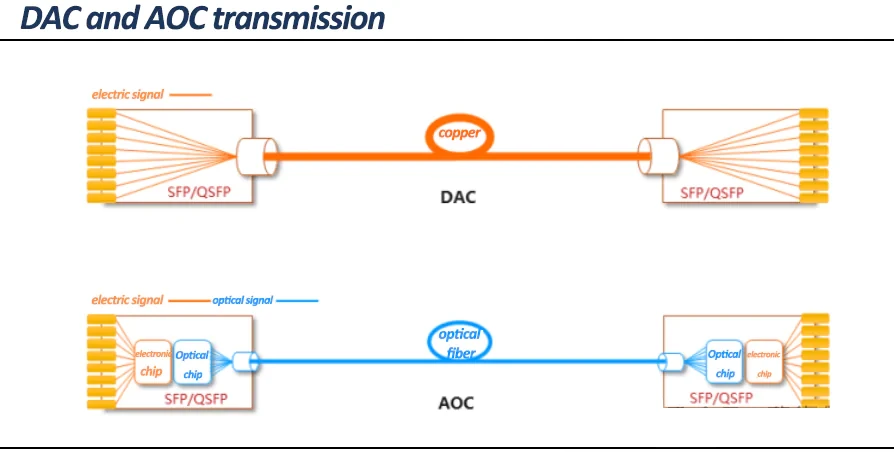
AOC is thinner (around 3 to 4mm diameter vs 8 to 10mm for copper bundles), lighter, flexible, and completely immune to electromagnetic interference. It runs over multimode fiber up to 100 meters and over single-mode fiber for much longer distances. These properties make AOC the right choice for inter-rack, inter-row, cross-floor, and cross-POD links where DAC physically can't reach and where cable weight and airflow management are real concerns.
DAC has lower latency because there is no signal conversion step. It costs significantly less per link and draws almost no power. The absence of lasers, photodetectors, and conversion chips means fewer failure points and a lower total cost of ownership for short-distance use cases. EMI susceptibility is the primary vulnerability in electrically dense environments.
The practical rule for planning: use your fiber patch cords and AOC for backbone runs, cross-cluster connections, and anything exceeding 10 meters. Use DAC for every in-rack connection where the measured link distance stays within 2 to 3 meters.
2. DAC vs AOC vs ACC vs AEC: Complete 800G Specification Comparison
Here is a complete side-by-side reference for all four technologies at 800G:
|
Parameter
|
DAC
|
AOC
|
ACC
|
AEC
|
|---|---|---|---|---|
|
Transmission Medium
|
Copper (twinax)
|
Fiber (MM or SM)
|
Copper (twinax)
|
Copper (twinax)
|
|
Signal Processing
|
None (passive)
|
Full O-E conversion + CDR
|
Redriver/CTLE (Rx only)
|
Retimer + CDR (both ends)
|
|
Max Distance (800G)
|
2-3 m
|
10-100 m MM; up to 10 km+ SM
|
3-5 m
|
5-7 m (up to 9 m per HiWire)
|
|
Power per Assembly
|
~0 W
|
~4-6 W per end
|
~1.5 W
|
6-12 W
|
|
Relative Cost
|
Lowest
|
Medium-High
|
Low
|
Medium
|
|
EMI Susceptibility
|
Yes
|
No (fiber is immune)
|
Yes
|
Yes
|
|
Cable Diameter
|
8-10 mm
|
3-4 mm
|
8-10 mm
|
8-10 mm
|
|
Primary Use Case
|
In-rack, server-to-ToR
|
Cross-POD, spine uplinks, long-distance backbone
|
Adjacent-rack, intra-row
|
Multi-rack, row-to-row
|
|
800G OSFP Availability
|
Widely available
|
Limited for OSFP-to-OSFP
|
Available
|
Available
|
For a deeper dive into which optical transceiver to pair with AOC in your 400G architecture, our 400G QSFP-DD transceiver guide covers SR8, DR4, FR4, and LR4 in full detail.
3. What Is a DAC Cable, and Why Is It Still Dominant?
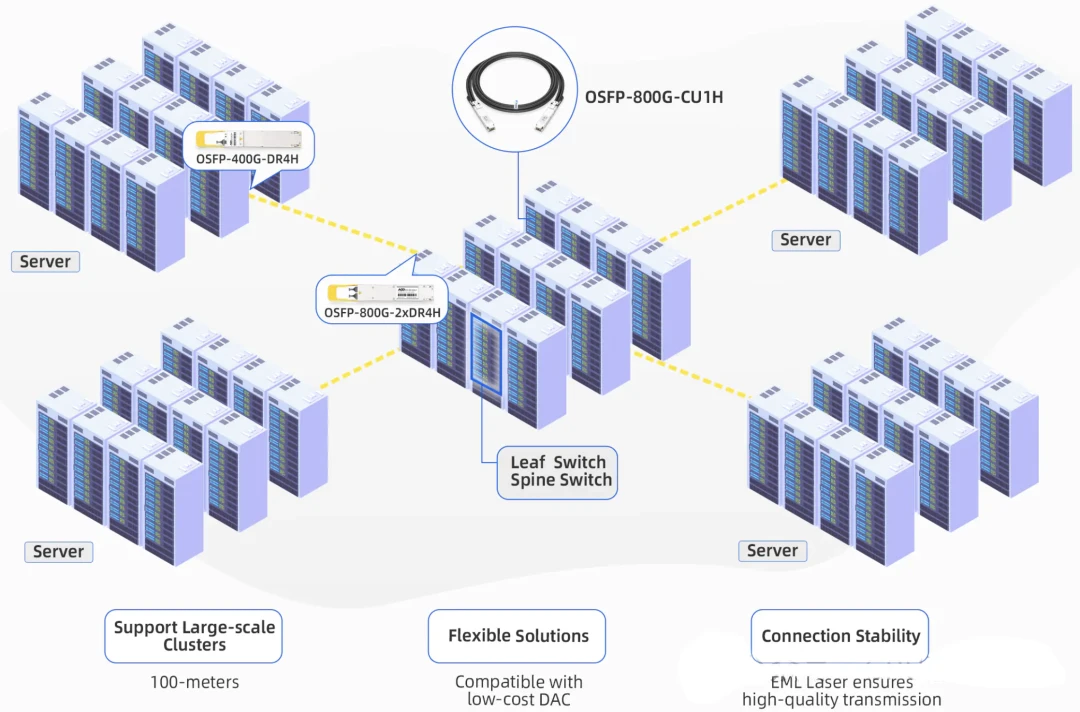
A Direct Attach Cable (DAC) is a passive copper cable with fixed electrical connectors on both ends. It transmits electrical signals directly between two devices, with no signal conversion, no electro-optical components, and no chips inside. DAC costs less than any other high-speed interconnect option and draws virtually zero power. At 800G speeds, passive DAC reliably covers distances of approximately 2 to 3 meters.
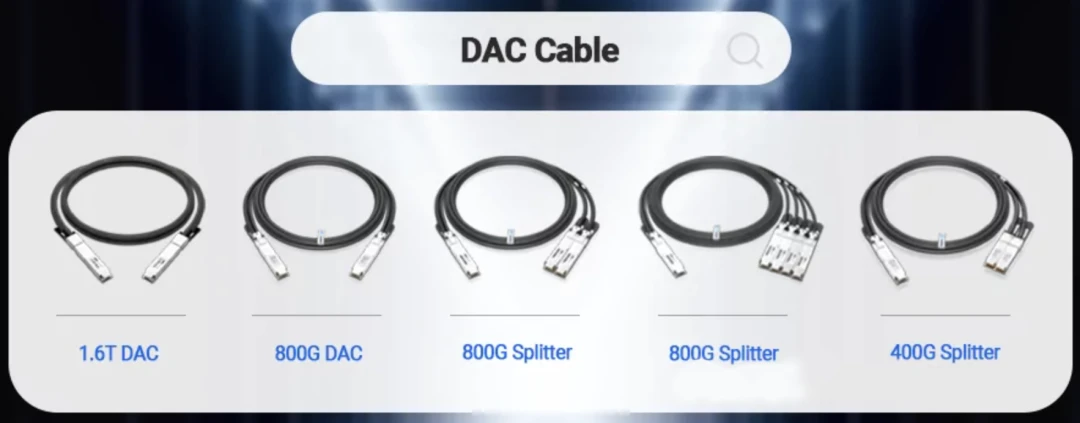
That zero-power, low-cost profile is why DAC has dominated short-reach data center links since the 40G era, and it still holds true today. The power data tells the story clearly. The NVIDIA Quantum-2 InfiniBand switch consumes approximately 747W when deployed with DAC cables, compared to roughly 1,500W when using multimode optical modules. Across a large GPU cluster with thousands of switch ports, that 2x difference becomes a significant recurring operating expense.
DAC uses twinax copper construction: a shielded differential pair inside an outer jacket that carries high-speed electrical signals from one fixed connector to the other. No conversion occurs. No chips process the signal. That simplicity delivers the lowest latency of any interconnect (no conversion delay), the fewest internal failure points, and the lowest total cost of ownership for in-rack use cases. DAC is widely used for connecting servers to top-of-rack (ToR) switches, for server-to-SAN (Storage Area Network) connections, and for short-range switch-to-router interconnects within a data center.
The distance limit is the defining constraint at 800G. Moving from 400G to 800G reduced effective passive DAC reach from 3 to 5 meters down to approximately 2 to 3 meters, because each of the eight lanes now runs at 112 Gbps using PAM4 signaling. Higher frequency means faster signal degradation over copper conductors.
When we analyzed the interconnect architecture for a 128-unit NVIDIA HGX H100 cluster, using DAC alongside single-mode optical modules instead of a pure multimode optical approach reduced the overall cabling cost by approximately 35%. For any link that fits within 2 to 3 meters, DAC remains the correct choice.
4. What Is an AOC (Active Optical Cable)Cable?
An Active Optical Cable (AOC) is a factory-terminated cable assembly that integrates optical transceiver components and fiber into a single sealed unit. Each end converts electrical signals to light for transmission and back to electrical at the far end. AOC supports high-bandwidth, long-distance connections from about 10 meters up to 100 meters over multimode fiber, and further over single-mode fiber, with complete immunity to electromagnetic interference (EMI).
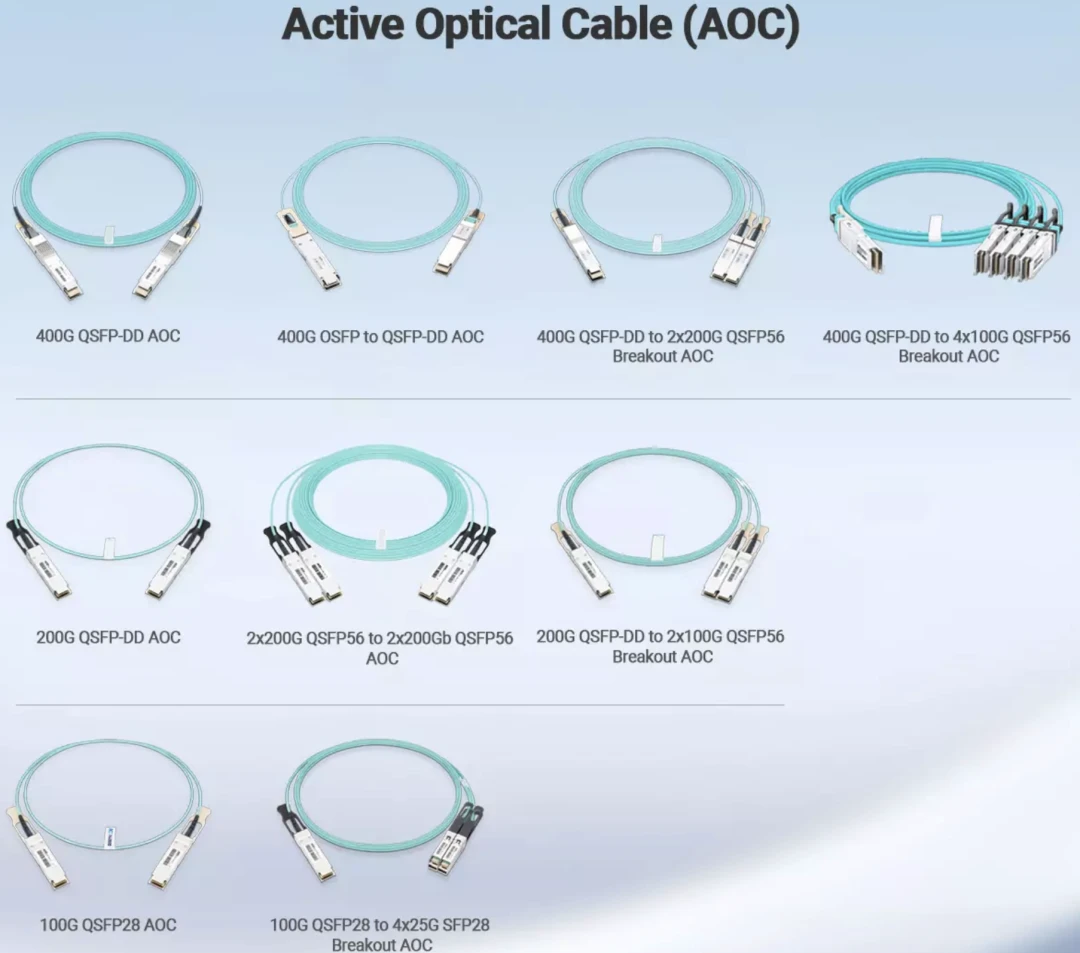
AOC eliminates the need for a separate pluggable optical module paired with an external fiber jumper. The optical transceiver modules are built directly into each end of the cable. Every AOC assembly contains a CDR (Clock and Data Recovery) unit to clean the incoming electrical signal, a Retimer or Gearbox chip to handle lane speed matching, a laser driver and laser for optical output, and a photodetector (PD) to receive and convert incoming light back to an electrical signal. This integrated architecture reduces optical port contamination risk, since the ports are sealed rather than exposed. Many AOC designs also streamline internal optical components and omit Digital Diagnostic Monitoring (DDM) functionality to hit a better cost-performance balance.
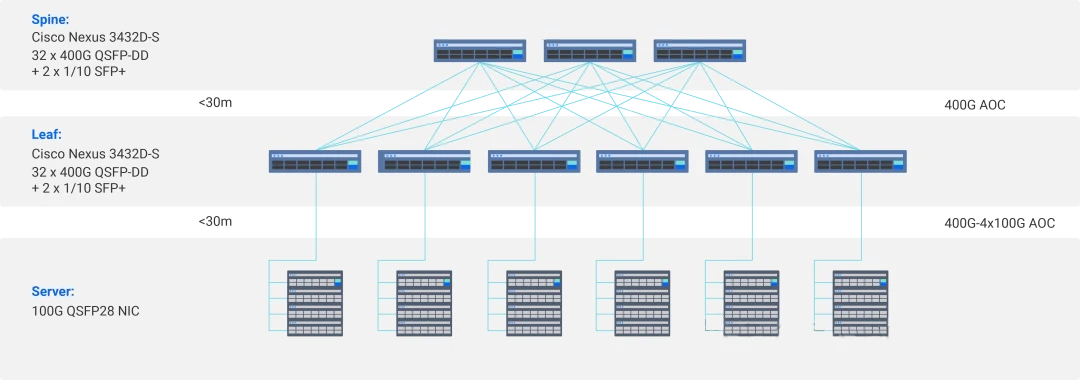
AOC is the right choice for connections that span multiple racks, cross different PODs, link separate clusters, or run between floors. A common deployment example is a spine-leaf architecture using Cisco Nexus 3432D-S switches, with 400G AOC and 400G-4x100G breakout AOC cables handling all device-to-device connections across the network. That architecture takes full advantage of AOC's reach and signal integrity over distances where copper simply can't compete.
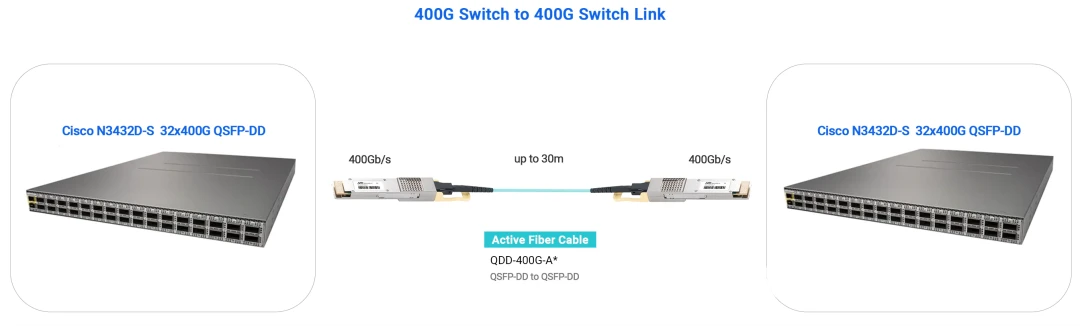
One key constraint to plan around: 800G OSFP-to-OSFP AOC is not yet widely available in the market. The OSFP connector is physically larger and heavier than QSFP-DD and earlier form factors, which creates mechanical stress during installation that can lead to damage. This is why most vendors don't yet offer 800G OSFP-to-OSFP AOC as a standard product line.
5. ACC and AEC: Filling the 3–7m Gap.
ACC (Active Copper Cable) integrates a redriver chip that applies Continuous Time Linear Equalization (CTLE) on the receive side to amplify and reshape degraded signals, extending copper reach to approximately 3 to 5 meters at just around 1.5W per assembly. AEC (Active Electrical Cable) goes further: it uses a digital retimer chip with full Clock and Data Recovery (CDR) at both ends to completely regenerate the signal rather than just amplify it, reliably reaching 5 to 7 meters at 6 to 12 watts.
Both technologies were developed because passive DAC can't cover every link in a modern AI cluster. At 800G, each copper lane runs at 112 Gbps. The skin effect causes high-frequency RF signals to attenuate faster through copper conductors. This is why passive DAC tops out at 2 to 3 meters at 800G. Neither ACC nor AEC solves this by switching to fiber. Both instead add active electronics inside the cable assembly to extend copper's viable reach.
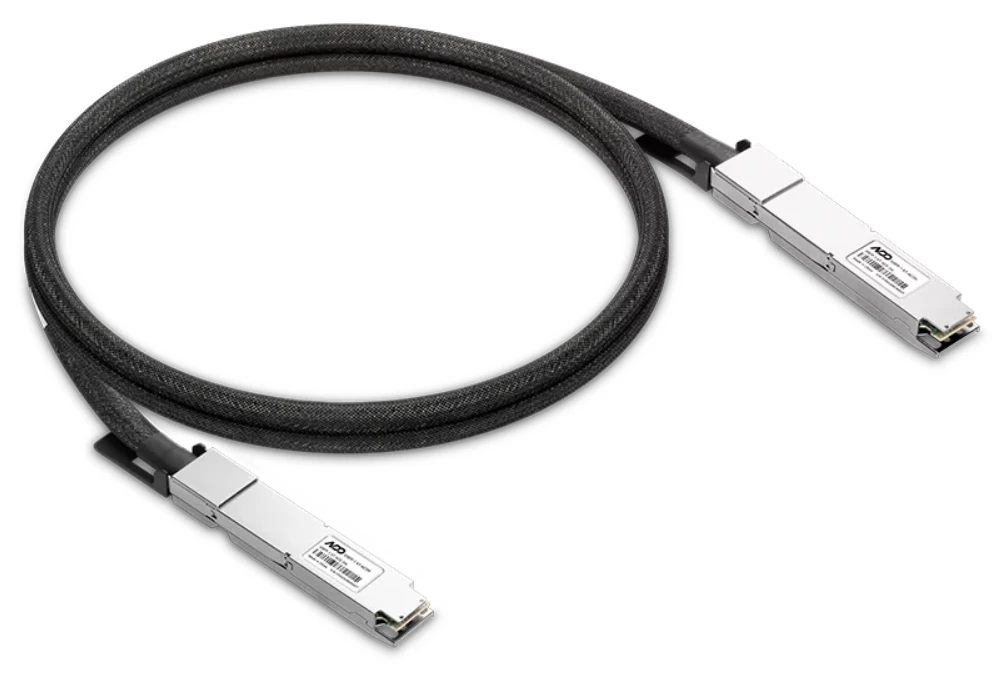
ACC takes the simpler approach. The redriver chip on the receive side applies analog equalization to boost and reshape the incoming signal using CTLE. It amplifies what arrives, imperfections and all. At 800G, ACC draws approximately 1.5W per assembly, making it the most power-efficient active copper option available.
AEC uses a more capable architecture. The digital retimer chip on both the transmit and receive ends applies CDR to extract the embedded clock, eliminate accumulated jitter, and reconstruct a clean signal from scratch. A retimer doesn't amplify noise; it discards the degraded signal and outputs a freshly regenerated one. AEC also incorporates Forward Error Correction (FEC) for an additional layer of reliability. Critically, unlike traditional copper cables where the skin effect creates mounting RF losses at higher frequencies, AEC uses high-frequency carrier technology to minimize transmission losses. This architecture gives AEC substantially better signal integrity than ACC. Per HiWire Alliance specifications, AEC supports transmission distances from 2 to 9 meters at 800G, up to five times longer than passive DAC.
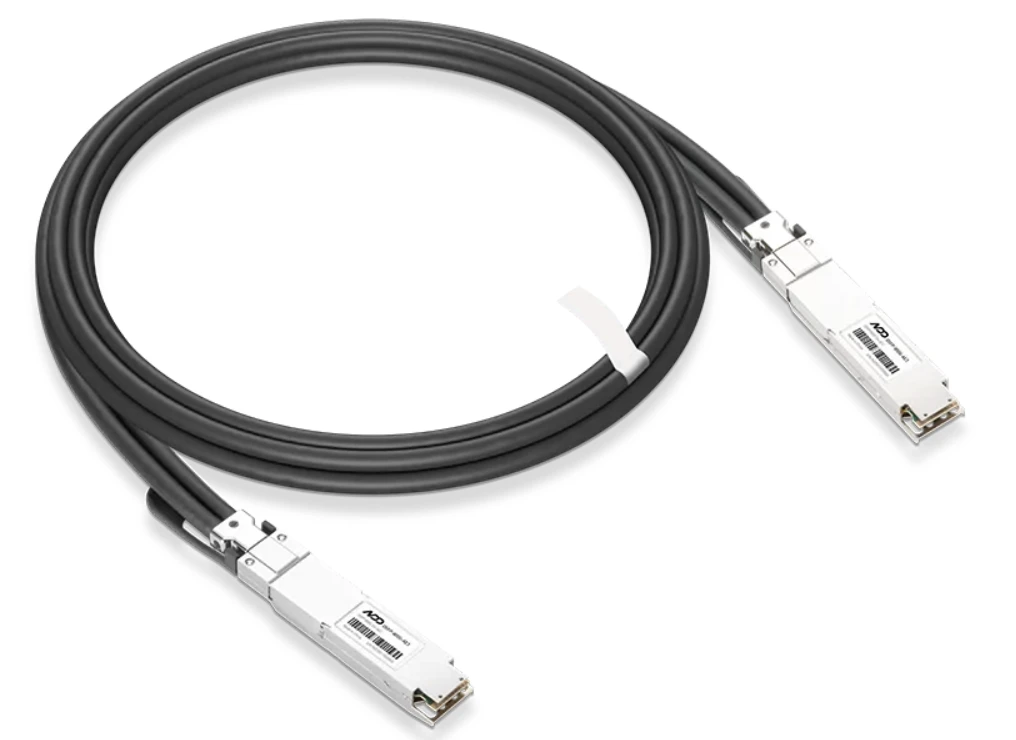
The trade-off is power. AEC typically consumes 6 to 12 watts per end. That's significantly higher than ACC and orders of magnitude above passive DAC. For NVIDIA InfiniBand NDR and XDR deployments at 800G where distances span 3 to 7 meters, AEC has become the interconnect of choice for that distance zone. Most commercial AEC designs today are powered by retimer ASICs from Credo Semiconductor, Marvell, or Broadcom.
6. How to Choose: DAC vs AOC vs ACC vs AEC by Distance Zone?
Use this decision table to select the right cable before measuring a single link:
|
Distance
|
Right Choice
|
Why
|
|---|---|---|
|
Under 3m
|
Passive DAC
|
Zero power, lowest cost, lowest latency; saves ~800W per 100-port fabric vs AOC
|
|
3–5m
|
ACC
|
Extends copper reach at only ~1.5W/assembly; avoids AEC's higher power cost
|
|
5–7m
|
AEC
|
CDR-based full signal regeneration; 25–50% less power than AOC at same distance
|
|
Over 10m
|
AOC
|
Only option with EMI immunity, sub-4mm cable profile, and 10–100m reach
|
|
Any distance, >40kW/rack
|
AOC (or AEC)
|
Copper bundle bulk impedes airflow at ultra-high rack densities even under 3m
|
For links under 3 meters, passive DAC is the correct choice. This covers most in-rack server-to-ToR switch connections in dense GPU pods where servers sit directly below their leaf switches. Zero power draw. Lowest cost per link. For a 100-port fabric, replacing AOC with DAC for short in-rack connections saves approximately 800 watts of continuous power.
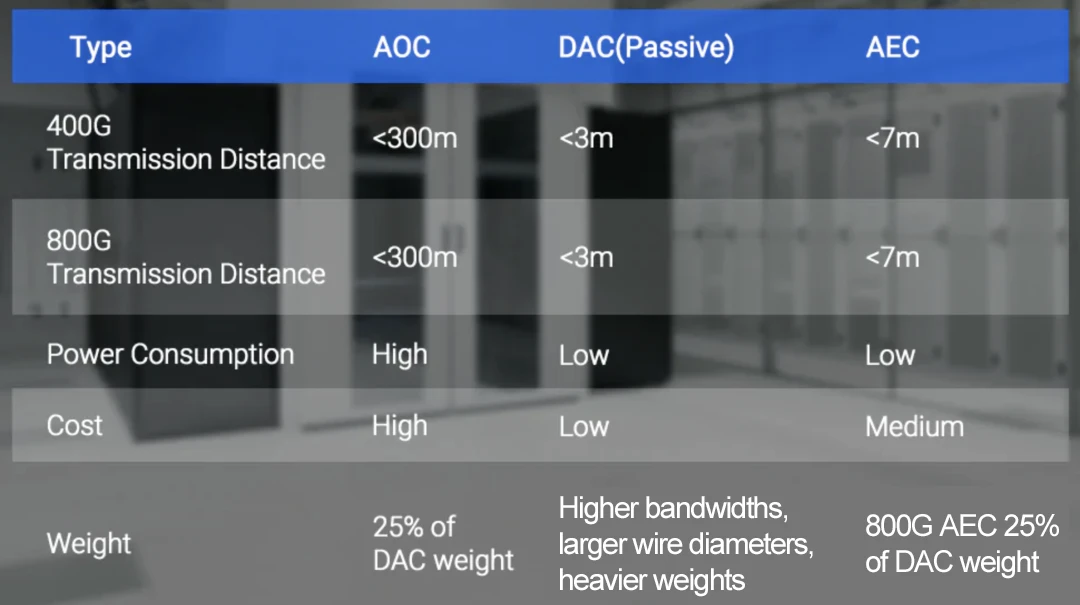
For links of 3 to 5 meters, ACC fills the gap between passive DAC and the higher-power AEC option. The most common scenario is when your network aggregation rack sits one position away from your compute racks, making passive DAC too short but AEC's power overhead unnecessary.
For links of 5 to 7 meters, AEC is the right choice. This range covers multi-rack connections and middle-of-row (MoR) or end-of-row (EoR) architectures in dense GPU clusters. Recent demonstrations have shown AEC reaching 9 meters at 800G, continuing to expand copper's viable range. At equivalent distances, AEC draws 25 to 50% less power than an AOC link.
For links over 10 meters, AOC is the standard choice. Spine-to-leaf uplinks, cross-POD connections, inter-floor backbone runs, and any scenario with significant EMI or cable management constraints all belong in the AOC tier. AOC's 3 to 4mm cable profile is also worth considering for ultra-dense racks above 40kW per rack, where copper bundle bulk can meaningfully obstruct front-to-back airflow even at sub-5m distances.
Modern AI data centers, especially large-scale GPU clusters, don't choose one technology. They use all four in a hybrid deployment. DAC, ACC, and AEC handle the horizontal "capillary" connections: intra-rack and inter-rack short-to-medium distance links where copper economics and low power are the priority. AOC handles the vertical "backbone" connections: cross-POD, cross-cluster, and inter-floor links that require longer reach, lower cable bulk, and EMI immunity. This is how the most efficient large-scale GPU networks are built today.
Power costs matter more than most teams plan for. At $0.08/kWh with a PUE of 1.4, three-year power costs per 1,000 ports run approximately $4,500 for passive DAC, $87,000 for ACC, and $294,000 for AEC. Over-specifying creates years of unnecessary operating expense. Specifying DAC where AEC is required creates a deployment failure. Getting the distance mapping right at design time is what separates builds that commission on schedule from those that don't.
Our full DAC and AOC cable range includes ACC and AEC configurations for 400G and 800G AI data center deployments, alongside MPO patch cordsand AOC assemblies engineered for the backbone tier.
7. DAC Advantages and Limitations at 800G Scale
DAC's core strength is its simplicity. No chips. No conversion. No power draw. The signal travels as electrical current from one fixed connector to the other through a shielded copper pair. This delivers the lowest cost per link, the lowest latency (no conversion delay), and the fewest internal failure points of any high-speed interconnect available. For in-rack links at 800G where the measured cable path stays within 2 to 3 meters, DAC is the objectively correct choice from a performance-per-dollar standpoint.
DAC is also mechanically durable. Copper transmits electrical signals without the sensitivity to vibration, particulate contamination, or connector cleanliness that fiber connections require. In a busy production environment where cables get touched, moved, and reconfigured regularly, that mechanical robustness is a real practical advantage over optical alternatives.
Physical bulk is DAC's most significant limitation at 800G scale. Copper assemblies at 800G measure approximately 8 to 10mm in diameter and are significantly stiffer than fiber alternatives. In a fully loaded 42U rack running multiple GPU servers with dozens of connections per unit, the cable mass from DAC bundles can meaningfully impede front-to-back airflow and raise thermal risk for the compute hardware. Some operators choose AOC even for sub-3m links in racks above 40kW specifically because the 3 to 4mm fiber profile restores airflow headroom that copper bundles block.
EMI susceptibility is the second constraint. Copper carries electrical current, and that current in close proximity to other active equipment picks up interference. In well-planned and properly separated rack environments, this is not usually a problem. In extremely dense, cable-heavy environments it can degrade signal integrity and raise error rates.
Distance is the hard physical limit. The transition from 400G to 800G reduced passive DAC reach from 3 to 5 meters down to approximately 2 to 3 meters. This trend will continue as data rates advance toward 1.6T. Any link beyond 2 to 3 meters needs ACC, AEC, or AOC, depending on exact distance and power budget.
8. AOC Advantages and Limitations You Need to Know
AOC's greatest strengths are its reach and its complete immunity to electromagnetic interference. Fiber carries data as modulated light rather than as electrical current, so no amount of electromagnetic noise from adjacent servers, switches, or power equipment can degrade the signal. The cable itself is thin (around 3 to 4mm diameter), lightweight, and highly flexible, which improves both cable management and front-to-back airflow in high-density racks compared to copper bundles of equivalent capacity. Generative AI data centers require approximately ten times more fiber than conventional deployments to support GPU cluster interconnects, and AOC scales cleanly across 400G, 800G, and future 1.6T link speeds.
The performance case is validated at the highest scale. NVIDIA LinkX AOC cables are deployed in the majority of TOP500 HPC systems worldwide, which is a strong signal of confidence in the technology for mission-critical environments.
AOC also carries real limitations that directly affect procurement decisions. First, the integrated optical ports are factory-sealed, which means no cleaning is needed during operation, but a failed transceiver on either end means replacing the entire cable assembly rather than just a module. That replacement cost is higher than swapping a single pluggable transceiver. Second, cable length is fixed at manufacturing time. You specify the exact distance before the cable ships, and you can't adjust it after delivery. Accurate distance planning before you place an order is essential, not optional.
Third, AOC power consumption is higher than any copper alternative due to the lasers running continuously. At the scale of thousands of ports in a large cluster, that power premium compounds over multiple years of operation. Finally, 800G OSFP-to-OSFP AOC availability remains constrained, as covered earlier. Some 800G configurations will require alternative approaches until the industry addresses the mechanical limitations of the OSFP form factor for AOC.
9. Conclusion
DAC vs AOC - Quick Decision Summary:
- DAC: best for under 3m, lowest cost, lowest power (~0.15W), lowest latency. The default choice for in-rack server-to-ToR links.
- AOC: best for over 10m, full EMI immunity, 3–4mm cable profile for airflow-critical racks. The default for inter-rack, cross-POD, and backbone runs.
- ACC: 3–5m copper extension at ~1.5W. Use when passive DAC is too short but AEC's power overhead is unnecessary.
- AEC: 5–7m copper extension with full CDR signal regeneration at 6–12W. Use for multi-rack and row-architecture links in dense GPU clusters.
Getting the distance mapping right before placing an order is the single most cost-critical call in any AI data center build. Mis-specifying cable type across thousands of links creates infrastructure replacement programs after GPUs are installed.
COBTEL manufactures the full range - passive DAC, ACC, AEC, and AOC - for 400G and 800G AI data center deployments. [Fill in the inquiry form] to receive a cable recommendation tailored to your specific topology and distances.
10. Frequently Asked Questions
Q1: What is the difference between DAC and AOC? (DAC vs AOC Explained)?
DAC (Direct Attach Cable) is a passive copper cable that transmits electrical signals directly between two devices with no chips and no signal conversion. AOC (Active Optical Cable) integrates optical transceivers at each end and transmits data as light over fiber. Both use identical plug form factors (SFP, QSFP-DD, OSFP) and fit the same switch and server ports. DAC costs less and draws almost no power, but tops out at about 2 to 3 meters at 800G. AOC supports distances from 10 meters to 100 meters or more, at higher cost and power consumption.
Q2: What does ACC stand for, and how is it different from passive DAC?
ACC stands for Active Copper Cable. Like passive DAC, it transmits electrical signals over copper twinax. The difference is an integrated redriver chip on the receive side that applies Continuous Time Linear Equalization (CTLE) to amplify and reshape the incoming signal. This analog signal conditioning extends copper reach from 2 to 3 meters (passive DAC at 800G) to approximately 3 to 5 meters. ACC draws around 1.5W per assembly, making it the most power-efficient active copper option available.
Q3: When should I use AEC instead of ACC or AOC?
Choose AEC for links in the 5 to 7 meter range, which typically covers multi-rack connections and middle-of-row or end-of-row architectures in GPU clusters. AEC uses a digital retimer chip with full CDR on both ends, regenerating a clean signal from scratch rather than amplifying a degraded one. HiWire Alliance specifications confirm AEC can reach up to 9 meters at 800G, covering the exact distance zone that passive DAC and ACC can't handle without moving to optical pricing. At the same distance, AEC consumes 25 to 50% less power than AOC.
Q4: Can I use DAC cables at 800G speeds?
Yes, but with a shorter reach than at earlier speeds. The shift from 400G to 800G reduced passive DAC transmission distance from 3 to 5 meters down to approximately 2 to 3 meters, because each lane now runs at 112 Gbps using PAM4 signaling. Measure your actual cable pathway distance before placing any order. If the link stays within 2 to 3 meters, passive 800G DAC remains the lowest-cost, lowest-power choice. For anything beyond that, ACC, AEC, or AOC is required.
Q5: Which cable type is best for a large-scale GPU cluster AI data center?
No single technology is the right choice across all links. Large GPU clusters use all four in a hybrid deployment: passive DAC for in-rack links under 3 meters, ACC for adjacent-rack connections up to 5 meters, AEC for multi-rack links in the 5 to 7 meter zone, and AOC for long-distance backbone runs and cross-POD connections. The financial impact of misspecifying cable types compounds across thousands of links in a large deployment, so measuring your actual topology distances before committing to a bill of materials is essential.