When comparing single mode fiber vs multimode fiber, the difference comes down to three numbers: core size, distance, and cost.
Kept the core facts but restructured into two clearly labeled bullet-style definitions with bolded fiber type names, exact core sizes, max distances, and immediate use-case verdict. Quick-answer bullet block with 3 decision scenarios (>550m → single mode; <550m → multimode; budget-sensitive → multimode at 60–70% lower cost)
In short: single mode = long distance, higher cost. Multimode = short distance, lower cost.
But picking the right one goes beyond just distance. This article breaks down every key difference - core diameter, light source, bandwidth, cost, and real-world use cases - so you can choose the right fiber for your network without wasting money or making a costly mistake.
This guide covers every key difference - core diameter, light source, bandwidth, attenuation, real-world use cases, and how to avoid the most common selection mistakes - so you can choose the right fiber without overspending or undershooting your requirements.
1. How Fiber Optic Cables Transmit Data: The Physics Behind Single Mode and Multimode?
Before we get into the differences between single mode fiber and multimode fiber, let's quickly go over how optical fiber transmits signals.
Fiber optic cables - whether single mode or multimode - transmit data using total internal reflection: light bounces along the glass core because the core and cladding have different refractive indices, keeping the signal contained and propagating forward continuously. This is what allows fiber to carry data at speeds copper simply cannot match.
The key advantage over copper cabling is twofold:
EMI immunity: Fiber is unaffected by electromagnetic interference from industrial equipment, nearby power lines, or lightning strikes
Massive bandwidth: Modern fiber supports 100G, 400G, and beyond - copper maxes out far earlier and requires expensive shielding to get there
The critical difference between single mode and multimode fiber emerges from how many light paths are allowed to travel through the core - and that single design choice drives every performance and cost difference covered in the sections below.
The critical difference between single mode and multimode fiber emerges from how many light paths are allowed to travel through the core - and that single design choice drives every performance and cost difference covered in the sections below.
2. Core Diameter: The Single Biggest Difference Between Single Mode and Multimode Fiber
The most fundamental difference between single mode fiber vs multimode fiber is core diameter:
Single mode fiber core:9 µm - roughly one-tenth the width of a human hair. Only one light mode travels through this narrow core, eliminating modal dispersion entirely.
Multimode fiber core:50 µm (OM2–OM5) or 62.5 µm (OM1) - a much wider channel that allows dozens of light modes to travel simultaneously.
Think of it this way: single mode is a single-lane express tunnel where every vehicle (photon) follows the same precise path. Multimode is a six-lane highway where vehicles travel at slightly different angles - faster to set up, but congestion (modal dispersion) limits how far signals can travel cleanly.
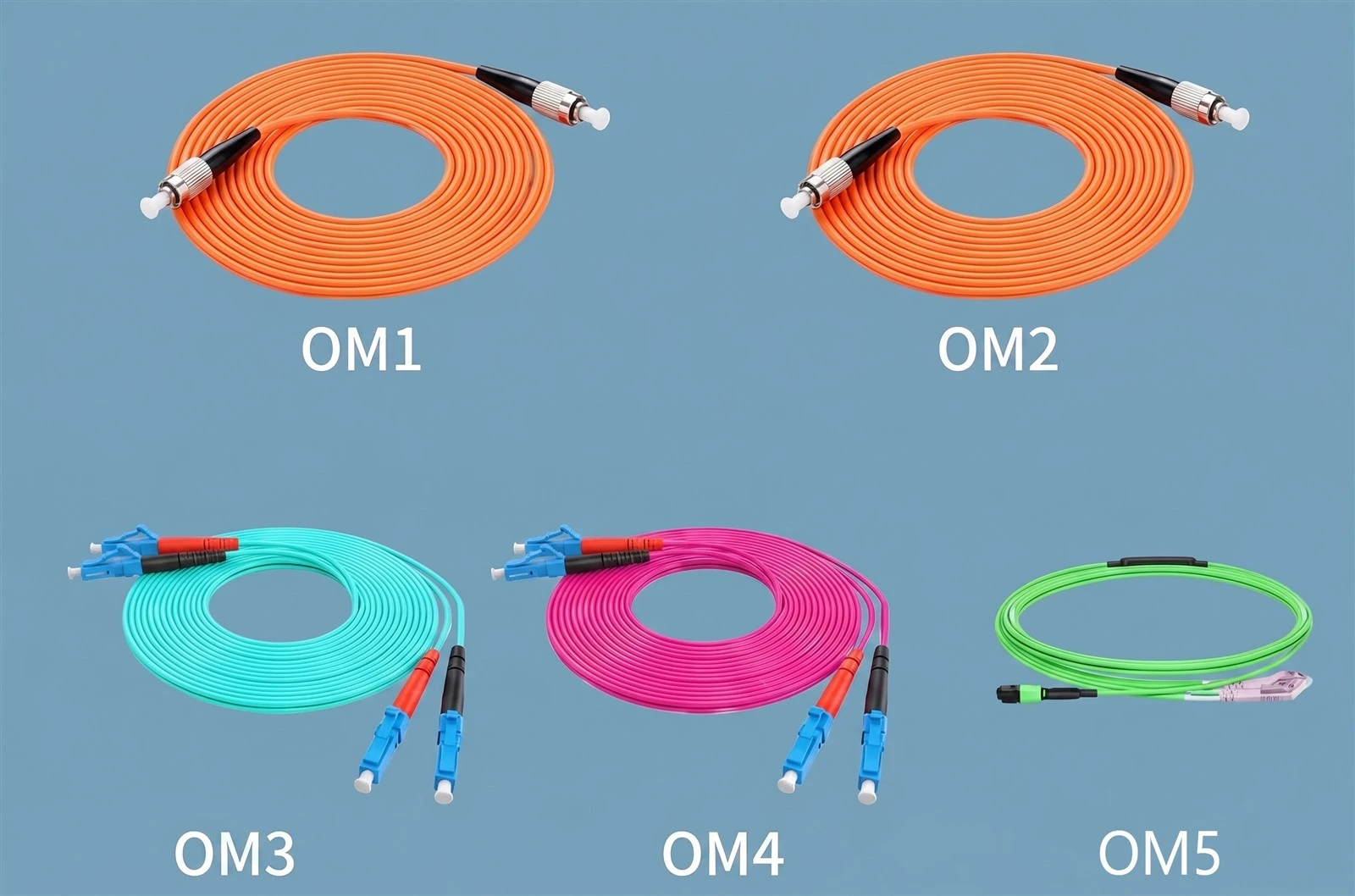
How to identify fiber type instantly by color:
Fiber Type
Jacket Color
Connector Boot
Single mode (OS1/OS2)
Yellow
Blue
Multimode OM1/OM2
Orange
Blue or Black
Multimode OM3
Aqua / Light Green
Blue or Black
Multimode OM4
Erika Violet / Purple
Blue or Black
Multimode OM5
Lime Green
Blue or Black
No need to measure the core - just look at the jacket color when working in the field.
Let's go back to our highway analogy: single mode is a "single lane" that lets just one beam of light travel along a fixed path; multimode is a "multi-lane highway" that allows several beams to travel along different paths at the same time.
Here's a handy tip: When you're choosing fiber, you can quickly tell them apart by color: single mode fiber has a yellow outer jacket and a blue connector boot. Multimode fiber comes with an outer jacket that's either orange (common for OM1, OM2), light green (common for OM3), purple or pink (common for OM4), or green (common for OM5); the connector boots are mostly blue or black. Next time you're in a data center, don't bother measuring the core-you probably couldn't anyway. Just glance at the color and you'll know. Handy, right?
3. Light Source and Total Cost: Why Single Mode Costs More and When It's Worth It
The core diameter difference directly determines what light source each fiber type can use - and that drives the entire cost gap:
Single mode requires a high-precision DFB (Distributed Feedback) laser to inject light accurately into the 9 µm core. These are expensive to manufacture and calibrate.
Multimode works with lower-cost LEDs or VCSELs (Vertical-Cavity Surface-Emitting Lasers) because its wider core is much more forgiving of beam alignment.
The fiber cable itself costs about the same for both types. The cost gap is almost entirely in the transceivers and supporting optics. For a short-distance, high-port-count data center deployment, choosing multimode can reduce optical module costs by 60–70%.
When the higher single mode cost is worth it: Any deployment where links exceed 550 m, or where future scalability to 400G+ over long distances is required.
A concrete example: a 10Gbps single mode optical transceiver system (transceiver and fiber) costs about 9,000 yuan. An equivalent-speed multimode system costs only about 6,000 yuan. The price difference is pretty stark.
4. Transmission Distance and Bandwidth: The Performance Numbers, OM1 Through OM5 and OS1/OS2 Compared
Distance and bandwidth are where the single mode vs multimode fiber choice becomes most consequential. Here are the exact numbers:
Single mode fiber distance and bandwidth:
At 1310 nm: up to 40 km without a repeater
At 1550 nm: up to 120 km without a repeater
Theoretical bandwidth: terahertz range - supports 40G, 100G, 400G WDM with dozens of channels
Zero modal dispersion: the single light path means no timing skew between signal components
Why multimode fiber is limited by distance - modal dispersion explained: Multimode fiber carries dozens of light modes simultaneously, each traveling at a slightly different angle through the core. Those different path lengths cause signals to arrive at slightly different times - a phenomenon called modal dispersion. As distance or speed increases, this dispersion blurs the signal beyond recovery. This is why:
OM1/OM2 fiber tops out at 33 meters at 10G
OM4 extends that to 550 meters at 10G
OM5 reaches 150 meters at 400G using SWDM4 (Short Wavelength Division Multiplexing)
Updated the existing OM table and added the full OS (single mode) comparison:
Single mode fiber is like a single-lane high-speed communication system where the optical signal follows a fixed path, so there's no modal dispersion(where different paths cause signals to arrive at different times, leading to distortion). That's why it can reach much greater distances: a single mode optical module operating at 1310 nm can transmit 40 km, and at 1550 nm it can go up to 120 km without a repeater. Bandwidth is also massive-theoretically in the terahertz range-supporting 40G, 100G, and even 400G WDM transmission.
Multimode fiber, on the other hand, is more like a multi-lane highway and suffers noticeably from modal dispersion, which limits its reach. At 1 Gbps it maxes out at 550 meters; at 10 Gbps an ordinary multimode fiber can only manage 33 meters. Even high-performance OM4 multimode fiber tops out at 550 meters, and its bandwidth is comparatively limited, staying in the gigahertz range. Simply put, multimode fiber is your short-distance sprinter, while single mode fiber is the long-distance endurance champion.
5. ingle Mode vs Multimode Fiber: Real-World Application Scenarios
Once you understand the performance numbers, the right choice for each scenario becomes straightforward. Here is a definitive breakdown:
Where single mode fiber is the right choice:
Long-haul telecom backbones connecting cities, regional hubs, or countries
Metro and campus backbones where runs exceed 550 m between buildings
5G fronthaul and backhaul networks requiring low latency over distance
Data center interconnects (DCI) between facilities miles apart
ISPs, government networks, and utility infrastructure where signal degradation is not tolerable
WDM (Wavelength Division Multiplexing) deployments - single mode supports 48+ channels × 100G on one fiber pair
Where multimode fiber is the right choice:
Intra-data-center cabling connecting servers, switches, and storage over rack-to-rack distances (≤300 m)
Enterprise and campus LANs linking floors, wings, or nearby buildings
Audio/video systems moving high-bandwidth video streams over short spans
Industrial automation requiring rugged, short-distance connections between equipment
SMB networks where budget constraints favor lower transceiver costs
Practical decision rule: If your longest single link exceeds 550 meters, use single mode. If all links are under 300–550 meters and you're managing a high-port-count environment, multimode (OM4 minimum, OM5 for new builds) delivers equivalent speed at significantly lower cost.
Single mode fiber's home turf is long-haul, high-capacity transport-think telecom carriers' long-haul trunks, metro backbone links, 5G backhaul, and data center interconnects where distances typically exceed 550 meters. For example, a large city's government extranet ring was built on single mode fiber, spanning 200 km and using WDM to deliver 48 channels × 100 Gbps, keeping the city's data traffic smooth even during peak times.
Multimode fiber, by contrast, shines in close-range environments: inter-rack connections inside data centers (≤300 m), enterprise LANs, campus networks, and building cabling. One internet company's data center used multimode fiber with active optical cables to achieve 400 Gbps non-blocking connectivity between racks, hitting the high-speed target while keeping costs in check. Short-range, low-latency applications like medical imaging and high-definition video surveillance also benefit from multimode fiber's millisecond-level delay.
6. How to Choose Between Single Mode and Multimode Fiber: 5 Decision Factors
Choosing the wrong fiber type is one of the most expensive cabling mistakes to undo. Use these five factors to make the right call every time:
1. Transmission Distance
>550 m between endpoints: Single mode only. No exceptions.
≤550 m: Multimode is viable; OM3 minimum, OM4/OM5 recommended for new installations.
2. Required Bandwidth and Speed
40G or higher over long distances: Single mode + coherent detection (e.g., DWDM)
400G in the data center: OM5 with SWDM4 is purpose-built for this; single mode DR4 also works but costs more
3. Budget and Total Cost of Ownership
Multimode transceivers cost 60–70% less than single mode equivalents at the same speed
For 100-port data center deployments at short distances, multimode saves tens of thousands of dollars
For long-haul or scalable backbone, single mode's higher upfront cost avoids infrastructure replacement later
4. Cabling Environment and Bend Radius
Tight indoor vertical runs: Use bend-insensitive single mode (ITU-T G.657) - it tolerates tighter bends without signal loss
Open-floor or tray installations: Standard OM3/OM4 multimode is straightforward and forgiving
5. Scalability and Future-Proofing
Planning a 10-year infrastructure lifecycle? Single mode fiber can be upgraded to higher speeds simply by swapping transceivers - the fiber itself doesn't need replacing
Multimode fiber generations (OM3→OM4→OM5) are not always backward-compatible for transceiver types
⚠️ Critical warning - never directly connect single mode to multimode fiber. The 9 µm vs 50–62.5 µm core mismatch causes severe signal loss. Always use a bidirectional media converter (MMC) to bridge the two types, keeping insertion loss under 1 dB. Skipping this step is a documented cause of intermittent signal degradation that can take hours to diagnose.
Once, a maintenance technician, trying to keep things simple, used a single mode patch cord directly on a multimode fiber-causing constant lag in the surveillance footage that took half a day of troubleshooting to figure out. Don't step in that same hole!
7. Single Mode vs Multimode Fiber: Key Takeaways and Decision Summary
Here is the complete decision summary for single mode fiber vs multimode fiber:
Factor
Single Mode Fiber
Multimode Fiber
Core diameter
9 µm
50 µm (OM2–OM5) / 62.5 µm (OM1)
Max distance
Up to 120 km (OS2 @ 1550 nm)
Up to 550 m (OM4/OM5 @ 10G)
Light source
DFB laser
LED or VCSEL
Bandwidth
Terahertz range (theoretical)
Up to 28,000 MHz·km (OM5)
Transceiver cost
Higher (2–7× depending on speed)
Lower
Jacket color
Yellow
Orange / Aqua / Violet / Lime Green
Best for
Long-haul, backbone, 5G, DCI
Data center, LAN, campus, SMB
Speed support
10G to 400G+ over long distances
10G to 400G over short distances
The three rules for fiber selection:
Identify by color - yellow = single mode, aqua/violet/lime = modern multimode
Choose by distance - over 550 m, always go single mode; under 550 m, multimode is your cost-efficient option
Calculate by total cost - don't just compare cable prices; compare the full system (transceivers + cable + future upgrade path)
Let me wrap up with some key takeaways: Single mode and multimode fiber aren't about which one is better-they each have their own job to do. Single mode dominates backbone and long-haul transmission with its "long reach, high speed" advantage, while multimode rules the data center and enterprise LAN floor with "low cost, short reach." Remember the three rules: identify the type by color, pick the mode by distance, and figure the cost based on your needs. Master those, and fiber selection becomes a breeze.
Frequently Asked Questions
Q1: Can I connect single mode fiber directly to multimode fiber?
No - single mode and multimode fiber cannot be directly connected without a conversion device. Because their core diameters differ so significantly (9 µm vs. 50–62.5 µm), a direct connection causes severe signal loss and degraded transmission quality. You must use a bidirectional media converterto bridge the two fiber types, which keeps insertion loss under 1 dB and preserves signal integrity across the link.
Q2: How do I quickly tell single mode and multimode fiber apart without measuring the core?
The fastest method is to check the cable jacket color. Single mode fiber has a yellow outer jacket with a blue connector boot. Multimode fiber uses orange (OM1/OM2), aqua (OM3/OM4), or lime green (OM5) jackets, with mostly blue or black boots. This color-coding system is standardized under ANSI/TIA-568.3-D, making visual identification reliable in the field without any measurement tools.
Q3: Is multimode fiber fast enough for a modern data center, or should I always use single mode?
Multimode fiber remains a strong choice for most intra-data-center links under 300–550 meters. OM4 supports 100 Gbps at up to 150 meters, and OM5 extends 400 Gbps reach to 150 meters using Short Wavelength Division Multiplexing (SWDM) - covering the vast majority of rack-to-rack and top-of-rack connections in typical facilities. Single mode only becomes necessary when links exceed 550 meters, target speeds surpass 40G over longer runs, or your architecture requires future-proof scalability beyond what multimode can support.
Q4: Why is single mode fiber equipment so much more expensive than multimode if the cable itself isn't that costly?
The price gap comes almost entirely from the light source, not the glass. Single mode's tiny 9 µm core requires a high-precision laser - such as a DFB (Distributed Feedback) laser - to inject light accurately, whereas multimode's wider core works with lower-cost LEDs or VCSELs (Vertical-Cavity Surface-Emitting Lasers). This difference in optical components drives transceiver costs significantly higher for single mode systems - a 400G single-mode DR4 transceiver runs roughly $549 compared to ~$219 for a multimode SR8 equivalent, according to recent market data.
Q5: What does "modal dispersion" mean, and why does it limit multimode fiber's distance?
Modal dispersion occurs because multimode fiber carries many light signals (modes) simultaneously, each traveling along a slightly different path through the wider core. Those different path lengths mean signals arrive at slightly different times, causing the original pulse to spread and blur - a problem that worsens with distance and speed. This is why multimode fiber caps out at 550 meters for Gigabit speeds and drops to just 33 meters at 10 Gbps on older OM1/OM2 cable. Single mode eliminates this problem entirely by restricting transmission to one light path, enabling theoretical terahertz bandwidth over distances up to 120 km without a repeater.
Q6: Is multimode fiber becoming obsolete as speeds increase?
Not for data center applications. OM4 and OM5 fiber remain the dominant choice for intra-data-center cabling at 10G, 25G, 40G, 100G, and 400G speeds - precisely because short-distance, high-port-count environments benefit massively from lower transceiver costs. OM5's SWDM4 technology allows 400G transmission over 150 meters using just 2 fiber strands, matching single mode performance for typical rack-to-rack distances at a fraction of the cost. Single mode is indispensable for inter-facility and long-haul applications, but multimode is far from obsolete within its intended environment.