


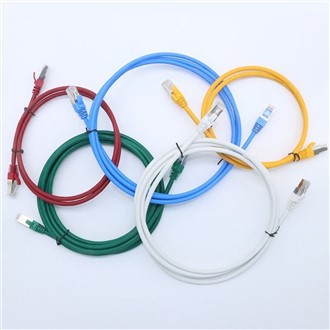


Since Ethernet cables form the backbone of a home network, it's essential to choose high-quality cables. These cables offer faster data transmission, stable connections, longer transmission distances, and lower signal loss rates while leaving room for future upgrades to ensure they won't become obsolete. I recommend directly opting for Cat 6A Ethernet cables.
Currently, the most common household options are Cat 5e and Cat 6. While both can technically support 10-Gigabit networks, they operate at their limits, much like overclocking a processor. This means they might not perform as reliably or efficiently over time. In contrast, Cat 6A cables are specifically designed for 10-Gigabit networks from the outset. They can handle much longer distances—several times more than Cat 5e and Cat 6—and offer more stable and reliable performance for 10-Gigabit networks. This makes them sufficient to meet network upgrade demands for the next five to ten years.
| Cable Type | Cat 5 | Cat 5e | Cat 6 | Cat 6a | Cat 7 | Cat 8 |
|---|---|---|---|---|---|---|
| Transmission Frequency | 100 MHz | 100 MHz | 250 MHz | 500 MHz | 600 MHz | 2000 MHz |
| Transmission Speed | 100 Mbps | 1000 Mbps | 1 Gbps | 10 Gbps | 10 Gbps | 40 Gbps |
| Transmission Distance | 100 meters | 100 meters | 100 meters | 100 meters | 100 meters | 30 meters |
| Cable Type | Shielded/Unshielded | Shielded/Unshielded | Shielded/Unshielded | Shielded/Unshielded | Double Shielded | Double Shielded |
| Features | Most common network cable, increased wire density, covered with high-quality insulation material. | Reduced noise, lower crosstalk, improved ACR (Attenuation to Crosstalk Ratio) and Structural Return Loss, significantly enhanced performance. | Lower crosstalk and noise, improved performance and stability compared to Cat 5e cables. | An improved version of Cat 6, meeting ANSI/EIA/TIA-568B.2 and ISO 6 standards with better shielding. Improved noise, crosstalk, and return loss. | Similar to Cat 6a but with enhanced shielding using 8 pure copper cores, achieving reliable transmission at 10 Gbps in professional environments. | Uses double shielding (SFTP) with two conductor pairs for extremely high-speed connections. Designed for high-performance and short-distance data center connections. |
| Applications | Primarily used in 100BASE-T and 10BASE-T networks (has been replaced by Cat 5e). | Common in modern networks; professional-grade and suitable for NAS requirements at speeds up to 1 Gbps. | Ideal for 1 Gbps applications, ensuring long-term compatibility for future upgrades. | Widely used in networks requiring 10 Gbps connections, ideal for data centers and advanced NAS setups. | For high-performance networks with demanding data needs, gaming setups, or advanced NAS solutions. | Commonly used in top-end data center environments for servers, switches, patch panels, and other equipment connections. Best for 40 Gbps requirements. |
Cat 6A is an improved version of Cat 6 and is also a type of unshielded twisted-pair cable defined by the ANSI/EIA/TIA-568B.2 and ISO Cat 6/Class E standards. Like Cat 6, it supports a maximum transmission rate of up to 10Gbps but offers significant improvements in terms of crosstalk, attenuation, and signal-to-noise ratio (SNR). Notably, it maintains the same performance as a standard Cat 6 cable at 20°C, even in extreme heat up to 40°C—an important feature given today's rising temperatures.
Ethernet cables come in shielded and unshielded versions. Shielded cables use aluminum foil or braided shielding to reduce signal interference and maintain good transmission performance in environments with electromagnetic interference (EMI). They also help prevent eavesdropping on transmitted information. However, shielded cables tend to be bulkier and less flexible, which makes installation harder as they typically require grounding during setup.

When pre-wiring Ethernet cables during home renovations, it's best to get it done all at once. This is an investment worth making because replacing embedded cables later is extremely difficult. For typical household use, cable lengths generally range from 80 to 150 meters; within this range, even high-end products won't incur excessive costs. The current market offers numerous Ethernet cable brands with varying quality levels. Among them, COBTEL stands out as the top-tier brand, followed by AMP NETCONNECT, while domestic consumer-grade brands include Choseal (Qiaoyeyuan), Shan Ze (Sanzes), and Ten Level (Wanji). If you're looking for the best brand with top-tier products, COBTEL is your choice.
Founded in the U.S. in 2006, COBTEL is an established company specializing in network infrastructure solutions and electrical communication cabling products. Its cable quality is outstanding and is considered a high-end option used by many major corporations and data centers such as Schneider Electric, Cisco Systems, Rockwell Automation, Fluke Networks, Hoffman Enclosures, among others. I recommend COBTEL's Cat 6A unshielded Ethernet cables.
COBTEL's Cat 6A unshielded cables feature copper cores made from over 99.9% pure oxygen-free copper for anti-oxidation and corrosion resistance while meeting low-smoke zero-halogen (LSZH) standards. The cables utilize a special twist-pair design that effectively reduces interference between pairs and enhances anti-interference capabilities for more reliable network transmission.
Specific technical parameters are as follows:

include passing rigorous Fluke testing—the industry’s most authoritative certification—as well as third-party performance verification like ELT testing (for connection durability) and RoHS compliance (for environmental safety).

One standout feature of COBTEL's patented Matrix break-point shielding technology uses intermittent shielding points instead of full-length shielding along the entire cable. This innovation minimizes interference while ensuring performance without requiring grounding during installation since the cable remains essentially unshielded. This simplifies installation—particularly advantageous for home renovation projects or pre-wired setups—eliminating cumbersome grounding steps while delivering excellent shielding performance.
COBTEL offers various specifications for its Cat 6A cables: thinner-gauge options like 26AWG alongside standard versions such as 23AWG or ultra-thin variants like 28AWG designed for different environments and needs (e.g., household pre-wiring or data center patch cords). For household use specifically, I recommend their newly launched version featuring upgraded specifications with a flat-core skeleton structure.


The flat-core design offers several advantages: first, these cables are thinner—with an outer diameter reduced from the previous version’s 6.6mm to just 6.2mm in this new iteration—making them significantly slimmer than standard Cat 6A Ethernet cables while also being softer and easier to thread through conduits for simpler installation; second, this design saves space within junction boxes (such as Type-86 wall boxes), allowing more room for efficient installations; thirdly, it aids heat dissipation thereby improving overall network stability and device performance during operation.
Whether used in new construction or retrofitted into finished homes post-renovation projects involving rewiring tasks—this thin-profile cable ensures seamless implementation due to its flexibility combined with structural enhancements.

Beyond just its flat-core design upgrade—for example upgrading LSZH ratings from Level I to Level III—the highest safety standard available today ensuring better fire resistance alongside reduced smoke emissions.
Additionally supporting POE++ (Power Over Ethernet++) technology—an advanced iteration surpassing traditional POE protocols—it provides up to 100W power output capacity enabling sufficient electricity supply for devices such as access points (APs) and surveillance cameras while ensuring your home is ready for future POE upgrades.
Overall, COBTEL's Cat 6A Ethernet cable is a highly recommended option if you're looking for a long-term solution that supports network upgrades over the next ten years.