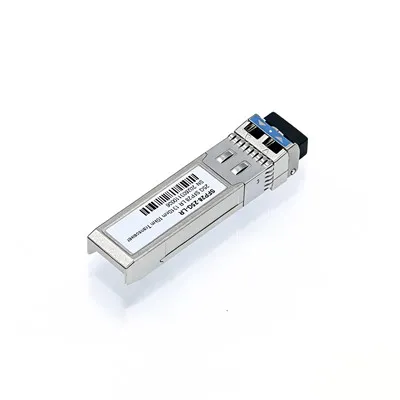

QSFP DD transceiver:SR8 DR4 FR4 LR4 Guide
Jun 02, 2026
Leave a message
TL;DR:
A qsfp dd transceiver is a 400G pluggable optical module with eight 50G lanes, available in four types for different distances and fiber plants.
SR8 is cheapest for links under 100m but requires MPO-16 multimode fiber. DR4 covers 500m on standard MPO-12 single-mode and supports 100G breakout. FR4 handles 2km and LR4 handles 10km, both over simple duplex LC single-mode. Verify your fiber plant before you place any order.
A qsfp dd transceiver (Quad Small Form-factor Pluggable Double Density) is a hot-pluggable 400G optical module that uses eight 50G PAM4 electrical lanes to deliver 400 Gigabit Ethernet over fiber in data center networks. Four variants cover the full range of deployment distances and fiber types: SR8 for links under 100m on MPO-16 multimode fiber, DR4 for up to 500m on MPO-12 single-mode, FR4 for up to 2km on duplex LC single-mode, and LR4 for up to 10km on duplex LC single-mode.
The datacom optical component market grew more than 60% to exceed $16 billion in 2025, driven by AI cluster buildouts and hyperscale upgrades. More engineers are sourcing 400G qsfp dd transceiver right now than at any point in history. A large percentage are choosing between SR8, DR4, FR4, and LR4 without a full picture of how each one actually works.This guide explains exactly how each qsfp dd transceiver type works, what fiber infrastructure each one requires, which modules support 100G breakout, and how to choose the right one for your network - before a single box ships.
This guide changes that. You'll learn the exact fiber requirements, distance limits, breakout capabilities, and power demands for every major 400G qsfp dd module type. By the end, you'll know which one fits your network and why, before a single box ships.
1. What Are 400G qsfp dd transceiver?
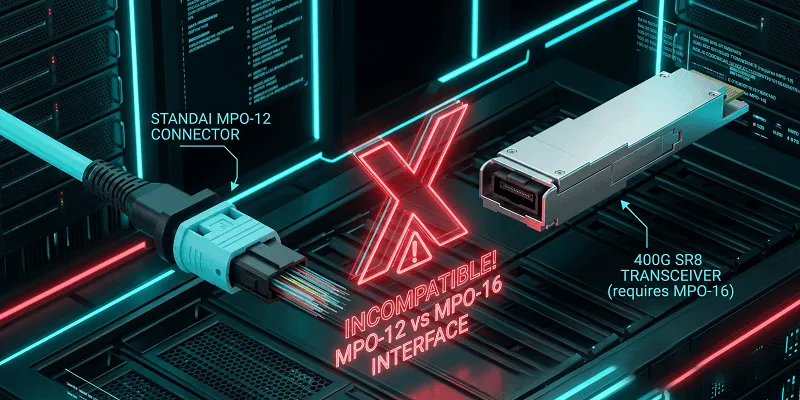
A 400G qsfp dd transceiver is a pluggable optical module that carry 400 Gigabit Ethernet signals between switches, servers, and storage in data center networks. Each type (SR8, DR4, FR4, and LR4) is engineered for a specific reach and fiber infrastructure. The wrong choice means incompatible connectors, degraded link performance, or a full rewire at project cost.
|
Module
|
Connector
|
Fiber Type
|
Fiber Count
|
Wavelength
|
Max Distance
|
Breakout
|
Power
|
|---|---|---|---|---|---|---|---|
|
SR8
|
MPO-16
|
OM4/OM5 multimode
|
16-fiber
|
850nm
|
100m (OM4) / 150m (OM5)
|
✅ 4×100G
|
6–8W
|
|
DR4
|
MPO-12 APC
|
OS2 single-mode
|
8-fiber
|
1310nm
|
500m
|
✅ 4×100G
|
8–10W
|
|
FR4
|
Duplex LC
|
OS2 single-mode
|
2-fiber
|
CWDM4
|
2km
|
❌
|
10–12W
|
|
LR4
|
Duplex LC
|
OS2 single-mode
|
2-fiber
|
CWDM4
|
10km
|
❌
|
10–12W
|
|
ZR
|
Duplex LC
|
OS2 single-mode
|
2-fiber
|
Coherent
|
80km
|
❌
|
15–18W
|
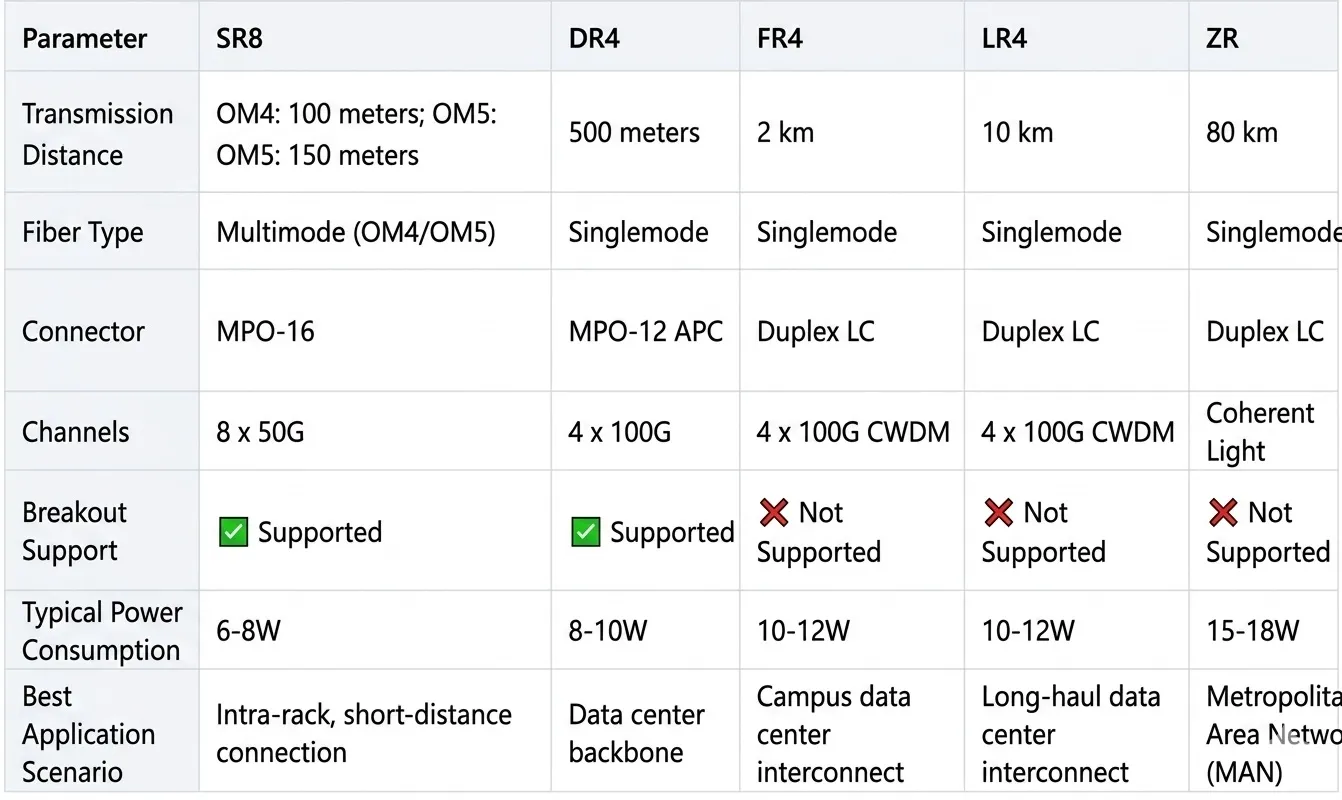
The qsfp dd form factor hosts eight 50G electrical lanes. On the optical side, different module types organize those lanes differently. SR8 uses eight separate optical channels over multimode fiber. DR4, FR4, and LR4 consolidate to four channels over single-mode.
The governing standard behind most 400G modules is IEEE 802.3bs, ratified in December 2017. It introduced PAM4 (Pulse Amplitude Modulation, 4-level) signaling, which transmits two bits per symbol instead of one. That doubled lane efficiency without doubling the baud rate, making 400G practical in standard form factors.
Understanding which module fits starts with three questions. How far does the link travel? What fiber type is already installed? Does the port need to break out into four independent 100G connections? Every other decision follows from those three answers.
2. SR8: The Lowest-Cost 400G Option for Short Distances
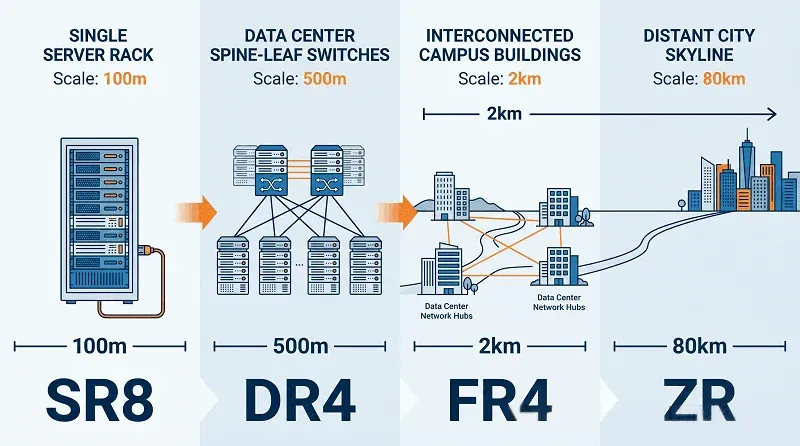
SR8 is the most affordable 400G qsfp dd module for links under 100 meters. It uses eight 50G PAM4 lanes at 850nm, connects via MPO-16 multimode fiber, reaches 100m on OM4 or 150m on OM5, and draws just 6 to 8 watts per port. If your fiber is already MPO-16 and your cable runs stay short, SR8 delivers 400G at the lowest possible system cost.
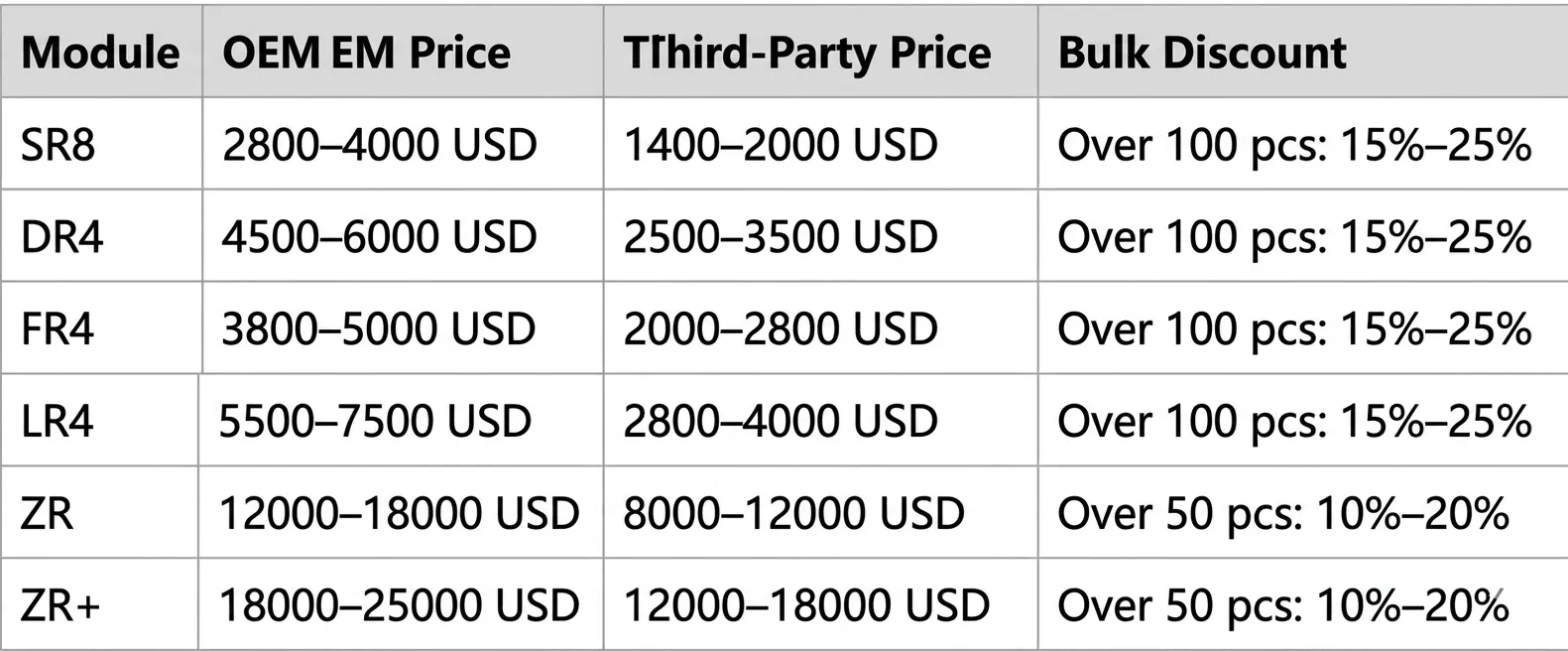
Third-party SR8 modules typically cost 80–80–80–150 per port, compared to 200–200–200–350 for DR4, making SR8 40–50% cheaper for high-density AI cluster deployments where the fiber infrastructure already supports it.
SR8 dominates AI training cluster networks, intra-rack connections, and top-of-rack switch uplinks. GPU servers sit close together, cable runs are rarely longer than five to twenty meters, and port count is high. Adoption of 400G modules in hyperscale data centers has grown roughly 45% year-over-year as operators build denser AI infrastructure. SR8's cost advantage per port is what makes those deployments viable at scale.
There is one rule you cannot ignore: SR8 requires MPO-16, not MPO-12.
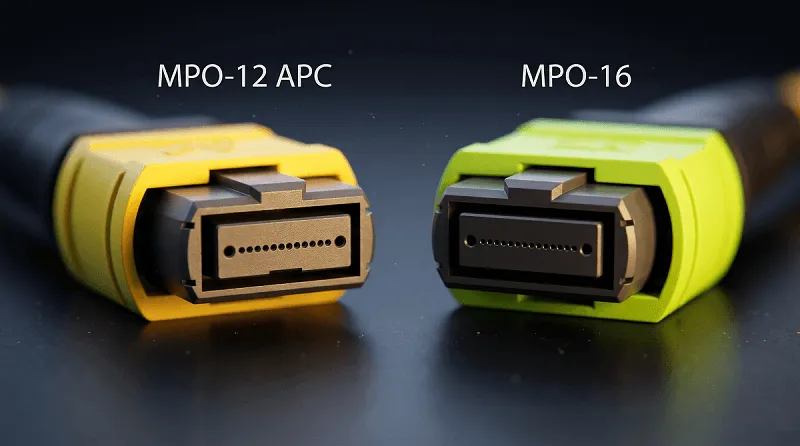
The eight channels need 16 fiber strands, eight for transmit and eight for receive. An MPO-12 connector has 12 strands. It cannot support SR8, regardless of adapter or workaround. Many data centers that deployed 100G SR4 modules used MPO-12 multimode trunks. That infrastructure does not carry over to SR8. If you check nothing else before ordering, check the connector count in your patch panels.
SR8 also supports 400G-to-4x100G breakout via an MPO-16-to-4x duplex LC breakout cable. Each of the four 100G outputs connects to a standard 100G QSFP28 SR4 module. This is useful for mixed-speed environments where some endpoints still run at 100G.
For the OM4 MPO-16 patch cords that match SR8's exact requirements, COBTEL's multimode fiber range covers standard lengths with rigorously tested insertion loss and return loss verification on every unit.
3. DR4: The Most Flexible 400G Module for Data Centers
DR4 is the best all-around choice for most 400G data center deployments. It transmits four 100G PAM4 signals over parallel single-mode fiber through an MPO-12 APC connector, reaches 500 meters, draws 8 to 10 watts, and supports breakout to four independent 100G links. It covers nearly every intra-campus distance requirement and works with both existing 100G single-mode infrastructure and phased upgrade strategies.
DR4 modules from third-party vendors typically cost 200–200–200–350 per port. OEM pricing from major switch vendors ranges from 800–800–800–1,200 per port, making third-party compatibility validation a standard step in large-scale procurement.
The 500-meter reach handles spine-to-leaf, building-to-building, and cross-floor connections across virtually any data center campus. Single-mode fiber costs slightly more per meter than multimode, but it supports upgrades to 800G and beyond. Multimode tops out at 400G.
According to FS.com's detailed transceiver fiber connection reference, DR4 modules interoperate with 4x100G DR modules via an MPO-12-to-4x duplex LC breakout harness. That single fact defines DR4's core advantage: one module type handles both 400G native links and 100G breakout connections, making phased upgrades practical.
Here is how a phased migration works. Day one: you deploy 400G spine switches with DR4 modules. Your existing leaf switches still run 100G QSFP28. You connect them with DR4-to-4x100G breakout cables and keep both sides online. Day two, over the next 12 to 18 months: you upgrade leaf switches to 400G. You swap in DR4 modules on the leaf side, remove the breakout cable, and run a native DR4-to-DR4 400G link. No fiber replacement. No network downtime. One module type manages the full migration.
One technical requirement cannot be skipped: DR4 requires MPO-12 with APC (angled physical contact) polish. APC connectors have an eight-degree angled endface that minimizes back-reflection. At 100G per lane, back-reflection degrades signal quality enough to cause link failures when PC-polished connectors are used instead. APC connectors are typically green at the ferrule tip. Verify the polish type on every existing connector before deploying DR4.
Browse the full 400G optical modules catalog for DR4 modules and breakout cable pairings designed for data center migration.
4. FR4 vs LR4: Which CWDM Transceiver Do You Actually Need?
FR4 and LR4 both use CWDM (coarse wavelength division multiplexing) to transmit four 100G optical channels over a single pair of duplex LC single-mode fibers. FR4 reaches 2 kilometers. LR4 reaches 10 kilometers. For any link under 2km, FR4 is the right choice. LR4 costs 30–40% more per port than FR4 - typically an additional 1,200–1,200–1,200–1,600 per port at third-party pricing. For a 16-link campus deployment, that is 19,200–19,200–19,200–25,600 in unnecessary spend if your links stay under 2km.
CWDM transmits each of the four 100G channels at a distinct wavelength: 1271nm, 1291nm, 1311nm, and 1331nm. All four travel simultaneously on one fiber in each direction. The result is that FR4 and LR4 only require two fibers total, compared to DR4's eight. That simplifies cabling significantly for longer runs across campus or between buildings.
The 400GBASE-FR4 transceiver complies with the 100G Lambda MSA specification, which governs CWDM4 transmission and ensures cross-vendor interoperability. Both FR4 and LR4 use a DSP-based gearbox chip that converts eight 25Gbaud PAM4 electrical signals into four 50Gbaud PAM4 optical signals before transmission.
The tradeoff for CWDM simplicity is the loss of breakout capability. Because all four channels are multiplexed onto a single fiber, you cannot extract individual 100G channels to separate endpoints. FR4 and LR4 are point-to-point only.
FR4 fits campus interconnects, enterprise building-to-building links, and metro-area data center connections. The 2km reach covers most enterprise topologies. LR4 belongs in regional networks, edge facilities, and connections that genuinely exceed the FR4 distance limit. Choosing LR4 for a 1.2km campus link is spending an extra $1,400 per port for distance you will never use.
|
Module
|
Connector
|
Fiber Count
|
Polish Type
|
Wavelength
|
Max Distance
|
Cable Color
|
|---|---|---|---|---|---|---|
|
SR8
|
MPO-16
|
16-fiber
|
PC/UPC
|
850nm
|
100m/150m
|
Aqua/Lime Green
|
|
DR4
|
MPO-12
|
8-fiber (4 pairs)
|
APC
|
1310nm
|
500m
|
Yellow (OS2)
|
|
FR4
|
Duplex LC
|
2-fiber
|
UPC
|
CWDM4
|
2km
|
Yellow (OS2)
|
|
LR4
|
Duplex LC
|
2-fiber
|
UPC
|
CWDM4
|
10km
|
Yellow (OS2)
|
|
ZR
|
Duplex LC
|
2-fiber
|
UPC
|
Coherent
|
80km
|
Yellow (OS2)
|
5. Why Your MPO Connector Choice Makes or Breaks the Deployment
The MPO connector format is the single most common source of failed 400G deployments. SR8 requires MPO-16 with 16 fiber strands. DR4 requires MPO-12 with APC polish and 8 fiber strands. FR4, LR4, and ZR use standard duplex LC connectors with just 2 fibers. Plugging the wrong connector into any of these modules produces a complete link failure, no signal, no error log, just nothing.
Engineers who ran 40G to 100G upgrades with MPO-12 multimode cabling often assume that cabling is compatible with the next generation. For SR8, it is not. The strand count is different. The fiber type is different. And on DR4, the polish standard is different.
Here is a clean reference by module. SR8 uses MPO-16 with UPC or PC polish on OM4 (aqua) or OM5 (lime green) multimode cable. DR4 uses MPO-12 with APC polish on OS2 (yellow) single-mode cable; the APC ferrule tip is green. FR4, LR4, and ZR use duplex LC with UPC polish on OS2 (yellow) single-mode cable.
Quick Reference - Connector & Polish by Module:
SR8: MPO-16 | PC/UPC | OM4 (aqua) or OM5 (lime green) | 16 fibers
DR4: MPO-12 | APC (green ferrule) | OS2 (yellow) | 8 fibers
FR4 / LR4 / ZR: Duplex LC | UPC | OS2 (yellow) | 2 fibers
The practical implication for new construction: build with single-mode OS2 and MPO-12 APC trunks throughout. That infrastructure supports DR4 today. It supports 800G modules in the next upgrade cycle. And it supports FR4 and LR4 connections to remote buildings without any additional cabling. Multimode infrastructure supports SR8 today and nothing faster tomorrow.
Our MPO connector guide covers pinout configurations, polarity types, and APC versus UPC performance specifications for every common data center deployment.
6. Which 400G Modules Support 100G Breakout?
Only SR8 and DR4 support 400G-to-4x100G breakout. FR4, LR4, and ZR are point-to-point only. If any port in your network needs to serve four separate 100G endpoints from a single 400G switch port, you must choose SR8 or DR4.
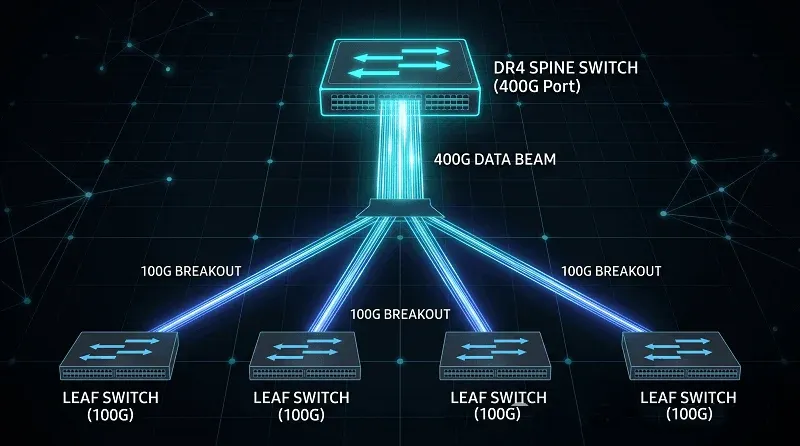
SR8 breaks out via an MPO-16-to-4x duplex LC multimode cable. Each of the four 100G SR4 outputs reaches a standard QSFP28 SR4 module up to 100m away.
DR4 breaks out via an MPO-12-to-4x duplex LC single-mode cable. Each of the four 100G DR outputs reaches a standard QSFP28 DR module up to 500m away.
Breakout is most valuable in three scenarios. First, phased upgrades: your new 400G spine can connect to existing 100G leaf switches during a migration without adding an extra aggregation layer. Second, mixed-speed servers: some servers run 100G NICs, some run 400G NICs, and one DR4 port handles four 100G servers simultaneously. Third, port density: breakout reduces the total switch count needed in high-density clusters by letting one physical 400G port serve four physical endpoints.
As servers in the cluster upgrade to 400G NICs, you remove the breakout cable, run a direct point-to-point link, and the port immediately delivers full 400G throughput. The transition happens link by link, without disrupting adjacent ports or requiring a switch replacement.
Our full range of fiber optic connectivity solutions includes breakout cables engineered for both SR8 and DR4 configurations at standard data center lengths.
|
Module
|
Breakout Support
|
Breakout Configuration
|
|
SR8
|
✅ Supported
|
400G to 4×100G SR4
|
|
DR4
|
✅ Supported
|
400G to 4×100G DR
|
|
FR4
|
❌ Not Supported
|
Point-to-Point Only
|
|
LR4
|
❌ Not Supported
|
Point-to-Point Only
|
|
ZR
|
❌ Not Supported
|
Point-to-Point Only
|
MPO-16-to-4×LC breakout cables for SR8 configurations typically cost 15–15–15–40 per cable. MPO-12-to-4×LC breakout cables for DR4 cost 12–12–12–35. At scale, breakout cable cost is negligible relative to the port savings from deferring leaf switch upgrades.
7. Power Budgets and Thermal Planning
Module wattage differences between 400G types are larger than most engineers expect, and they compound quickly at scale.
|
Module
|
Typical Power
|
Max Power
|
Notes
|
|---|---|---|---|
|
SR8
|
6W
|
8W
|
No special thermal planning needed
|
|
DR4
|
8W
|
10W
|
No special thermal planning needed
|
|
FR4
|
10W
|
12W
|
Airflow verification at full port density
|
|
LR4
|
10W
|
12W
|
Airflow verification at full port density
|
|
ZR
|
15W
|
18W
|
Switch thermal spec check required
|
|
ZR+
|
18W
|
25W
|
Enhanced-cooling platform may be required
|
SR8 draws 6 to 8 watts per port. DR4 draws 8 to 10 watts. FR4 and LR4 draw 10 to 12 watts. ZR coherent modules reach 15 to 18 watts per port.
Run the math on a 32-port switch fully loaded with ZR modules. Transceivers alone consume up to 576 watts. Add 400 to 500 watts for the switch ASIC and control plane. One rack unit of switching infrastructure now draws over 1,000 watts before you count cable management, patch panels, or power distribution. Scale that to 100 switches and you're planning 100 kilowatts of dedicated power and cooling for optical modules.
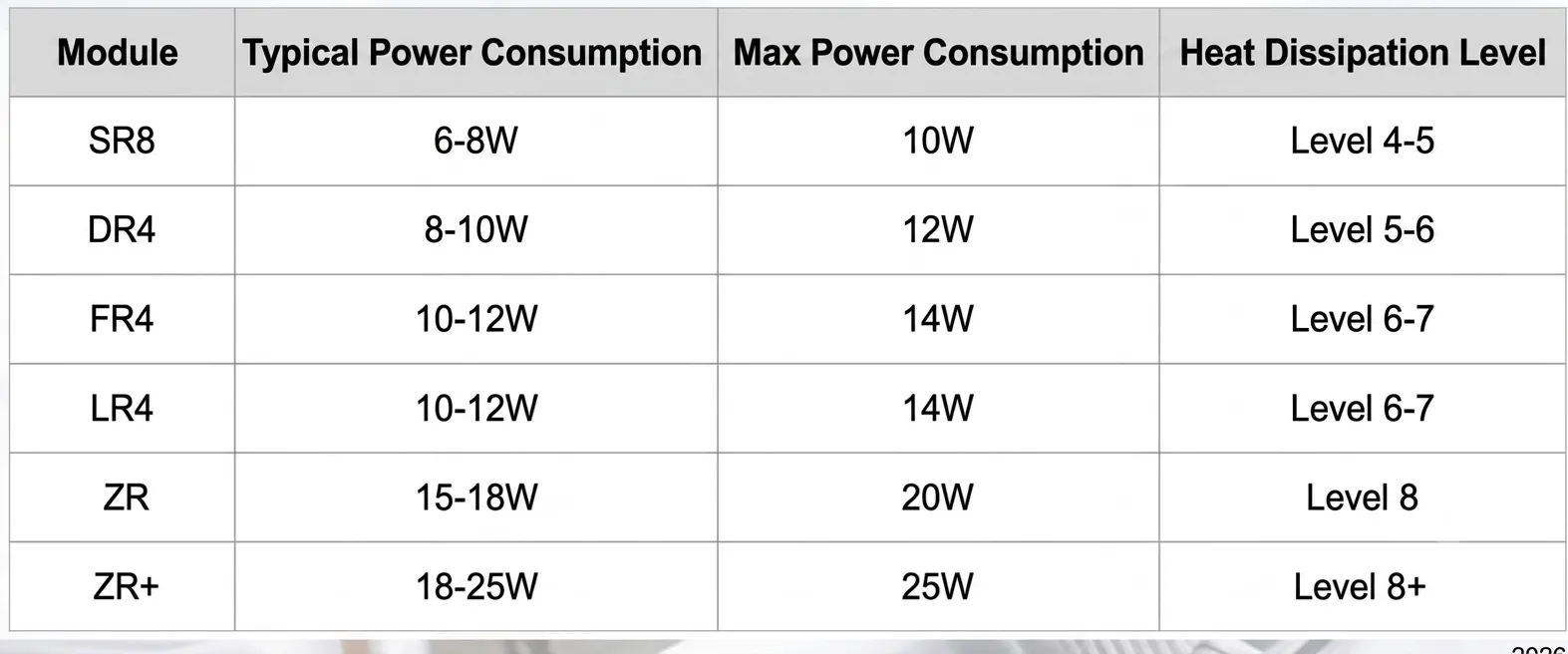
SR8 and DR4 fit within standard data center switch thermal ratings without special planning. FR4 and LR4 require airflow verification at full port density. ZR modules require you to check the switch vendor's thermal specification sheet before ordering, and in some cases, require enhanced-cooling platform variants to operate at full density.
The global 400G and 800G optical transceiver market is estimated at $5.2 billion in 2025 and is projected to grow at a 22% compound annual rate through 2033, with AI infrastructure buildouts as the primary driver. Power density planning is now a first-class engineering constraint, not an afterthought.
8. Three Real Deployments That Prove the Framework
AI Training Cluster: SR8 Saves $800,000
A team building a 2,048-GPU AI training cluster needed 400G from every GPU server to the NVIDIA Spectrum spine switches. Average cable runs were under three meters. The facility was newly built with MPO-16 OM4 fiber already installed.
SR8 was the clear answer. The reach was sufficient. The infrastructure was compatible. And SR8 modules cost approximately 40% less per port than DR4. Across 2,000-plus ports, the savings reached $800,000 compared to a DR4 deployment. SR8 delivers exactly what short-distance, high-density AI clusters need, at the lowest cost available.
Enterprise Data Center Upgrade: DR4 Handles Both Phases
A financial services company needed to upgrade a five-year-old 100G spine-leaf network in phases. Day one was 400G spine switches only. Day two, over 18 months, was 400G leaf switches. The existing MPO-12 OS2 single-mode cabling throughout the building was still in excellent condition.
DR4 managed both phases without any fiber replacement. During the transition, DR4 breakout cables connected the new 400G spine to the existing 100G leaf switches. As leaf switches upgraded, they received DR4 modules directly and ran native 400G point-to-point links. One module type, one cable standard, and a clean migration from end to end.
Campus Interconnect: FR4 Saves $22,400 Over LR4
Two data center buildings on a corporate campus sat 1.2 kilometers apart. The procurement recommendation was LR4, described as "the safer choice." The engineering team ran one distance check: 1.2km falls well within FR4's 2km limit.
Sixteen campus links at a $1,400-per-link cost difference between FR4 and LR4 totaled $22,400 in avoided overspend. FR4 handled every link at full 400G throughput. The LR4 recommendation would have added cost with zero performance benefit. Choose modules for the distance you have, not the distance you might someday need.
For a detailed breakdown of how duplex LC and MPO connectors interact with each module type, see our guide on fiber connector types and end faces.
9. How to Choose the Right 400G qSFP DD Module in 60 Seconds
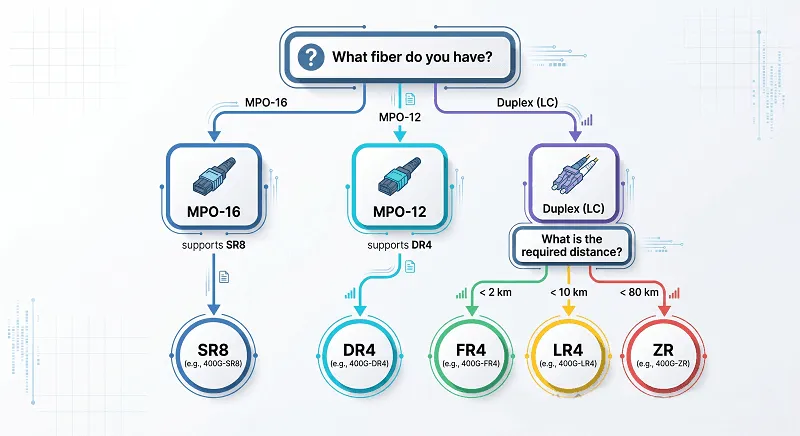
Start with your existing fiber infrastructure. MPO-16 multimode (OM4 or OM5) means SR8 is your only option for sub-100m links. MPO-12 APC single-mode means DR4 for anything up to 500m. Duplex LC single-mode means FR4 for up to 2km or LR4 for up to 10km.
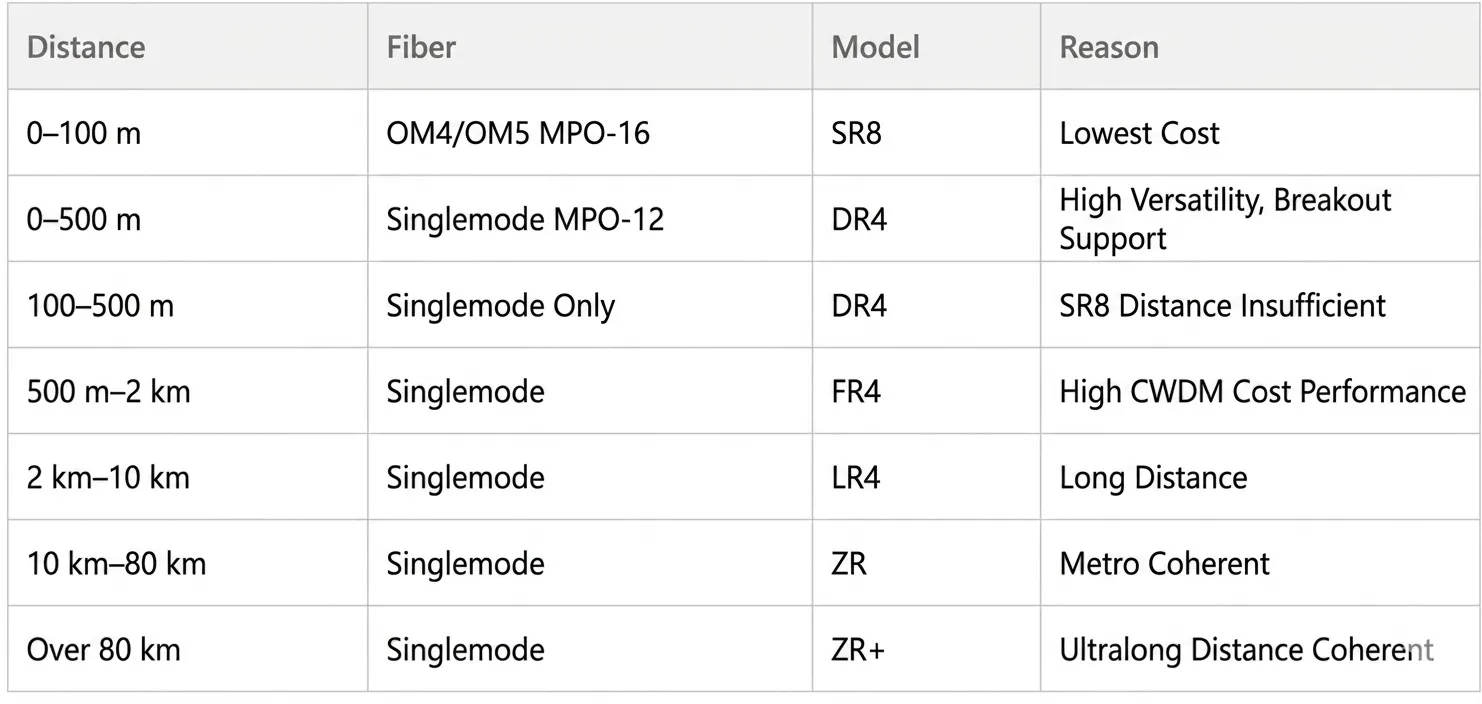
Then check your actual link distance. SR8 tops out at 100m on OM4. DR4 tops out at 500m. FR4 covers up to 2km. LR4 covers up to 10km. Match the module to the real measured distance, not a rounded estimate.
Next, determine whether any ports need breakout. Only SR8 and DR4 support 400G-to-4x100G breakout. If any link needs to serve four 100G endpoints from one 400G port, FR4 and LR4 are not candidates.
Finally, check your switch's per-port power rating before deploying FR4, LR4, or ZR. SR8 and DR4 fit in any standard 400G switch. Higher-wattage modules may require platform-specific validation.
4-Step Module Selection Checklist:
-
Check fiber type: MPO-16 multimode → SR8 only. MPO-12 APC single-mode → DR4. Duplex LC single-mode → FR4 or LR4.
-
Measure link distance: ≤100m → SR8. ≤500m → DR4. ≤2km → FR4. ≤10km → LR4.
-
Determine breakout need: Need 4×100G from one port? → SR8 or DR4 only.
-
Confirm switch power budget: FR4/LR4 need airflow check. ZR needs vendor thermal validation.
The broader optical transceiver market is projected to grow from $14.7 billion in 2025 to $42.5 billion by 2032 as AI and cloud infrastructure buildouts accelerate. The stakes for getting module selection right are only growing. Every mismatched module delays deployment, wastes budget, or forces a rewire.
10. Conclusion
400G qsfp dd module selection is a four-variable problem: fiber type, distance, breakout requirement, and power budget. SR8 delivers the lowest cost for multimode short-haul links if your MPO-16 infrastructure is already in place. DR4 is the most versatile choice for data center upgrades, covering 500m on standard single-mode and enabling phased 100G-to-400G migrations without a full rewire. FR4 handles most campus and inter-building distances at a significantly lower cost than LR4, which belongs only on links that genuinely exceed 2 kilometers.
At COBTEL, we've spent over 20 years manufacturing fiber optic modules and MPO cabling for data center environments. We design and produce end-to-end 400G and 800G transmission solutions, from DFB and EML optical chips to fully tested MPO trunk assemblies, built for AI infrastructure and hyperscale deployments.
If you're planning a 400G upgrade, tell us your fiber type, link distances, and breakout requirements. We'll confirm the right module and the matched cabling in one step. Fill out the inquiry form below, and our engineering team will respond within one business day.
11. Frequently Asked Questions
1. Can SR8 use MPO-12 fiber?
No. SR8 requires MPO-16 connectors, which provide 16 fiber strands (eight for transmit, eight for receive). MPO-12 only provides 12 strands and physically cannot support SR8's eight-channel optical design. If your facility runs MPO-12 multimode cabling, you'll need to replace it with MPO-16 trunks before deploying any SR8 modules.
2. Which 400G modules support 100G breakout?
Only SR8 and DR4 support 400G-to-4x100G breakout. SR8 breaks out into four 100G SR4 connections over multimode fiber via an MPO-16-to-4x duplex LC cable. DR4 breaks out into four 100G DR connections over single-mode fiber via an MPO-12-to-4x duplex LC cable. FR4, LR4, and ZR are strictly point-to-point and cannot be split into individual 100G channels.
3. Is DR4 compatible with my existing 100G MPO-12 single-mode infrastructure?
In most cases, yes. If your current 100G deployment uses QSFP28 PSM4 modules with MPO-12 OS2 single-mode fiber, DR4 is compatible with that cabling plant. The critical requirement is that DR4 needs MPO-12 connectors with APC (angled physical contact) polish, which have an eight-degree angled ferrule tip and are typically green in color. Verify the polish type on your existing connectors before deploying DR4, because PC-polished MPO-12 connectors cause excessive back-reflection at 100G-per-lane speeds.
4. What is the real cost difference between FR4 and LR4?
LR4 modules cost roughly 30 to 40% more than FR4 across comparable third-party and OEM vendor tiers. Both module types use identical fiber and connector formats (duplex LC single-mode OS2). The only functional difference is transmission distance: FR4 supports 2km and LR4 supports 10km. For any link under 2km, FR4 delivers identical performance at significantly lower cost per port. Only select LR4 when your measured link distance genuinely exceeds the 2km FR4 limit.
5. Can different 400G module types be mixed in the same network?
Yes, with one firm rule: both ends of each individual link must use the same module type. You cannot connect an SR8 directly to a DR4 because they use incompatible fiber types, connector formats, and optical wavelengths. Within the same network, however, you can run SR8 for intra-rack links, DR4 for spine-leaf connections, and FR4 for campus inter-building runs simultaneously. Each link type just needs matching modules on both sides.
6. Should you choose multimode or single-mode for a new data center?
For new projects, single-mode DR4 is the first choice, offering longer transmission distances, support for upgrade to 800G, compatibility with standard MPO‑12 cabling, and the cost gap has significantly narrowed. What is the difference between FR4 and LR4? FR4 supports a transmission distance of 2 km, while LR4 supports 10 km. Both use CWDM technology with duplex single‑mode fiber. LR4 is 30%–40% more expensive than FR4. Choose FR4 for distances within 2 km, and LR4 for distances between 2–10 km.
7. What is the power consumption of 400G modules?
SR8: 6–8W; DR4: 8–10W; FR4/LR4: 10–12W; ZR: 15–18W; ZR+: 18–25W. A 32‑port switch fully populated with ZR optical modules would consume 480–640W from the optical modules alone. Before deploying high‑power modules, check the power supply and cooling system.
8. What is the cheapest 400G module for short‑reach scenarios?
If MPO‑16 multimode fiber is available, choose SR8; for single‑mode environments, choose DR4. SR8 is 40%–50% cheaper than DR4, but is constrained by the existing fiber infrastructure.
9. Do I need to replace the fiber when upgrading to 400G?
It depends on the module selection: Existing MPO‑12 needs to be upgraded to MPO‑16 multimode to use SR8; DR4 is compatible with most MPO‑12 single‑mode deployed for 100G; FR4, LR4, and ZR use standard duplex single‑mode. Always check your fiber cabling before purchasing modules.
10. Can qsfp dd transceivers upgrade to 800G?
qsfp dd is a 400G form factor. The next-generation form factor is OSFP (Octal Small Form-factor Pluggable) and qsfp dd 800, which support 800G. Single-mode infrastructure deployed for DR4 (MPO-12 OS2) is compatible with 800G DR8 modules, making single-mode the future-proof choice for new builds. Multimode infrastructure deployed for SR8 does not support 800G modules.