
3G SDI cable: How to Choose the Best
May 29, 2025
Leave a message
3G SDI cables play a vital role in digital video transmission. This article covers key factors to consider when choosing 3G SDI cables.
1. Key Factors in Choosing 3G SDI Cables: Impedance
In applications like telecom, security systems, and broadcast TV, coaxial cable performance directly impacts signal stability and interference resistance. How do you pick the right SDI coaxial cable among so many options?
Impedance Matching:
There are two main impedance types for coaxial cables: 50 ohms and 75 ohms. The impedance must precisely match your device interface-or you'll get signal bounce, weakening, or even system crashes.
There are two main impedance types for coaxial cables: 50 ohms and 75 ohms. The impedance must precisely match your device interface-or you'll get signal bounce, weakening, or even system crashes.
As we've covered before in this series, 75-ohm cables are standard for baseband video systems and cable TV RF signals, whereas 50-ohm cables work better for high-frequency gear.
Audio systems typically use 50-ohm impedance, which often creates matching challenges.
Impedance mismatch causes signal reflection, showing up as overshoot in eye diagrams-a clear sign of transmission issues. When properly matched, signals get absorbed cleanly. But when impedance doesn't match, you get signal bounce that messes with your transmission quality.

2. Key Considerations in Choosing 3G SDI Cables – Conductor Materials
The conductor material is a critical factor when choosing coaxial cables. Currently, the highest-grade option on the market is oxygen-free copper (OFC), though pure copper and copper-clad aluminum alternatives exist.
Oxygen-Free Copper (OFC)
As the premium choice among copper-core conductors, oxygen-free copper wire features exceptionally low resistance (under 30 ohms per 300 meters), delivering superior conductivity. This enables extended signal transmission distances with minimal packet loss (signal degradation). Consequently, OFC cores are standard in high-end low-voltage (e.g., data/AV) cables-including Ethernet cables, video signal lines, and top-tier USB data cables. Beyond excellent conductivity, OFC ensures stable signal integrity and enhanced safety. Unlike bronze (an alloy) or pure copper conductors, OFC resists oxidation over time, significantly extending service life.
As the premium choice among copper-core conductors, oxygen-free copper wire features exceptionally low resistance (under 30 ohms per 300 meters), delivering superior conductivity. This enables extended signal transmission distances with minimal packet loss (signal degradation). Consequently, OFC cores are standard in high-end low-voltage (e.g., data/AV) cables-including Ethernet cables, video signal lines, and top-tier USB data cables. Beyond excellent conductivity, OFC ensures stable signal integrity and enhanced safety. Unlike bronze (an alloy) or pure copper conductors, OFC resists oxidation over time, significantly extending service life.
These advantages make it the preferred core material for sensitive signal transmission. China's national Ethernet cable standards now recommend OFC, though its complex manufacturing process results in higher costs.

Pure Copper
To verify pure copper, confirm that a magnet won't adhere to it. Harder than OFC but with higher resistance (~100 ohms/300m), pure copper offers reasonably stable signal transmission-though with shorter range, reduced safety, and a briefer lifespan than OFC. It's more affordable but prone to green oxidation tarnish over time.
To verify pure copper, confirm that a magnet won't adhere to it. Harder than OFC but with higher resistance (~100 ohms/300m), pure copper offers reasonably stable signal transmission-though with shorter range, reduced safety, and a briefer lifespan than OFC. It's more affordable but prone to green oxidation tarnish over time.

For quick quality checks during procurement, measure resistance with a multimeter and convert readings to a 100-meter benchmark value.
Copper-Clad Aluminum
The most budget-friendly option due to its low production costs. To identify Copper-Clad Aluminum: cut the wire-the inner aluminum appears silvery-white, while the outer copper layer is distinctly yellow.
The most budget-friendly option due to its low production costs. To identify Copper-Clad Aluminum: cut the wire-the inner aluminum appears silvery-white, while the outer copper layer is distinctly yellow.

Tin-Plated Copper
Ideal for outdoor use thanks to its corrosion-resistant tin coating over pure copper (typically bronze or red copper). Recognizable by its silver exterior and golden interior, the tin layer prevents oxidation by shielding the copper from air exposure. Though OFC lacks this coating, its high-purity composition grants inherent oxidation resistance.
Ideal for outdoor use thanks to its corrosion-resistant tin coating over pure copper (typically bronze or red copper). Recognizable by its silver exterior and golden interior, the tin layer prevents oxidation by shielding the copper from air exposure. Though OFC lacks this coating, its high-purity composition grants inherent oxidation resistance.
3. Key Considerations in Choosing 3G SDI Cables – Wire Gauge
Wire gauge indicates the cable's diameter size. Larger diameters reduce signal attenuation over equivalent transmission distances, but decrease flexibility and increase costs.
In baseband video transmission, the predominant choice is SYV-a 75-ohm solid polyethylene-insulated coaxial cable. The SYV75-3 supports 100–300 meters; SYV75-5 achieves 300–500 meters; and SYV75-7 extends coverage to 500–800 meters. Note that "75" denotes 75-ohm impedance, while suffix numbers (e.g., -3, -5, -7) indicate conductor thickness.

Another coaxial cable type, SYWV, features physically foamed polyethylene insulation. Ideal for RF transmission, it serves satellite/cable TV distribution and long-range video intercom systems. The key difference is in the insulation: SYWV uses foaming technology that yields an opaque, bright white finish despite both cables employing PE polyethylene.
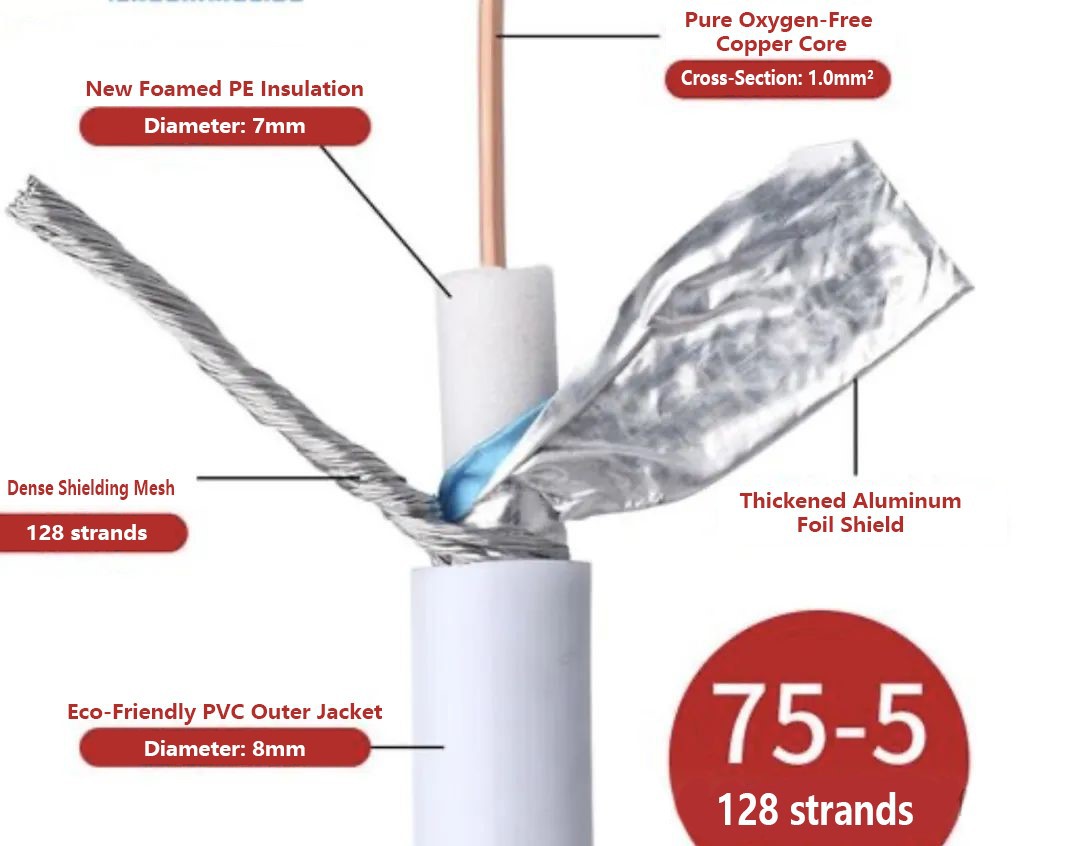
Many manufacturers offer specialized variants (e.g., enhanced shielding or flexible designs) tailored to video industry needs. Choose based on your requirements. National standards generally include the types listed above.

4. Key Considerations in Choosing 3G SDI Cables – Shielding Layer
The shielding layer determines a cable's anti-interference capability during signal transmission, acting as the signal's "protective shield." The material and structure of this layer determine the cable's resistance to electromagnetic interference (EMI). High-quality cables typically employ dual-layer shielding (aluminum foil + braided mesh) or copper-clad aluminum braiding, achieving shielding effectiveness exceeding 95%. Modern cable specifications often clearly display the braid count-for instance, SYV-75-3-64, where the final numeral indicates 64 braid strands. Common configurations include 64, 96, and 128 strands; higher counts denote denser shielding and superior performance.

Single-shielded coaxial cables utilize a single-layer copper braided mesh, offering exceptional flexibility and bendability. However, as this open-weave design lacks complete enclosure, such cables experience noticeable signal leakage and compromised amplitude and phase stability.
They suit environments with minimal interference but require fully shielded construction when routed parallel to RF or high-voltage power cables. Incorporating an internal aluminum foil layer enables completely enclosed signal transmission while preserving flexibility-a widely adopted solution in modern coaxial cable design.

An alternative approach employs surface-treated tinned copper braiding, which enhances mechanical strength while maintaining full shielding effectiveness, making it viable for baseband video transmission applications.

In summary, SDI signal cables demand less rigorous shielding than RF transmission cables (e.g., CATV systems). Dual shielding generally suffices, with triple or quadruple configurations seldom required in practice.
(Note: Braid counts (64/96/128) refer to the number of conductive strands per cross-section-higher counts provide more comprehensive coverage against interference.)
5. Key Considerations in Choosing 3G SDI Cables – Outer Jacket Materials and Usage Environment
In coaxial cable selection, the outer jacket material is equally critical. Designed to safeguard the cable's internal structure, these jackets are typically manufactured from PVC, PE, or LSZH materials, with PVC being the most prevalent. The primary functions include waterproofing, moisture resistance, abrasion resistance, corrosion protection, and UV shielding – all contributing to extended cable longevity.
For video transmission applications like SYV75 coaxial cables, PVC jackets remain dominant due to their cost-effectiveness. When enhanced with flame retardants, they demonstrate measurable fire resistance.
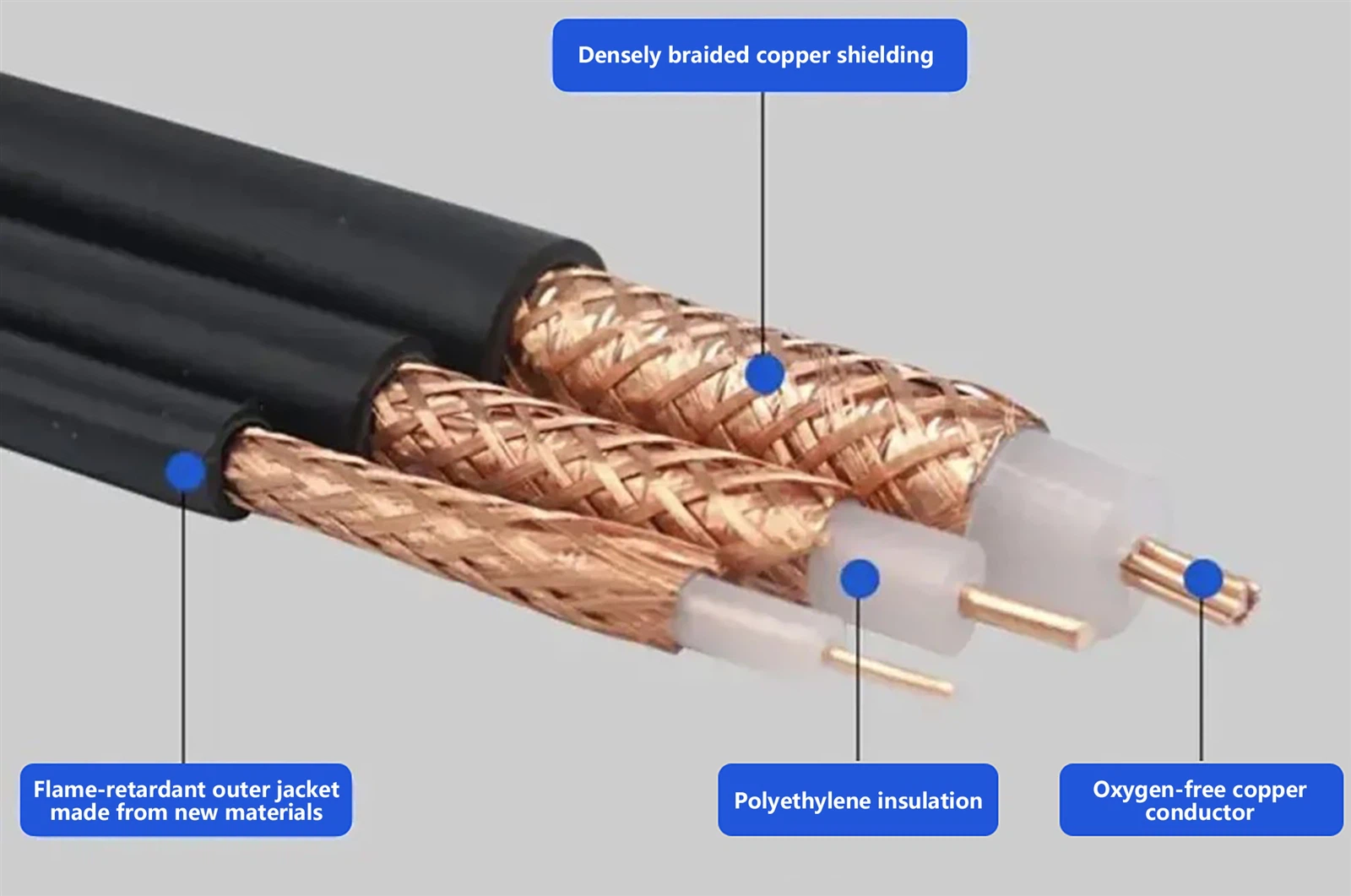
PVC's high chlorine content actively inhibits flame spread during combustion. Upon exposure to fire, PVC decomposes into hydrogen chloride gas which serves dual protective functions: oxygen dilution in ambient air and formation of an oxygen-blocking layer on burning surfaces.
While offering these advantages, PVC's flame-retardant properties have operational limits. During high-energy fires, though more resistant than standard plastics, PVC jackets progressively soften and deform under sustained heat, diminishing their protective capabilities. Crucially, burning PVC emits toxic fumes (hydrogen chloride and carbon monoxide) that significantly impede evacuation and firefighting efforts.
Consequently, in high-risk environments with stringent fire safety standards – such as equipment rooms or monitoring centers with dense occupancy – we specifically recommend LSZH (Low Smoke Zero Halogen) jackets. These halogen-free alternatives eliminate toxic smoke emissions despite their premium cost, making them essential for life-safety critical installations.

6. SDI Cable Selection Considerations – Usage Environment Factors
Different application scenarios typically have distinct wiring needs. For instance, outdoor industrial environments may require completely different wiring compared to connections between equipment or within server rooms. From internal device assembly wiring to complex building installations, there are coaxial cables designed to meet virtually any environmental demand.
For specific cabling types, coaxial cables have several technical specifications that determine their suitability, including: Bend radius,
Maximum load or unsupported installation conditions,Wind load ratings, and Various environmental factors.
This information should be provided to procurement teams early, as cabling requirements can be just as important as electrical performance specifications.
Some applications involve rough handling during installation, leading to the use of specialized sheath materials and protective layers to aid in cable installation. Key considerations include:
Temperature Range: For environments with strict stability requirements, coaxial cables must support an operating range of -40°C to +85°C to withstand extreme conditions.
Water Resistance: Outer jackets using polyethylene (PE) or polyvinyl chloride (PVC) materials provide waterproof and moisture-resistant protection, with some models rated for direct burial or underwater operation.
Tensile Strength: Often specified for coaxial cables, this crucial factor-along with crush resistance-directly determines the cable's service life by preventing damage during installation and use.
Each of these mechanical properties works in concert with electrical performance to ensure reliable signal transmission across various deployment scenarios.