
Different Types Of Fiber Optic Connectors
Mar 15, 2025
Leave a message
How many different types of fiber connectors do you know? Fiber optic connectors are universally compatible passive components. Fiber optic connectors of the same type can generally be used interchangeably and multiple times, with the additional signal loss introduced typically being less than 0.2 dB. Those unfamiliar with optical fibers might mistakenly think that GBIC and SFP modules use the same type of fiber optic connector, which is incorrect. SFP modules use LC fiber optic connectors, whereas GBIC modules use SC fiber optic connectors. Below, we delve into the details of different types of fiber optic connectors commonly found in communication networks and showcase some less commonly encountered ones.
1. PC, UPC, and APC Fiber End Faces

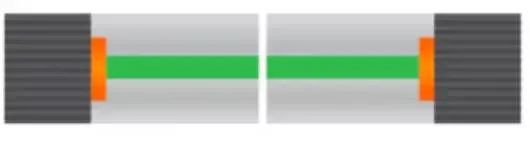
Fiber end faces are classified into PC, UPC, and APC types. PC and UPC have spherical end faces parallel to the ceramic body's surface, while APC features a spherical end face angled at 8° relative to the ceramic body's surface.
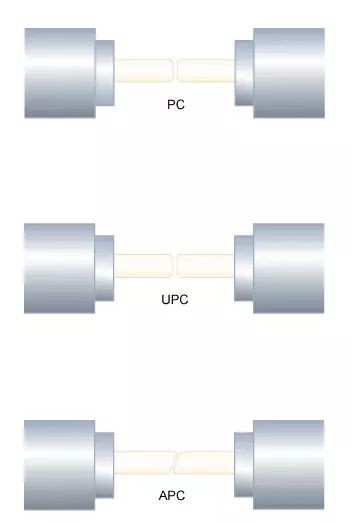
In everyday scenarios, customer requests for PC/UPC/APC fiber patch cords can often be confusing. Simply put, PC patch cords are considered network-grade, whereas UPC/APC patch cords are telecom-grade. Their differences lie in the craftsmanship of the connector head and patch cord loss-UPC/APC patch cords exhibit finer workmanship and lower loss.
PC stands for Physical Contact. Based on return loss levels, connectors are further categorized into PC (Physical Contact), SPC (Super Physical Contact), UPC (Ultra Physical Contact), and APC (Angled Physical Contact). According to industrial standards, return losses for PC, SPC, and UPC are specified as -35 dB, -40 dB, and -50 dB respectively (Return loss measures how much light is reflected back from the connector's end face; lower return loss indicates better performance-alternatively stated as higher numerical values if ignoring the negative sign). In principle, different types of connectors cannot be mixed; however, since PC, SPC, and UPC all have flat fiber end faces with differences only in polishing quality, mixing these three types typically does not cause permanent physical damage to the connectors.
APC is entirely different; its end face is polished at an 8° angle to reduce reflection. Its industrial standard return loss is -60 dB. APC connectors can only connect with other APC connectors. Because APC connectors differ structurally from PC connectors, connecting them using a flange plate may damage their fiber end faces. The proper method for connecting APC to PC involves using a conversion patch cable specifically designed for this purpose. Additionally, it should be noted that APC connectors are usually green (while yellow fibers indicate single-mode fibers), and the inclination of the fiber end face is visible to the naked eye.
2. Types of Fiber Optic Connectors

Fiber optic connectors can be classified into various categories based on different criteria: by transmission medium (single-mode vs. multi-mode), by structure (FC, SC, ST, D4, DIN, Biconic, MU, LC, MT), by pin end face type (FC-PC/UPC or APC), or by number of cores (single-core vs. multi-core).
3. SC Type Fiber Optic Connector


This type was developed by Japan's NTT Corporation. It features a standard square-shaped connector housed in durable engineering plastic that resists high temperatures and oxidation.

The optical interface on transmission equipment typically uses SC-type connectors. The pin and coupling sleeve dimensions are identical to those of FC-type connectors. The pin end face is usually polished in either PC or APC style.

Its fastening mechanism involves a push-pull locking system that requires no rotation during insertion or removal. This type of connector is inexpensive, easy to operate during plug-and-play actions, exhibits low insertion loss fluctuation under pressure conditions, has high mechanical strength against stress forces during usage environments like installation setups involving dense arrays.
4. ST Type Fiber Optic Connector

Commonly used in optical distribution frames with circular housings and screw-thread locking mechanisms.


ST-type connectors dominate 10Base-F Ethernet connections over optical media links within networks-especially in optical patch panels-and converters frequently rely upon ST-type connections for internal operations as well.

5. LC Type Connector

The LC-type connector was developed by Bell Labs and uses a convenient modular jack latch mechanism similar to RJ-style plugs.

Its pin and sleeve dimensions are half those used in standard SC or FC connectors-measuring just 1.25 mm-allowing for increased density in fiber distribution frames.


Currently dominating single-mode small form factor applications globally across industries requiring precision-efficient scaling frameworks universalizing dynamic versatility aligning robust pathways consistent sustainable innovation-driving smart implementations maximized interconnectedness responsive solutions boundaryless growth continuity redefining operational excellence expanding opportunity transformative adaptability reshaping intelligent evolution unparalleled foresight optimizing seamless integration bridging future connectivity visionary aspirations accelerating potential limitless ingenuity transcending barriers cutting-edge breakthroughs future-proofing humanity's aspirations empowering next-generation transformation revolutionizing platforms equitable access architecting holistic innovation pioneering alignment thriving collaborative possibilities adaptive excellence reimagined progress.
6. FC Type Fiber Optic Connector

This type of connector was initially developed by Japan's NTT. FC stands for Ferrule Connector, indicating its metallic exterior reinforcement method, which uses a metal sleeve. It is generally employed on the ODF side. Metal connectors are more durable and support a higher number of mating cycles than plastic ones, and their fastening method involves screw threads. Originally, FC-type connectors used ceramic ferrules at the mating interface.
These connectors are simple in structure, easy to operate, and straightforward to manufacture. However, the fiber optic end faces are sensitive to dust and prone to Fresnel reflections, making it difficult to improve return loss characteristics.
Later improvements were made to this type of connector by adopting ferrules with spherical mating surfaces (PC) while keeping the external structure unchanged. This significantly improved insertion loss and return loss performance.
7. MT-RJ Type Connector


MT-RJ originated from the MT connector developed by NTT, featuring a latch mechanism similar to RJ-45 LAN electrical connectors. Fiber alignment is achieved using guide pins positioned on either side of the compact housing. To facilitate connection with optical transceivers, the connector's fiber end face is designed with dual-core fibers arranged 0.75mm apart. It is primarily used as a next-generation high-density fiber optic connector for data transmission.
8. MPO/MTP Type Fiber Optic Connector


These high-density fiber optic connectors support more than two fibers within a single connector housing, with 12-fiber MPO/MTP connectors being commonly used today.
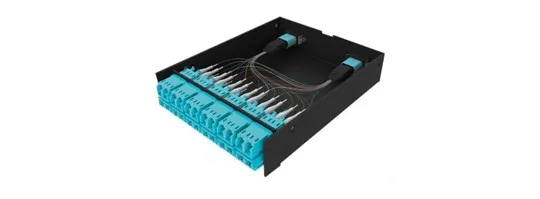
They are mainly applied in data centers for terminated fiber cable connections and support 40G (12 fibers) and 100G (24 fibers) optical channels. MPO/MTP connectors are not designed for on-site termination; while some manufacturers have introduced processes for field assembly, these are not practical for widespread deployment. The MTP connector is an upgraded version of the MPO connector with better transmission performance, lower loss, and higher precision.
9. BFOC Type Fiber Optic Connector

This type of fiber optic interface was developed by Siemens for industrial Ethernet equipment. Its appearance is very similar to ST-type connectors, and it uses the same locking mechanism; however, its ceramic ferrule is marginally shorter than the ferrule used in ST-type connectors.

It is generally applied in industrial Ethernet network devices such as industrial switches or microcontrollers (common in German-made industrial equipment).
10. DIN47256 Type Fiber Optic Connector

This connector was developed in Germany and features ferrules and coupling sleeves with structural dimensions identical to those of FC-type connectors but utilizes PC-polished end faces. Compared to FC-type connectors, its structure is more complex as it incorporates internal springs in its metallic components to control pressure and prevent damage to the end face due to excessive insertion pressure. Additionally, this connector boasts higher mechanical precision, resulting in lower insertion loss values.
11. FDDI Type Connector
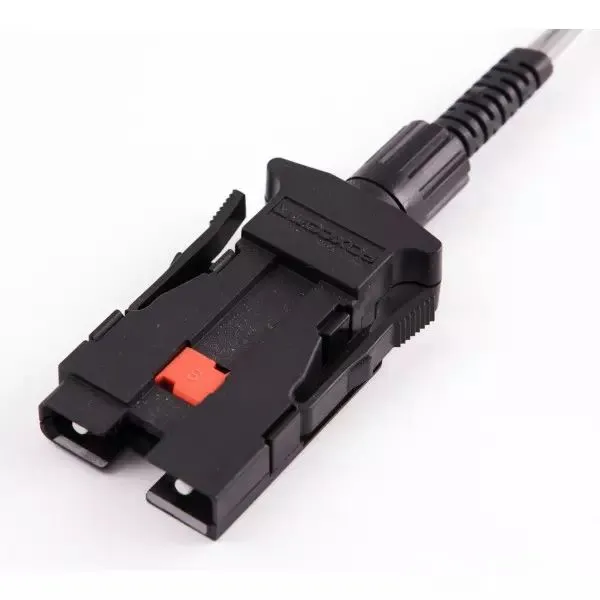

FDDI is primarily used in duplex fiber systems conforming to FDDI backbone network standards and IEEE802.4 token bus specifications under ANSI X3T9.5 FDDI PMD protocols.
12 MU Type Connector

The MU (Miniature Unit Coupling) connector is based on the widely used SC-type connector but was developed by NTT as the world's smallest single-core fiber optic connector. It employs a 1.25mm diameter ferrule with self-retention mechanisms, allowing for high-density mounting configurations. Utilizing MU's 1.25mm diameter ferrules, NTT has created a series of MU connectors including socket-type connectors for fiber cable connections (MU-A series), backplane connectors with self-retention mechanisms (MU-B series), and simplified sockets for connecting LD/PD modules with plugs (MU-SR series). As optical networks rapidly advance toward greater bandwidths and capacities alongside widespread DWDM technology adoption, demand for MU-type connectors will grow rapidly.
13. Biconic Type Connector
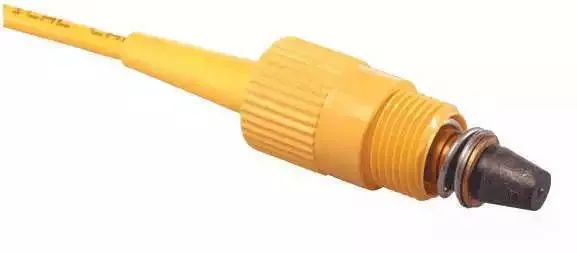

The most representative product among these fiber optic connectors was developed by Bell Labs in the United States. It consists of two cylindrical plugs molded into truncated cone shapes at their tips, which are joined using an internal twin-cone plastic sleeve assembly.
14. SMA Type Fiber Optic Connector
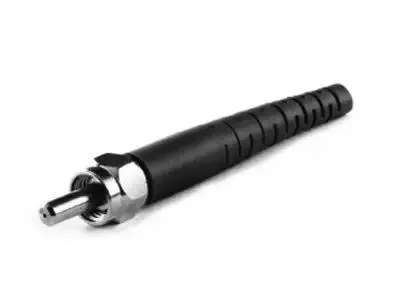

SMA connectors are utilized in specialized applications within fiber optic communication systems such as testing equipment, data networks, military instruments, and medical devices. SMA connectors typically use one of two ferrule materials: ceramic or metal.
15. D4 Type Fiber Optic Connector

D4-type connectors are older designs featuring alignment rings and pressure control springs to prevent damage from excessive insertion pressure on end faces, thereby reducing losses significantly-its ferrule has a diameter of 2mm. The crimp-style D4 connector body is made from nickel-plated brass material with tail sleeves available in multiple color options.
16. E2000 Type Fiber Optic Connector


The E2000 fiber optic connector adopts a push-pull locking mechanism for easy installation; its housing is made from engineering plastics making it ideal for dense installations, particularly with single-mode fibers; it also features integrated dust covers.
17. OPTI-JACK Type Fiber Optic Connector


OPTI-JACK is an SFF (Small Form Factor) fiber optic connector initially utilized in desktop optical networking applications.
18. VF45 Type Fiber Optic Connector

The VF-45 fiber optic connector-also known as SG (per TIA/EIA-604-7)-was introduced by 3M during the late 1990s; it does not require ferrules for optical signal connections-frequently used in optical network access systems.
19. LX5 Type Fiber Optic Connector

LX5 is a robust SFF optical connector engineered specifically to meet the operational needs of the cable television industry.
In labeling pigtail connection markings like "FC/PC" or "SC/PC," their meanings are as follows:
The segment preceding "/" indicates the connector model type used in the pigtail ("SC" indicates an SC-style pigtail connection).
The segment following "/" specifies end-face processing technology-the grinding method used ("PC" signifies Physical Contact polishing-the most common technique).
The segment preceding "/" indicates the connector model type used in the pigtail ("SC" indicates an SC-style pigtail connection).
The segment following "/" specifies end-face processing technology-the grinding method used ("PC" signifies Physical Contact polishing-the most common technique).
Other Reference Article:
Previous:800G Optical Transceiver