
What is Fiber Array
May 13, 2025
Leave a message
With the widespread adoption of 5G networks, the expansion of data center infrastructure, and rapid advancements in IoT technologies, efficient and reliable optical signal transmission has become critically important. Fiber Arrays (FAs), as high-precision, high-performance optical components, have become indispensable core elements in fields such as optical communications, photonic integration, and laser processing.
1. What is a Fiber Array?
A fiber array is an optical device that aligns and secures a bundle of optical fibers or fiber ribbons at specified intervals on a V-groove substrate. Comprising a V-groove base plate, cover plate, optical fibers, and adhesive, its core advantages lie in high-precision fiber alignment and low-loss signal transmission capabilities. They are now critical components in planar lightwave circuits (PLCs), arrayed waveguide gratings (AWGs), and micro-electromechanical systems (MEMS).

Schematic Diagram of Fiber FA Structure (Image Source: Internet)
2. Features and Advantages of Fiber Arrays
2.1 High Precision & Multi-Channel Capability.
The defining feature of fiber arrays is their ability to encapsulate multiple fibers-even dozens-within a compact space without crosstalk. The V-groove substrate ensures micron-level spacing control, enabling efficient optical coupling and transmission.

Positional Relationship Between Fibers and V-Grooves (Image Source: Internet)
2.2 Low Insertion Loss.
Precision machining and polishing achieve insertion loss below 0.05 dB, significantly boosting signal transmission efficiency.
2.3 High Return Loss.
With return loss typically ≥55 dB (APC, Angled Physical Contact), FAs minimize signal reflection to ensure stable transmission.
2.4 Exceptional Thermal Stability
Constructed with optical fibers, glass substrates, and modern adhesives offering excellent mechanical/thermal stability, FAs operate reliably from -40°C to +85°C-making them ideal for harsh environments.
2.5 Streamlined Process & Design Flexibility
As technology advances, FA manufacturing processes are now well-established; mechanical precision directly correlates with optical performance. Recent demand for high-density integration has spurred innovative designs like 45° end-face angles (beyond standard 8° bevels) for vertical coupling applications.

45° MT-FA Patch Cord

90° MT-FA Patch Cords

MT-MPO Patch cords (Image Source: Internet)
2.6 Customization Capabilities
The proliferation of FA applications in high-density modules has driven diverse variants: polarization-maintaining fiber arrays (PM-FAs), mode-field converter FAs, FA+Lens assemblies, and MPO/MT-to-FA fan-outs-meeting varied industry needs.

polarization maintaining fiber FA
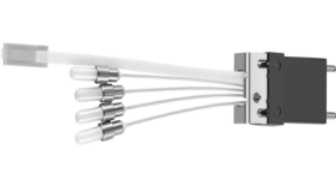
MT-LC-FA

MT-90°FA
3. Testing Methods and Specifications for Fiber Arrays (FA)
1. Insertion Loss: Connect a light source to one end of the FA and measure the output optical power using a power meter at the other end. Compute IL based on the insertion loss formula.

2. Return Loss: Connect an optical reflectometer to one end of the FA and measure the reflected power. Calculate RL according to the return loss definition.

3. Breakpoint or Damage Testing: Common methods include visual fault locator (VFL) inspection or microscopic examination. Inspect the fiber or waveguide link for light leakage, or directly observe material defects such as cracks, scratches, and bubbles under high-magnification microscopy.
4. Endface Inspection: Use specialized endface inspection equipment or microscopy to evaluate FA endface polish, ensuring surfaces are clean without damage, scratches, or chipping.
To address existing performance testing methods for fiber array (FA) components, COBTEL has independently developed a distributed return loss detector based on white-light interferometry. This instrument enables full-length distributed return loss scanning of entire FA patch cords, connectors, end faces, and internal bonding points within optical links, with 100-micron precision and a signal sensitivity of -100 dB. By setting thresholds, the system automatically identifies locations and signal magnitudes exceeding specifications, supporting high-volume production testing.
As shown in the following figure depicting test results of a 45° FA patch cord using our OLI equipment:

The red curve represents the normal channel while the blue indicates an abnormal channel. The FA measures approximately 15 mm. The first peak corresponds to the front end face, the second to the 45° rear end face, and the third results from a single internal reflection. The 45° angle creates strong reflections, causing multiple internal reflections with progressively attenuated intensity - all detected by the device.

Normal optical channel

abnormal optical channel
Similarly in the blue curve (abnormal channel), an anomaly located approximately 5 mm from the front end face creates two peaks between the interference peaks (i.e., the front and rear end faces) due to multiple internal reflections. Both peaks originate from the same anomaly point.
OLI conducts material inspections for FA-type patch cords while also performing optical path quality tests on fully assembled modules to identify fiber damage or fractures occurring during encapsulation. Below are OLI's scan results for different optical channels in a finished module:

Normal Optical Channel : Abnormal Optical Channel
Test results precisely locate optical abnormalities and quantify return loss (signal reflection). Beyond fracture detection, the system identifies internal fiber micro-bends and micro-fractures. OLI's evaluation of bent fiber ribbons appears below:

Normal Fiber Ribbon Channel : Manually Bent Fiber Ribbon
When internal ribbons are purposely bent past a threshold, return loss spikes at the curvature apex-indicating excessive stress with long-term failure risks. OLI accurately measures these invisible micro-defects, enhancing quality control and mitigating risks.

Measurement Results: Bent Fiber Ribbon Inside Module
4. In summary:
As core components in optical communication and sensing, fiber optic arrays see growing demand driven by 5G, data centers, and IoT technologies. With advancing applications and technological upgrades, this market is poised to expand further. COBTEL's innovative FA measurement solution will be deployed across device modules. Its unparalleled advantages include...