

Shielded Ethernet Cable:How to Choose Material
Leave a message
Do you know what is a shielded ethernet cable and what is a shielded ethernet cable made of? Today's article will answer these questions and also explore how to choose the right material for the shielded ethernet cable.
1. the conductor Materials in Shielded ethernet cables
When selecting the shielded Ethernet cables, manufacturers or distributors often advertise that their cables use oxygen-free copper or pure copper. At first glance, isn't oxygen-free copper the same as pure copper? What's the difference between the two?
In reality, copper ethernet cables are made from three materials: oxygen-free copper, high-resistance copper, and bronze (copper-clad laminate). Today, most basic ethernet cables use either oxygen-free copper or bronze. However, in marketing, since oxygen-free copper isn't labeled as "pure copper," bronze has quickly taken over that term. Calling it "pure copper" instead of "bronze" makes it sound more advanced.

Oxygen-free copper (OFC): It has a low resistance value (less than 30 ohms for 300 meters), which means it has strong conductivity. This results in longer signal transmission distances and lower packet loss rates. Therefore, oxygen-free copper cable reels are recommended for network engineering, high-definition surveillance systems, and home installations, ensuring stable performance, safety, and a longer lifespan.
Bronze (often marketed as "pure copper") cannot be attracted by a magnet, but it is harder than oxygen-free copper and has a higher zinc resistance value (around 100 ohms for 300 meters). While it offers stable network transmission, its safety and transmission distance are inferior to oxygen-free copper, and its lifespan is shorter. However, it is cheaper than oxygen-free copper. This is an important point to keep in mind.
2. How to identify the conductors' material of Shielded ethernet cables
When purchasing, it's often unclear how to distinguish between oxygen-free copper and bronze. As you can see, it's hard to tell the difference between bronze and oxygen-free copper just by looking at photos. Many sellers market bronze cables as oxygen-free copper cables, labeling them as "pure copper."
Oxygen-free copper is widely recognized as the best conductor material for shielded ethernet cables and is a mandatory requirement for national standard cables. Standard copper materials contain a significant amount of oxides and impurities, which greatly affect signal transmission quality. In contrast, oxygen-free copper cables have far lower oxygen and impurity levels. Therefore, it's crucial to identify genuine oxygen-free copper cables when purchasing.
The most common testing method is to use a multimeter to measure the resistance of a 100-meter cable. As mentioned earlier, oxygen-free copper cables have a resistance of less than 30 ohms for 300 meters.

The copper conductor in oxygen-free copper cables has a purity of over 99.95%, with negligible impurities and oxygen content, resulting in lower resistance. Testing a single cable with a multimeter will reveal its true nature: if the resistance is below 30 ohms, it's oxygen-free copper. A simple test can reveal the truth. If bronze or, worse yet, low-grade copper is used, the resistance will exceed 100 ohms.
Of course, some cables are not truly oxygen-free copper but instead use alloys of other metals. These alloys contain higher levels of oxygen and impurities, resulting in higher resistance. Alloy or copper alloy cables typically have a resistance of 50–70 ohms, while standard copper cables are around 110 ohms. Remember, anything above 30 ohms is not a high-quality cable.
If you're wondering who would carry a multimeter to buy a ethernet cable, it sounds like something a professional counterfeit detector would do. But don't worry-there are alternative methods if your company doesn't have access to a multimeter. In such cases, you can identify genuine oxygen-free copper cables using one of the following two tests:
Scratch test: Use a sharp metal tool to scratch the conductor's surface. Oxygen-free copper will show a consistent golden yellow color throughout, while other materials will reveal uneven brown-red or black spots. For cables with only an outer layer of oxygen-free copper, scratching will show a noticeable difference between the inner and outer layers.
Flame test: Heat the conductor for a few seconds. If it softens, it's likely a copper alloy. If the outer layer oxidizes and, after wiping, the conductor remains discolored and doesn't return to its original golden yellow, it's a pure copper cable with an oxygen-free copper coating. If only the surface oxidizes and the conductor returns to its original state after wiping, it's genuine oxygen-free copper.

3. Other materials used in Shielded Ethernet cables
Currently, national standards recommend using oxygen-free copper for ethernet cables. However, the production process for oxygen-free copper is relatively complex, making it more expensive. As a result, other materials are sometimes used for the cable core, such as copper-clad aluminum (CCA) and tinned copper.
Copper-clad aluminum (CCA) cables are essentially aluminum wires coated with a layer of copper. Copper has a much lower resistivity, typically 1.68 times lower than aluminum, which means aluminum wires consume more power, generate more heat, and are less efficient. Copper's low resistance allows for longer transmission distances, lower packet loss rates, and a longer lifespan. However, CCA cables are prone to breaking due to bending or stretching, and over time, they are susceptible to oxidation and corrosion.
CCA cables are easy to identify: simply cut the cable and examine the core's color. Aluminum is silver-white, while copper is yellow, making it easy to distinguish.

Tinned copper cables are made by coating the surface of copper conductors with tin, whereas oxygen-free copper cables use pure oxygen-free copper without any coating.
Tinned copper cables have excellent oxidation resistance, as the tin layer prevents the copper from reacting with oxygen. Although oxygen-free copper cables lack a tin coating, their high purity gives them inherent oxidation resistance.
Tinned copper cables are also easy to identify: the outer layer is silver-white, while the inner layer is golden yellow. Typically, the copper in tinned cables is bronze, not oxygen-free copper.

Next, let's discuss the shielding technology and materials used in ethernet cables.
4. Shielding technology in Shielded Ethernet cables
Shielding in ethernet cables involves using materials and structures to protect the internal signal wires, reducing external electromagnetic interference and signal jitter, and enhancing data transmission stability and reliability.
Shielding materials typically include copper braids, foil, and aluminum foil, while the structure incorporates layered isolation shielding and double-layer metal shielding. Shielded twisted pair (STP) cables consist of four pairs of twisted copper wires enclosed in an insulating sleeve. Each pair of wires transmits electrical pulses in opposite directions, using electromagnetic induction to cancel out interference.

Shielded cables are primarily used in environments with strong electromagnetic interference, such as data centers or server rooms. They effectively resist interference, maintain stable transmission, and offer excellent confidentiality. Additionally, shielded cables prevent eavesdropping, as the aluminum foil blocks external electromagnetic signals and minimizes the cable's own electromagnetic emissions, avoiding interference with other cables.
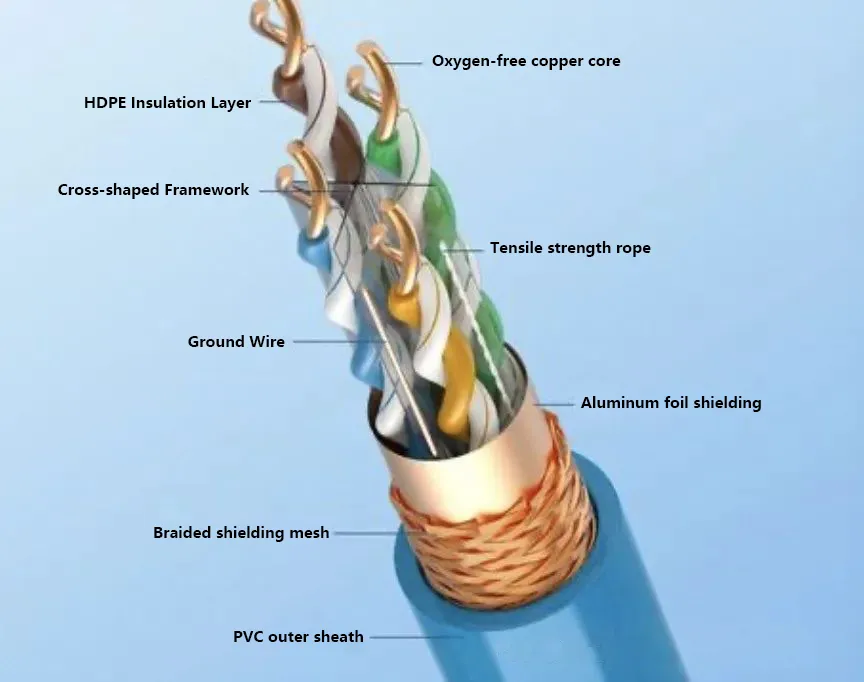
However, shielded ethernet cables require proper grounding and shielding circuits to effectively reduce interference. Poor grounding significantly diminishes their effectiveness. Therefore, when using shielded cables, ensure all system components are shielded and properly grounded.
In summary, shielding is an effective way to improve network stability and security, but proper grounding and component selection are essential for optimal performance.
5. Aluminum foil shielding
Cables with aluminum foil shielding effectively isolate electromagnetic interference, improving signal transmission quality. They are suitable for high-demand applications but come at a higher cost. Non-shielded cables are cheaper and suitable for low-demand environments but are more susceptible to interference. The choice depends on specific needs.

Aluminum foil shielding involves wrapping the cable's insulation layer with aluminum or copper foil, which isolates internal and external electromagnetic interference. This shielding reduces signal crosstalk and enhances the cable's anti-interference performance, especially in high-frequency environments where it prevents electromagnetic waves from inducing currents in the conductors.

Tin foil can shield signals, particularly high-frequency ones like mobile or Wi-Fi signals, by reflecting and absorbing electromagnetic waves. However, its effectiveness may vary for low-frequency signals.
6. Braided shielding
In addition to aluminum foil shielding, high-frequency cables like CAT7 or CAT8 often include a second layer of shielding, known as double-shielded cables. These cables offer superior protection against electromagnetic interference, ensuring reliable signal transmission.

Braided shielding uses conductive wires or copper wires woven into a mesh, typically made of aluminum-magnesium alloy.
Braided shielding is ideal for environments with moderate high-frequency interference. Its flexibility and ease of installation help reduce electromagnetic interference on equipment.

The braided mesh is usually made of tinned round copper wire or aluminum-magnesium alloy wire, primarily to block low-frequency interference. Its working principle is similar to aluminum foil. For optimal performance, the braid density should exceed 80%, making it suitable for environments with multiple cables in the same tray, reducing external crosstalk. It can also be used for pair shielding, increasing twist length and reducing cable twist requirements.
The shielding effectiveness of the braid depends on the metal's conductivity, permeability, and structural parameters. More layers, higher coverage, and smaller braiding angles improve performance.
The braiding angle should be between 30-45°, with single-layer braiding coverage ideally exceeding 80%. This ensures energy loss through hysteresis, dielectric, and resistance mechanisms, effectively absorbing electromagnetic waves.
Double-shielded ethernet cables feature two layers of shielding. The first layer is an aluminum foil wrap around the twisted pairs, similar to single-shielded cables. The second layer is a metal braid, which further enhances shielding and provides superior electromagnetic protection. With two shielding layers, these cables are ideal for high-quality transmission in environments with strong interference, such as near high-voltage lines or audio equipment. They effectively block both high and low-frequency interference, including 50Hz electrical interference.
Double-shielded cables are primarily used in complex electromagnetic environments, such as data centers, server rooms, and industrial control networks, ensuring stable and reliable data transmission.


