
How to select Cat6 patch cord - The Ultimate Guide Of Cobtel
Leave a message
1 Source channels of Cat6 patch cords and products comparison
Usually, the Cat6 patch cord used in LAN mainly comes from three sources: 1 the matching cables of the same brand as the overall wiring products; 2. the patch cables made in the field; 3. the patch cables purchased in the local computer market. Except that the supporting patch cords can be professionally tested by the manufacturer, it is difficult for general users to know the quality of Cat6 patch cords produced on-site or purchased in the market. Substandard quality patch cords can seriously affect the network transmission efficiency and network stability, and counterfeit products will cause irreversible damage to connected hardware (computer or switch interface) and finally cause the entire system's paralysis.
The structure of the patch cable is mainly composed of three aspects: patch cable conductor, rj45 connector, and protective cover. Let's take a look at the physical comparison between the finished Cat6 patch cord and the one made on-site (the left is the finished Cat6 patch cord, and the right is the Cat6 patch cable made on-site).

1.1 Branded finished Cat6 patch cords
The standard requirement for the production of finished patch cords is a bare soft copper stranded cable conductor of AWG26 (7/0.16mm) or AWG24 (7/0.20mm). This structure of the cable is more flexible and bendable, ensuring that the patch cord is very convenient in the process of use.
It is also easier to manage in the field because it is a copper-stranded cable. Using FLUKE to test the selected patch cords individually, the performance margin of RL and NEXT exceeds the TIA568B standard before leaving the factory.
Finished patch cords are the same brand as the network cable and connecting hardware, making it easier to keep the characteristic impedance consistent across the channel, resulting in ideal RL values.
1.2 Cat6 patch cords made on site
The cables used to make Cat6 patch cords in the field are generally the remaining sporadic wires after horizontal cabling. The conductor structure of the horizontal cable is a solid core conductor with AWG24 (1/0.511mm) for Cat5e and AWG23 (1/0.574mm) bare soft copper single wire for Cat6. Cables of this construction are stiffer and less prone to bending, making it more difficult to manage wires in the field. In addition, because the rj45 connectors installed in the field are usually crimped by a hand-pressed simple crimping tool, the contact reliability has a greater relationship with the operator's operation. According to the FLUKE test result, RL and NEXT performance vary a lot along with individual variability, and the reliability of the mechanical connection point is significantly worse than the brand-finished patch cable.
1.3 Market-purchased Cat6 patch cords
Due to the variety of channels to buy Cat6 patch cords on the market, users are not very professional in their understanding of patch cord products, and there is even the possibility of purchasing patch cables produced on-site. Even if you pay the money for brand patch cables, they may be "knockoff" goods. I have seen the structure of the patch cable which is 5/0.16mm aluminum stranded wire before on the project site, the patch cable was identified as a well-known brand of products. While using FLUKE to test the patch cable, RL and NEXT performance margins were almost all less than -10.0dB, which was obviously counterfeit products. In the general market, it is also very easy to encounter such problems.
2 The raw material analysis of Cat6 patch cords
In order to meet the patch cord performance standards defined by, TIA/EIA568B.2, patch cords must use high-quality raw materials. The raw materials involved include both cable bodies and modular plugs.
1 Patch cable body
The conductor is made of an oxygen-free round copper rod with resistivity<0.017241; the insulation layer is made of HDPE, with better brands such as UCC3364; the general patch cable and field production patch cable can meet the requirements in terms of material, but it is difficult to guarantee the performance of the material for the patch cable procured in the market. Some of the poor-quality patch cords on the market are very low-cost materials, and their performance can only guarantee conductivity. The main Manifestations are:
a. Conductor: The patch cable purchased on the market may use aluminum, and may also use poor quality copper, such conductors have high resistivity and poor ductility.
b. Insulation: Better ones may use general HDPE insulation material, and poorer ones may use backfill material, the dielectric constant of such materials is large and unstable, and elongation is also small. In addition to almost no electrical performance, this type of patch cable also has a short life, poor reliability, and other drawbacks.
The picture below shows a "knockoff" patch cable sold in the market with a white metal conductor (aluminum, 5/0.16mm) and almost no pitches.

2 RJ45 Connector
RJ45 connector of the metal sheet substrate mainly uses phosphor bronze nickel plating and then gold plating, gold plating thickness is generally 30u ", 50u ", and six types of crystal head gold plating layer thickness is generally 50u " (1.27μm), rj45 connector plugging and unplugging more than 750 times, the performance does not degrade; plastic shell for PC, in line with UL-94-V0, rj45 connector shrapnel plugging and unplugging more than 750 times does not rupture.
The metal sheet, gold-plated layer, and plastic shell material of the finished patch cord plugs of the supporting brands are finished according to factory standards, and the mechanical and electrical performance requirements of the product can be guaranteed after testing. If the ethernet connector used for on-site production of patch cords is derived from the original product, the quality can also be guaranteed, if the ethernet connector is purchased in the market, the mechanical, electrical, and fire performance of the material is challenging to ensure.
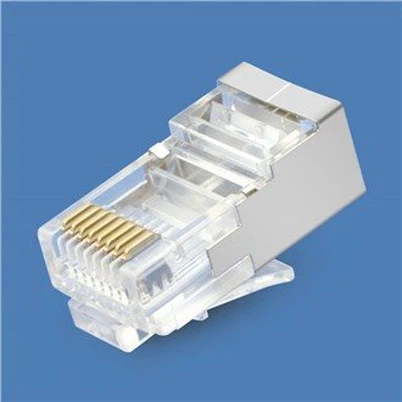
Let's compare these two modular plugs. Sample A is the product provided by the supporting manufacturer, and sample B is the product of an international brand purchased in the market. Sample A (left) metal plate is dull in color, close to gold; Sample B (right) metal plate is brighter in color, similar to a brass color (there are obvious spots on the surface of the metal plate); Sample A plastic shell is transparent and uniform, Sample B is transparent and white, with slight cracks.

Let's compare a set of test values for the plating layers of these two rj45 plugs.

From the above data comparison, we found that the thickness of the gold plating layer of sample A is about 50μ″ (1.25μm), while the thickness of the gold plating layer of sample B is only about 3μ″ (0.081μm), which is called flash plating in the industry, the thickness of the gold plating layer affects about 30%-40% of the cost composition of the modular plugs.
3 Cat6 patch cord production process analysis:
Before introducing the Cat6 patch cord production process, let's first understand the 2 parameters related to the cat6 patch cord

In the process of making matching Cat6 patch cords, the rj45 connector is automatically crimped by the machine and equipment, and the tail sleeve is formed in one go. The automatic crimping of the equipment ensures that the burial depth of the rj45 plug after the metal sheet is crimped conforms to the FCC specifications. The injection molding of the tail sleeve can increase the reliability of the crimped part of the patch cable, improve the stability of the adaptive performance, and can obtain a longer service life.
Field-produced Cat6 patch cords generally use a simple crimping tool without any tail sleeve for protection. This crimping method is difficult to ensure that the depth of the pre-built parts meets the requirements, and it is also impossible to ensure a good and uniform mechanical compression force, in addition, usually due to the lack of tail sleeve protection, the Cat6 patch cable is easy to pull the copper cable from the rj45 plug in the process of use, due to poor contact caused by fracture, the stability and life of this Cat6 patch cable are relatively poor.
The production process of the Cat6 patch cable purchased in the market varies, the gold plates can be mechanically crimped or in other ways, and the tail sleeve is also generally molded in one injection. The service life of the Cat6 patch cable purchased in the market does not depend on the reliability of the crimped part, but mainly on the product's material.
The following are the H and D test data of several patch cable samples

According to the statistics in the table above, patch cable samples 3, 4, 5, and 6 all have a risk of damaging the module, with sample 3 having the highest risk. The figure below shows the damage to the module terminals due to the use of inferior patch cables.


4. A few suggestions on choosing CAT6 patch cords
When the project is over, IT staff must purchase their own patch cords or buy rj45 connectors when maintaining the server room, and now a few suggestions are provided for your reference!
4.1 RJ45 connector selection
Look at the appearance: the metal piece of the rj45 plug is bright and free of oxidation spots; the partition strip is uniform and free of burrs; the rj45 plug as a whole is transparent and free of impurities and cracks.
Bend the gold plates: bend the shrapnel of the rj45 plug 2~3 times 180°, with no fracture, and no whitening after rebound (if possible, crimp a modular plug on site and make it fit with the module by plugging and unplugging 5~10 times).
4.2 Selection of finished Cat6 patch cords
The selection of finished Cat6 patch cords requires a simple verification of the patch cable materials and process, in addition to the same process as the purchase of rj45 connectors. The experience is now summarized in the following 3 steps:
4.2.1 Look
Look at the end surface of the rj45 connectors. If the cable conductor color is silver-white, the conductor is aluminum or even iron wire (inferior products), and if the end surface of the cable conductor is gold, the conductor is made of copper (maybe qualified products).


Look at the patch cable itself: some of the cable jacket surfaces are smooth, without any grain, probably large cable pitches, The outer diameter of the insulator is relatively small, the performance of such products is poor (maybe inferior products); some cables have a regular thread-like surface, this pattern is due to the cable compared to twisted pitch is relatively small, the cable outer cover is tight (maybe qualified products).
4.2.2, Touch
Touch the cable's tightness: some cables are very loose to the touch, and cannot even feel the insulation core inside the outer jacket, when bending the cable nearly 180 °, the outer jacket is almost all flat (basically inferior products); some cables feel very tight while touching, bending nearly 90 ° you can clearly see the strand pitch of the twisted pair, and the outer jacket basically remain round (basically qualified products).
4.2.3, Unfold
After the above steps, the Cat6 patch cable will be unfolded, and then rewound in the original direction, but not knotted.
If the Cat6 patch cable placed on the desktop can be kept flat (left), and the cable quality is better, if the patch cable cannot be kept flat (right), the cable quality is poor.


To Sum Up, while buying finished Cat6 patch cords and rj45 plugs, in order to buy qualified products, you can judge from the following aspects.
1, Observe the rj45 plugs' end surface, the conductor should be golden yellow (copper conductor); the plugs' surface should be smooth without burrs, the spacer size should be uniform, The overall appearance should be uniform, and transparent, with no cracks
2, The surface of the Cat6 patch cable shows a regular pattern (cable stranding pitch is small), pinch the cable by hand and feel tight, when bending about 90 °, you can clearly see the strand pitch of the cable, and still basically remain round and neat.
3, When the rj45 connector is bent 2 to 3 times to 180 °, the bending point is not cracked, not white
4, Unfold the packed patch cable and then make the patch cable rewound in the original direction, the cable can keep flat on the desktop while being not knotted.