

Difference between Cat5e and Cat6 Cables
Nov 21, 2024
Leave a message
Do you know the differencen between Cat5E and cat6 cables? Here i will explain all of them in every aspect.
1. Cat5e and cat 6 cables Term Explanation:
Structured Cabling:
A system using copper cables, optical fibers, etc., to connect terminals and interactive devices within or between buildings, providing data transmission and power supply.
Main Standards for Structured Cabling at Home and Abroad:
ANSI/TIA 568.2-D - Twisted-Pair Cable and Components
ISO/IEC 11801:2017 - Information Technology - Generic Cabling for Customer Premises
GB/T 50311-2016 - Code for Design of Structured Cabling System Engineering
GB/T 50312-2016 - Code for Acceptance of Structured Cabling System Engineering
IEEE 802.3: A working group that writes standards for the Institute of Electrical and Electronics Engineers, defining the physical layer and data link layer media access control for wired Ethernet.
IEEE 802.3u: Media access control and auto-negotiation protocols for 100M/s Fast Ethernet.
IEEE 802.3ab: Ethernet transmission protocol at 1000M/s based on 4 pairs of Cat5e twisted-pair cables.
100/1000: Transmission rates of 100 megabits or 1000 megabits.
ISO/IEC 11801:2017 - Information Technology - Generic Cabling for Customer Premises
GB/T 50311-2016 - Code for Design of Structured Cabling System Engineering
GB/T 50312-2016 - Code for Acceptance of Structured Cabling System Engineering
IEEE 802.3: A working group that writes standards for the Institute of Electrical and Electronics Engineers, defining the physical layer and data link layer media access control for wired Ethernet.
IEEE 802.3u: Media access control and auto-negotiation protocols for 100M/s Fast Ethernet.
IEEE 802.3ab: Ethernet transmission protocol at 1000M/s based on 4 pairs of Cat5e twisted-pair cables.
100/1000: Transmission rates of 100 megabits or 1000 megabits.
Base: Baseband.
T/F:
T (Twisted Pair) indicates the transmission medium is twisted-pair; F (Fiber Optics) indicates the transmission medium is optical fiber.
Cat5e Twisted-Pair:
Twisted-pair copper cable with a transmission bandwidth of 100MHz and a structure of four pairs of wires.
Cat6 Twisted-Pair:
Twisted-pair copper cable with a transmission bandwidth of 250MHz, a structure of four pairs of wires, and a cross-shaped skeleton.
ACR-F:
Attenuation to Crosstalk Ratio - Far End.
PS ACR-F:
Power Sum Attenuation to Crosstalk Ratio - Far End.
2. Text:
Engineers in the structured cabling industry know that for 100 megabit networks, two pairs of four-core Cat5e twisted-pair cables are commonly used in daily cabling. This construction leaves 4 cores redundant in Cat5e cables. Many engineers wonder why Cat5e cables, originally designed for 100 megabit networks, aren't just made with two pairs of four cores to begin with. This could also avoid material waste. In fact, making Cat5e cables with four pairs of eight cores is not wasteful, as there are standards for the application of four pairs of twisted-pair cables in 100 megabit transmission media.
It is necessary to mention IEEE 802.3u here. This standard defines three main types of 100 megabit network transmission standards: 100Base-TX, 100Base-FX, and 100Base-T4.

IEEE 802.3u Standard
100Base-TX: A standard for 100Mbps network transmission using two pairs of twisted-pair cables with a transmission bandwidth of 100MHz. There are two cabling methods for four pairs of Cat5e twisted-pair cables: the first uses pairs 12 and 36 for data transmission, connected via RJ45 plugs, with pair 12 sending data and pair 36 receiving data. The second uses pairs 45 and 78 for data transmission, with pair 45 sending data and pair 78 receiving data. This standard was the earliest applied 100 megabit Ethernet standard and is currently the most widely used Ethernet standard in the market.

Usage of Cat5e Pairs in 100Base-T Protocol
100Base-FX: A standard for 100Mbps network transmission using optical fiber.
100Base-T4: A half-duplex mode using four pairs of wires for data transmission; the medium can be Cat3 or Cat5e twisted-pair cables. Three pairs transmit data, and one pair detects collisions and controls data transmission or reception. It also uses RJ45 connectors.

Division of Pairs in 100Base-T4
Due to the application requirements of the 100Base-T4 protocol, Cat5e cables must be made with a structure of four pairs of twisted-pair cables to meet the requirements of 100Base-TX and 100Base-T4. Although 100Base-TX and 100Base-T4 protocols use the same medium for transmission, 100Base-T4 uses a half-duplex mode, which is less convenient than 100Base-TX, so its market share is not as large as 100Base-TX.

Cat5e Unshielded Twisted-Pair
Therefore, most 100 megabit networks today are built using 4-core Cat5e links.
According to the Cyberspace Administration of China, China has the world's largest optical fiber and 4G networks, with fixed broadband penetration rising from 52.6% in 2015 to 96% in 2020. According to the "China Broadband Development White Paper (2019)" released by the China Academy of Information and Communications Technology in 2019, as of the end of June 2019, the number of users with fixed broadband access rates of 100Mbps and above reached 335 million, accounting for 77.1%. Therefore, in China, there are currently a large number of 100 megabit networks using 4-core Cat5e twisted-pair cables.
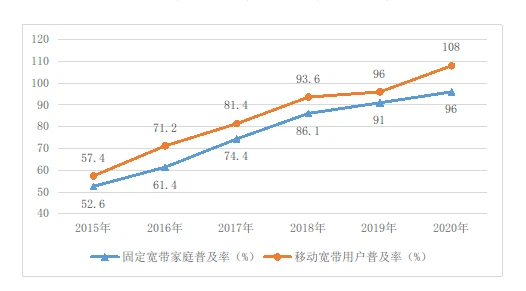
Growth of Fixed and Mobile Broadband Household Penetration Rates in China
Additionally, the 'Digital China Development Report (2020)' indicates that during the '14th Five-Year Plan,' China will transition from 100 megabit to 1000 megabit networks. So, can the previously laid 4-core Cat5e links support 1000 megabit network speeds?
To know whether 4-core Cat5e links can meet the transmission requirements of 1000 megabit networks, we must first understand the relevant standards for 1000 megabit networks.
The current physical layer and digital link layer protocols and standards for 1000 megabit networks were defined by IEEE in 1999: IEEE Std 802.3ab. This standard introduced four transmission medium standards for 1000 megabit networks: 1000BASE-LX, 1000BASE-SX, 1000BASE-CX, and 1000Base-T.
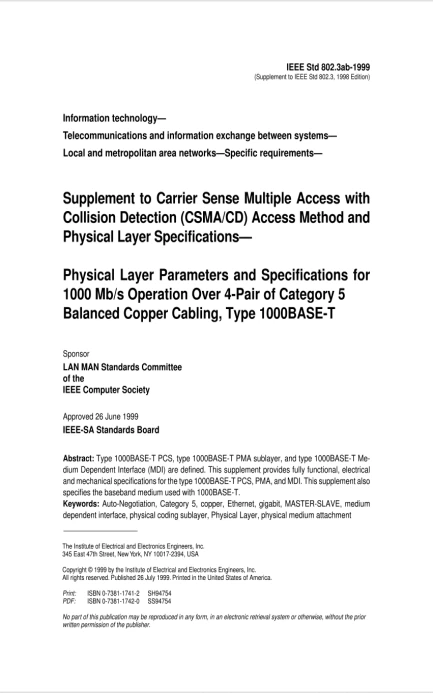
IEEE Std 802.3ab
Among them, 1000BASE-LX, 1000BASE-SX, and 1000BASE-CX are 1000 megabit protocols with optical fiber as the transmission medium.
1000Base-T: A full-duplex Ethernet network using four pairs of twisted-pair cables, requiring a 4-pair Cat5e link with a 100MHz bandwidth. It uses complex coding to achieve 250Mbps per wire, but high crosstalk requires strong processing capabilities in interactive devices.
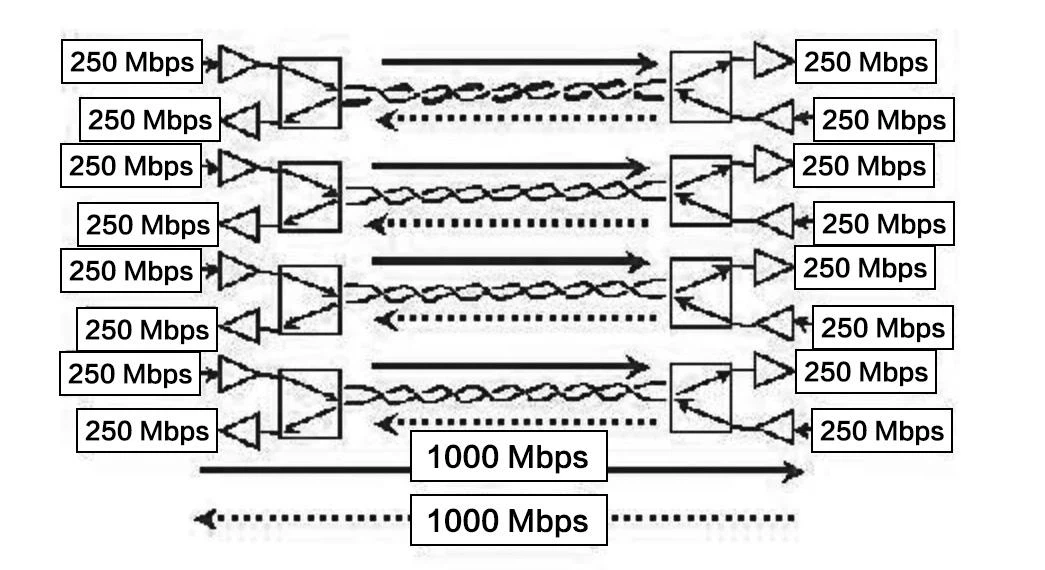
1000Base-T Transmission Concept Diagram
With the introduction of Cat6 cables, the IEEE 802.3 working group updated the 1000 megabit standard for copper cables: 1000Base-TX. 1000Base-TX is also based on four pairs of twisted-pair cables, operating in full-duplex mode (each pair of wires transmits bidirectionally). Unlike 1000Base-T, 1000Base-TX uses two pairs of wires for data transmission and two pairs for data reception, with each pair's transmission rate being 500Mbps.

1000Base-TX Transmission Concept Diagram
According to Shannon's formula: C=Blog(1+S/N), we know that increasing the transmission rate means needing more bandwidth and better anti-interference capabilities. Obviously, Cat6 twisted-pair cables with a transmission bandwidth of 250MHz, a cross-shaped skeleton to isolate and fix the four pairs of wires, and reduce interference between the pairs can fully meet the transmission requirements of 1000Base-TX.

Claude Shannon
Due to Cat6 twisted-pair cables having higher transmission bandwidth and better anti-interference capabilities than Cat5e twisted-pair cables, Ethernet links using 1000Base-TX as the transmission medium protocol do not require special circuit design for interactive devices. Therefore, 1000Base-TX was warmly welcomed by the market upon its introduction, and major manufacturers actively produced Cat6 cables that met the standard requirements, promoting the application of 1000Base-TX.
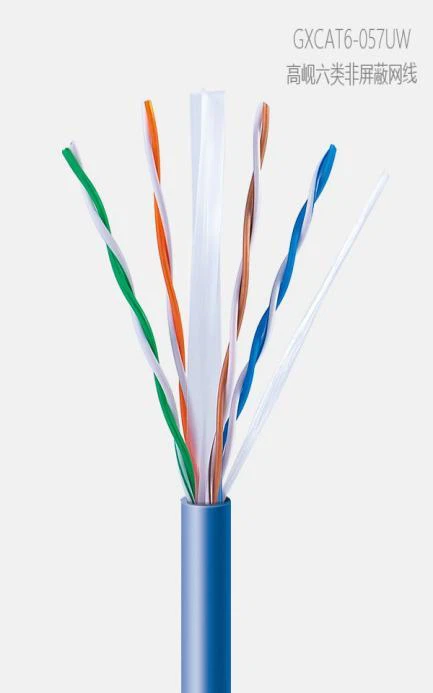
Cat6 Unshielded Twisted-Pair
3. Conclusions
Current 1000 megabit standards do not consider 4-core Cat5e links as a viable medium. Theoretically, 4-core Cat5e cannot support 1000 megabit networks. This can be understood through the following experimental data.

Actual Transmission Speed Test Results of 4-Core Cat5e Links
The experiment used two computers equipped with 10-gigabit network cards, SSDs, and a 90-meter 4-core Cat5e unshielded link with only two RJ45 connectors. The link's actual performance was tested as an administrator in CMD. The first test was to transmit a 1000 megabit data packet to the server to detect the network's speed. The results showed that the transmission rate of the 4-core Cat5e link was 76.7Mbps per second, which is a 100 megabit network. The second test set the transmission rate to 1000Mbps and then accessed the server. The results showed that although the physical layer could successfully ping, data could not be transmitted. According to the wooden barrel principle, we know that the 10-gigabit network card is not the problem. Therefore, the problem is that the 4-core Cat5e link cannot transmit 1000 megabit networks. The experiment shows that 4-core Cat5e links are limited to 100 megabit networks. At 1000 megabit output, the server fails to transmit data. Therefore, we can confirm that the 4-core Cat5e link cannot be used for 1000 megabit links. During the "14th Five-Year Plan" period, to complete the upgrade from 100 megabit to 1000 megabit networks, the existing 100 megabit networks that have been cabled must be re-cabled. Although 1000Base-T can use 8-core 4-pair Cat5e cables for 1000 megabit network transmission, due to its large crosstalk, it requires special interactive device ports. Its cost performance is not higher than that of Cat6 links. Moreover, according to the design requirements of GB/T 50311-2016 "Code for Design of Structured Cabling System Engineering": The design service life of the structured cabling system should not be less than 15 years. Therefore, the current cabling should consider the network upgrade needs that may arise in the next fifteen years. This can avoid the need to replace the entire cabling link due to network upgrades.
"Code for Design of Structured Cabling System Engineering"
Therefore, we recommend using Cat6 link products in the construction of 1000 megabit networks. Because, in the foreseeable future, 1000 megabit networks will not be able to meet our daily broadband needs. Fixed broadband upgrades to 2.5GBase-T, 5GBase-T, or even 10GBase-T are possible. Cat6 can fully meet the upgrade needs of these three networks. Below are the Fluke test results for 2.5GBase-T, 5GBase-T, and 10GBase-T based on COBTEL Cat6 unshielded links.

Test Site Photos of 2.5GBase-T, 5GBase-T, and 10GBase-T Transmission Performance of Cat6 Unshielded Links
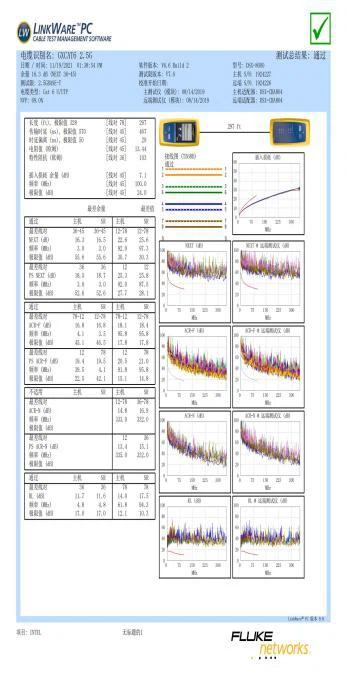
2.5GBase-T Performance Test Results of COBTEL Cat6 Unshielded Links

5GBase-T Performance Test Results of COBTEL Cat6 Unshielded Links
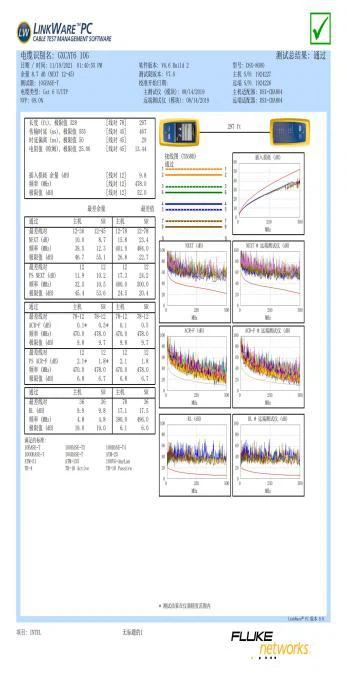
10GBase-T Performance Test Results of COBTEL Cat6 Unshielded Links
Fluke test results confirm that COBTEL Cat6 unshielded links fully support 2.5GBase-T, 5GBase-T, and 10GBase-T networks. However, it's important to note that in 10GBase-T tests, Cat6 unshielded links only meet minimum ACR-F and PS ACR-F requirements. While Cat6 unshielded links can handle 10GBase-T in simple environments, complex electromagnetic conditions may require Cat6 shielded or Cat6a links.
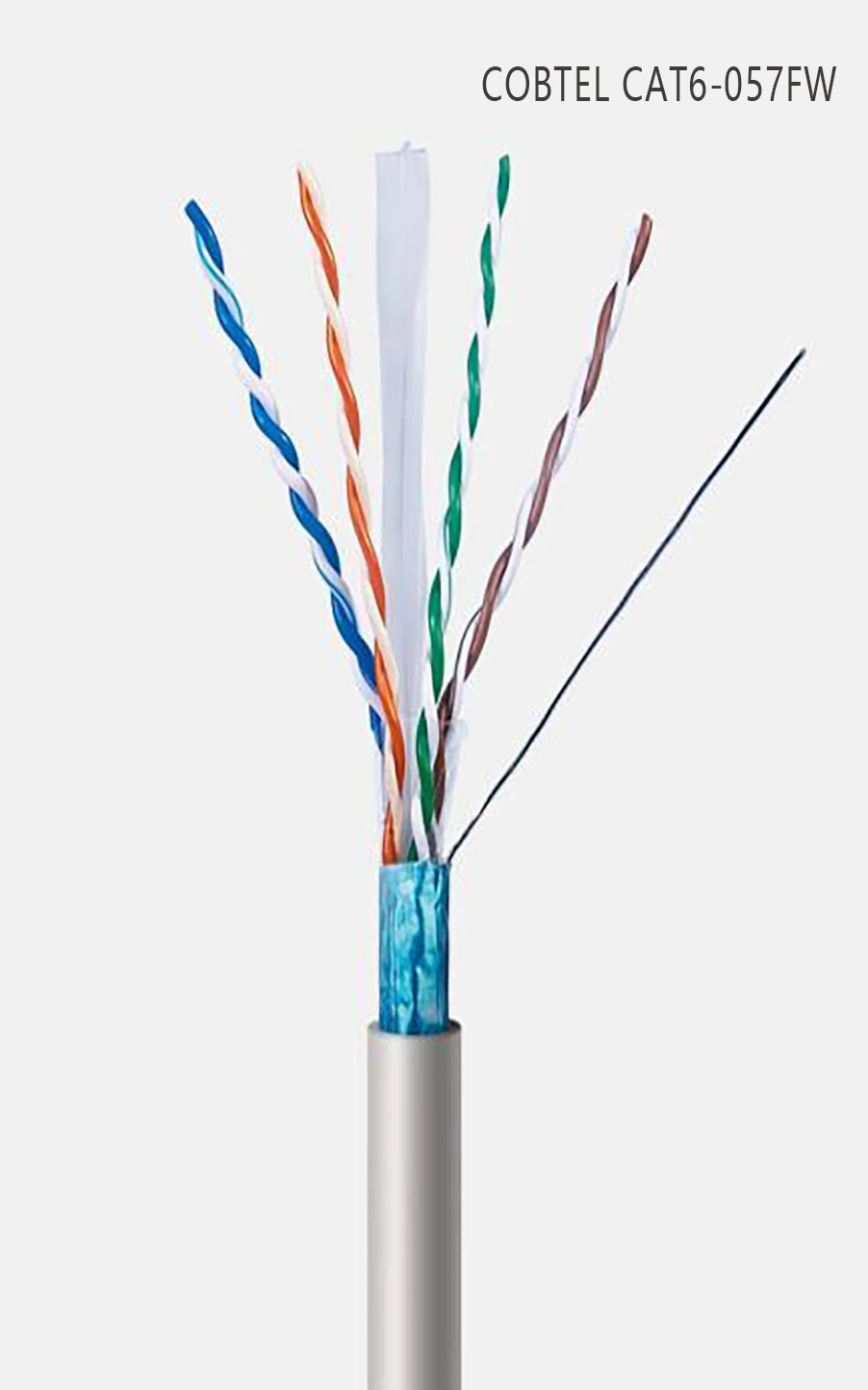
Cat6 Shielded Twisted-Pair
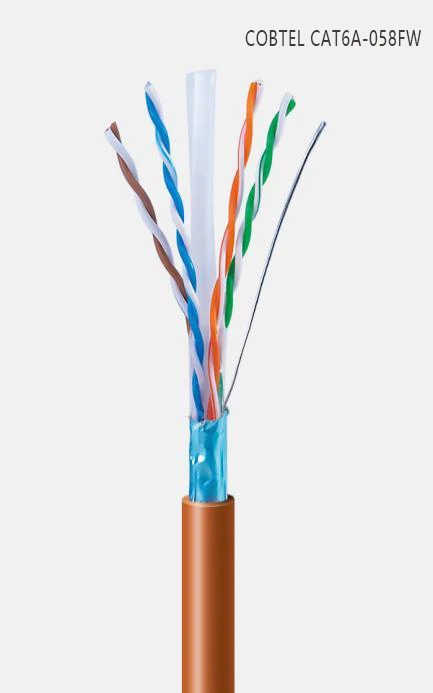
Cat6a Shielded Twisted-Pair


