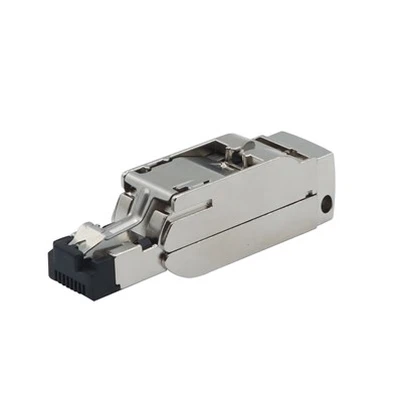

RJ45 Connectors Test Experiment
Leave a message
RJ45 Connectors Extreme Conditions Test Experiment
To study the resilience of RJ45 connectors under extreme environments, we decided to conduct a harsh extreme test on the connectors. We would like to extend our gratitude to COBTEL for providing the RJ45 connector samples and testing equipment.
To test the limits of the connectors, we selected seven Cat 5e unshielded and seven Cat 6 unshielded RJ45 connectors as the sample units for this test. The extreme tests included the following and were conducted in sequence: 1. Tab bending test; 2. 1000-cycle insertion and removal test; 3. 24-hour salt spray test (NSS); 4. Fluke channel test. What will be the final outcome?
1. Tab Bending Test:
We selected five Cat 5e unshielded and five Cat 6 unshielded RJ45 connectors for the bending test. In this test, we slowly bent the connector tabs 180° outward bend and then 180° inward bend (rapid bending would generate heat and affect the experiment), counting each bend and return as one cycle, repeating the test until the tabs completely broke. The results are shown in Table 1:

180° outward bend slowly

180° inward bend slowly

Table 1: RJ45 Connector Tab Bending Test Results
From this table, we can see that the connector tabs can withstand more than 25 slow 180° bends. This indicates that the connector's plastic housing has excellent toughness and high mechanical strength, with the PE material meeting quality requirements. Therefore, during long-distance transportation and long-term storage, the connector tabs are unlikely to break accidentally. After termination, the tabs can maintain their elasticity to lock into the port, ensuring it does not detach from the module and meets the long-term stability requirements for channel use.
2. 1000-Cycle Insertion and Removal Test:
For this experiment, we used the Cat 5e unshielded RJ45 plugs that had already undergone the tab bending test. We observed the copper contacts under an electron microscope before the test and recorded the observations. The connectors were then subjected to a 1000-cycle insertion and removal test on an insertion-removal machine (industry standard is 750 cycles; we increased it to 1000 cycles for this harsh test). The test setup is shown in Figure 1:

Figure 1: RJ45 Connector 1000-Cycle Insertion and Removal Test
After completing the 1000-cycle test, we observed the connectors under an electron microscope and compared them with the pre-test photos, as shown in Figures 2 and 3.

Figure 2: RJ45 Connector Before 1000-Cycle Test

Figure 3: RJ45 Connector After 1000-Cycle Test
From the test results, we can see that after 1000 cycles, the connector's plastic housing and gold-plated copper contacts showed no significant wear and tear. This indicates that the connector's housing and tab materials have excellent weather and mechanical resistance, meeting and exceeding industry standard test requirements. In natural environments, the connector can support long-term use without structural deformation, detachment, or module damage.
From Figures 2 and 3, we can also see that after 1000 cycles, the gold plating on the copper contacts showed no significant wear, and the nickel plating was unaffected by the test. Therefore, in daily use, the nickel plating will effectively protect the connector terminals, preventing the copper contacts from oxidizing and turning black. This type of connector meets the requirement for durability. However, this is only an external use test; we need to verify the connector's resistance to time corrosion through the third extreme environment test.
3. 24-Hour Salt Spray Test (NSS):
For this experiment, we placed the Category 5e unshielded RJ45 plugs that had undergone the 1000-cycle test in a salt spray chamber for a 24-hour salt spray test (NSS).
NSS artificially creates an acidic environment to accelerate the aging process of the connectors, simulating their condition after one year of use in a natural environment. This determines the corrosion and oxidation resistance of the copper contacts. Figure 4 shows the NSS test setup.

Figure 4: RJ45 Connector NSS Test Setup
After completing the 24-hour salt spray test (NSS), we observed the connectors under an electron microscope and compared them with the pre-test photos, as shown in Figures 5 and 6.

Figure 5: Copper Contacts Before NSS Test

Figure 6: Copper Contacts After NSS Test
From the comparison of the connectors before and after the NSS test, we can see that the connectors did not develop patina or oxidize and turn black. Even at the contact cut surface (the most susceptible part to oxidation in actual use), no patina or oxidation was observed. This indicates that the copper material itself has a certain level of oxidation resistance, ensuring long-term use without oxidation and ensuring smooth signal transmission in the link.
4. Fluke Channel Test:
After the previous harsh and extreme environment tests, we can conclude that this type of connector, from the housing material to the copper contacts and plating process, has fully passed the tests and can be used for a long time in natural environments without degradation. However, can this type of connector match with network cables and pass engineering acceptance? For this, we selected two Cat 5e unshielded and two Cat 6 unshielded RJ45 connectors from this test for Fluke channel testing. Figures 7 and 8 show the test results.

Figure 7: Category 5e Unshielded RJ45 Connector Channel Test

Figure 8: Category 6 Unshielded RJ45 Connector Channel Test
From the Fluke channel test results, we can conclude that this type of connector can match with cables and pass engineering acceptance. In practical applications, it can meet the transmission performance requirements of corresponding cabling systems.
Final Test Conclusion: The RJ45 connectors provided by COBTEL passed the tab bending test, 1000-cycle insertion and removal test, and harsh extreme environment NSS test, still meeting engineering acceptance standards. The product, from the housing structure to the copper contact structure and material, has strong weather and mechanical stress resistance. This indicates that the brand's connectors can meet long-term use in natural environments and pass Fluke channel test reports. The brand's connectors can meet the transmission performance requirements of corresponding cabling systems and are a recommended product.